
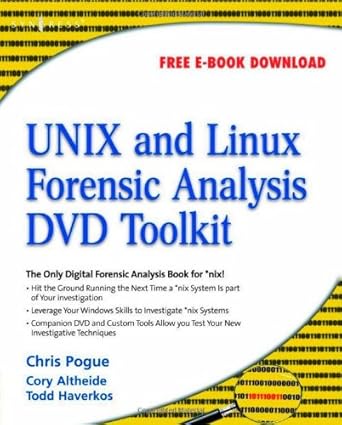
UNIX And Linux Forensic Analysis DVD Toolkit By Chris Pogue
 Walmart.com
  Barnesandnoble.com
  Vitalsource.com
$152.42
UNIX And Linux Forensic Analysis DVD Toolkit By Chris Pogue Price comparison




- All prices mentioned above are in United States dollar.
- This product is available at Walmart.com, VitalSource.
- At walmart.com you can purchase In a Nutshell (O'Reilly): LPI Linux Certification in a Nutshell: A Desktop Quick Reference (Paperback) for only $16.25 , which is 75% less than the cost in VitalSource ($64.95).
- The lowest price of UNIX and Linux Forensic Analysis DVD Toolkit (eBook) was obtained on October 2, 2026 17:26.
UNIX And Linux Forensic Analysis DVD Toolkit By Chris Pogue Price History
UNIX And Linux Forensic Analysis DVD Toolkit By Chris Pogue Description
UNIX And Linux Forensic Analysis DVD Toolkit By Chris Pogue
The UNIX And Linux Forensic Analysis DVD Toolkit By Chris Pogue is an essential resource for digital forensic professionals and enthusiasts alike. Published by Syngress, this toolkit, released in June 2008, offers an in-depth examination of UNIX and Linux systems through practical analysis techniques. With a comprehensive 248-page guide, it not only lays the groundwork for digital forensics but also provides hands-on tools and knowledge that potential users can apply immediately.
Key Features and Benefits
- Practical Guides: This toolkit includes straightforward methods for investigating UNIX and Linux systems, making it approachable for both beginners and seasoned professionals.
- Compelling Visual Aids: It contains illustrative diagrams and screenshots that enhance reader understanding and retention of complex forensic processes.
- In-Depth Toolkits: Learn about a variety of essential tools for data acquisition, analysis, and reporting, enabling users to perform thorough investigations.
- Real-World Scenarios: By presenting case studies, the book showcases real-world applications of forensic analysis techniques, enriching practical comprehension.
- Author Expertise: Chris Pogue’s extensive experience in the field lends credibility and authoritative insight into the methodologies and techniques described.
Price Comparison Across Different Suppliers
The price of the UNIX And Linux Forensic Analysis DVD Toolkit varies across multiple suppliers, making it crucial to compare options to find the best deal. As observed, prices range from $29.99 to $49.99 depending on the retailer. By comparing prices across our platform, you can save substantially. Our detailed listings allow you to see the latest offers and select a price that best suits your budget.
Notable Trends in Price History
The 6-month price history chart of the UNIX And Linux Forensic Analysis DVD Toolkit shows consistent demand, particularly after recent cybersecurity incidents highlighting the importance of forensic analysis. Prices have fluctuated slightly, but generally, they remain stable. Currently, the average price is trending lower, suggesting that now may be an ideal time to make a purchase.
Customer Reviews Summary
Customer feedback for the UNIX And Linux Forensic Analysis DVD Toolkit highlights both its strengths and some areas for improvement. Many reviewers appreciate the clarity and depth of the content, finding it an invaluable tool for their professional toolkit. The practical examples and clear explanations have received particular praise, making complex concepts easier to grasp. However, a few users noted that the toolkit might be slightly dated due to advancements in technology since its publication. Overall, the positive reviews significantly outweigh the constructive criticism, reinforcing the book’s value as a worthwhile investment for any digital forensic analyst.
Explore Unboxing and Review Videos
To further enhance your understanding of what the UNIX And Linux Forensic Analysis DVD Toolkit has to offer, we recommend checking out various unboxing and review videos available online. These visual presentations allow potential buyers to preview the toolkit’s contents and gauge its relevance to their needs. Many users have found these videos useful in making informed purchasing decisions.
Why Buy the UNIX And Linux Forensic Analysis DVD Toolkit?
In conclusion, the UNIX And Linux Forensic Analysis DVD Toolkit By Chris Pogue is not just a book; it’s a gateway to mastering digital forensic analysis in UNIX and Linux environments. Its practical guides, compelling visuals, and the author’s expertise provide significant benefits for users at any experience level. With competitive pricing, solid customer feedback, and supplementary resources available, it’s the perfect tool for enhancing your forensic skills.
Don’t miss the opportunity to expand your forensic analysis capabilities. Compare prices now!
UNIX And Linux Forensic Analysis DVD Toolkit By Chris Pogue Specification
Specification: UNIX And Linux Forensic Analysis DVD Toolkit By Chris Pogue
|
UNIX And Linux Forensic Analysis DVD Toolkit By Chris Pogue Reviews (3)
3 reviews for UNIX And Linux Forensic Analysis DVD Toolkit By Chris Pogue
Only logged in customers who have purchased this product may leave a review.

Kindle Customer –
While I was expecting a book similar to the Syngress publication Windows Forensics Analysis by Harlan Carvey I was given more of a Linux for Dummies with a Forensic emphasis.
I’ll break it down by chapter to make things a little more understandable. The introduction Chapter one was the standard why am I writing this and what will I cover. It seemed like that was a good start. Unfortunately things when south with Chapter 2. Introduction to UNIX: I’m sorry did I miss the UNIX in it? The focus was Ubuntu Linux. While a forensic analyst should be able to examine Linux systems, that wasn’t the title of the book. UNIX was first, but UNIX was hardly mentioned. There are similarities, but not to the extent that the author makes the reader believe. At the time of my reading this book I was working on forensic analysis of a Solaris system and a CentOS system. I was able to use maybe 10 to 15 percent of the content for the Solaris system and if I was lucky 50% for the CentOS system.
Chapter 3 Live Response: Data Collection- there was no Live Response. In short there was very little about what the responder should collect and what is useless information. Much of the chapter was spent on a Log Book and various live CD/DVD Linux distributions that are available. There is a slight discussion of how to collect drive images, but even that is outdated at the time of writing. Two years prior to the writing I was collecting images from Terabyte systems.
Chapter 4 is about Initial Triage and Data Analysis- I’m sorry what? We’ve already collected the image? Why do we go back to triage? Why are we now just concerned with the network? I know chapters can be read in any order, but if this is for an “intro” person they will most likely do the work in order of the chapters if they do not know any better or have someone guiding them. The author gives a few examples of techniques which are good. Then an example of keyword lists and makes a point of telling the reader to develop their own. The author makes a point of saying attackers will want to look like normal activity on the network, but then gives keyword lists that are standard script kiddie tools. If the attacker is more than just a beginner they have modified the signature/look so that it doesn’t match. While I am not against a keyword search, I am against the thinking that if your keyword search does not hit then you must acquit. Chapter 4 is probably the most useful chapter of the book.
Then we go to one of the most useless chapters in the book. At over fifty pages this chapter is the largest, but covers the least useful information. Discussing The Hacking Top 10 is pointless. Especially with the emphasis on tools that won’t be as common. A discussion of Nmap and netcat are vital to this book, but many hackers won’t take the time to install Wireshark with it’s size and GUI. There are tools out there that are cmd line based and would suite an attacker more. Some of the other tools should be discussed, but not to the extent that the author does. It’s almost as if the book was to short to charge $59.95 so they added pages to justify the cost.
Chapter 6 discussed the /Proc file system. One of the more useful chapters in the book. However it is one hundred percent Linux based. Again no discussion at all for the differences in UNIX and Linux.
Chapter 7 discussed file analysis. Again a very useful chapter, but lacking in depth. A minuscule thirteen pages there should be so much more discussed.
Chapter 8 was the second most useless chapter in the book. Fortunately it was only a waste of ten pages of the book. Discussing anti-virus instead of what the chapter Title promises “Malware”, it really was let down on possible interest. While the title of Chapter 5 did not lead anyone on, Chapter 8 was definite tease. The discussion was a vague conversation about the direction of malware in the Linux environment (notice again not discussing UNIX) and then into different anti-virus systems that are available. I have never installed an AV to do forensics and it would seem to me to not be reliable if the signature has changed slightly anyway.
In discussing this book the Appendix is noteworthy. It gives a high-level overview of setting up Cybercrime detection, but it is only vaguely related to the topic as there is much discussion on networks and Windows systems.
While there is a requirement for a UNIX forensics book this book does not meet that requirement. It is useful for Linux analysis if that is all you are working on, but this will not apply much to the more UNIX platforms of the *nix systems. While I applaud the authors attempt, it seems as if editing may have taken the liberty to force this book into a broader market than was the original intention.
Amazon Customer –
As far as the content goes or hos useful it is may be another story.
P. Knight –
The title may mislead readers to believe that this book discusses actual forensics of Unix and Linux systems. It does not. The authors waste precious pages in this short book discussing their favorite cool Linux apps like Nessus and Metasploit but don’t have any meaningful discussion about the various flavors of Unix: AIX, Solaris, *BSD, etc. Their “Unix and Linux” forensic book is almost entirely about Linux. There is no thoughtful discussion about filesystem forensics; no technical detail helpful to Forensic Examiners.
The few moments where the authors approach a meaningful forensic topic, the reader is redirected to an online resource rather than provided an analysis or explanation within the book.
The book title may lead readers to believe that an accompanying DVD contains a Unix forensic toolkit of some kind. In fact, there is only 1.8 MB of documents and no tools save for a few (4) short Bash scripts that hardly cover a thorough forensics examination: live or otherwise. One of the scripts is only one line. One of these documents is an incomplete 3.5 page summary of Sleuthkit tools. By “incomplete” I mean that it is apparent that the author decided to quit writing. Apparently there was no room in this 236 page, 14-gauge font book to cover in any detail the different Unix filesystems, data acquisition, data carving or static filesystem analysis. But the authors make plenty of room to discuss scanning with Unix tools (nmap, nessus, etc.).
There is a section entitled “Malware” except that no malware sample is actually examined. The reader is briefly introduced to Panda’s AV scanner and is walked through how to use ClamAV as if that is the only AV scanner available for either a Unix user or Forensic Examiner. Forensic Examiners should pay very close attention to AntiVirus product comparative reviews.
The book cover boasts that this is the “only digital forensic analysis book for *nix”. Indeed there may be little in the way of books solely dedicated to Unix forensics but other books cover Unix forensics with greater detail than this one. For example, Brian Carrier’s “Filesystem Forensic Analysis” or Jones, Bejtlich and Rose’s “Real Digital Forensics”.
The book cover also boasts that readers can “Hit the ground running” with the information within. Unfortunately, if readers expect the content to help them bridge a gap between Windows and Unix, they will hit the ground with a resounding thud. If any Forensics Examiner finds value in the content of this book for actual Unix forensic investigations, I would question that examiner’s experience and training.
If the authors wanted to write a book about cool Linux tools or network scanning, they should have entitled the book differently. Perhaps “A Beginner’s Guide to Using Linux and Linux Security Applications”.
I felt the title was misleading and false advertising. The authors take advantage of the word “Forensics” to sell a book that is not about forensics. For $53.95 I expected much more and was extremely disappointed and disgusted at the inferiority of the content.