
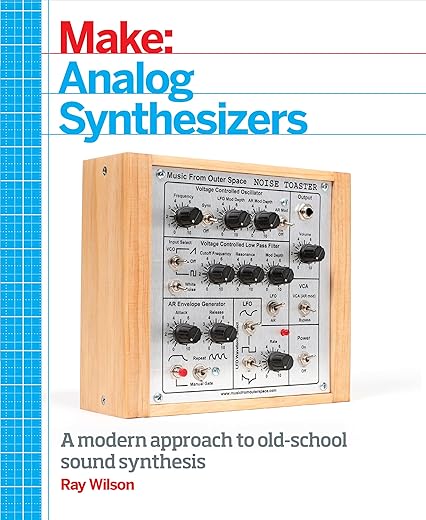
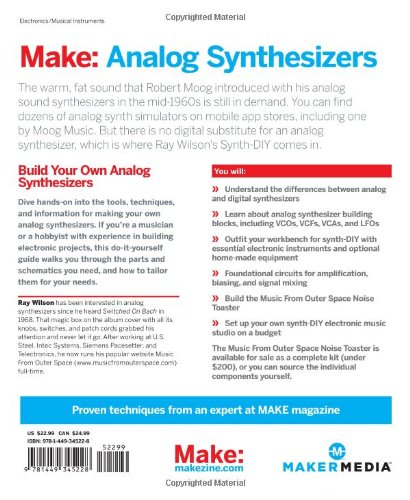
Analog Synthesizers: Electronic Sounds DIY Way
 Kobo.com
  Barnesandnoble.com
  Walmart.com
  Knetbooks.com
  Reverb.com
Original price was: $22.99.$19.59Current price is: $19.59.
Analog Synthesizers: Electronic Sounds DIY Way Price comparison















- All prices mentioned above are in United States dollar.
- This product is available at Barnes & Noble, Rakuten Kobo US, Amazon.com, Walmart.com, Knetbooks.com.
- At barnesandnoble.com you can purchase Make: Analog Synthesizers: Make Electronic Sounds the Synth-DIY Way Ray Wilson Author for only $17.99 , which is 97% less than the cost in Walmart.com ($599.99).
- The lowest price of 4-Voice Polyphonic Analog Synth with Presets was obtained on October 20, 2026 11:51.
Analog Synthesizers: Electronic Sounds DIY Way Price History
Analog Synthesizers: Electronic Sounds DIY Way Description
Discover the Magic of Analog Synthesizers: Electronic Sounds DIY Way
Unleash your creativity with the *Analog Synthesizers: Electronic Sounds DIY Way* book. Perfect for both aspiring musicians and seasoned sound designers, this comprehensive guide explores the fascinating world of analog synthesizers. Published by Make Community, LLC, the first edition released on June 25, 2013, promises to equip you with the knowledge and skills required to craft your own electronic sounds. Whether you’re searching for *Analog Synthesizers price* information or looking for *Analog Synthesizers reviews*, this book is your go-to resource to delve into the art of sound synthesis.
Key Features of Analog Synthesizers: Electronic Sounds DIY Way
- In-depth Knowledge: With 183 pages of rich content, this book offers a thorough understanding of analog synthesizers. Learn the principles behind sound synthesis in a clear, engaging manner.
- DIY Projects: Featuring numerous hands-on projects, this book invites you to assemble and modify synth circuits. Experience the joy of creating unique sounds and personalizing your musical creations.
- Illustrative Examples: Illustrated diagrams and case studies make complex concepts easy to grasp. This ensures you can apply theories practically and creatively.
- Accessibility: Written in English and crafted for both beginners and advanced users, it demystifies synth technology, allowing everyone to participate in its amazing possibilities.
- Comprehensive Resources: Includes detailed explanations of components, synthesis techniques, and programming tips. Transition from novice to a proficient synthesist with handy references.
Price Comparison Across Different Suppliers
When considering purchasing *Analog Synthesizers: Electronic Sounds DIY Way*, it’s crucial to compare prices across multiple suppliers to ensure the best deal. Prices generally range between $24.99 and $39.99 depending on the seller and any applicable discounts. By comparing across different platforms, you can save significantly while investing in your musical journey.
6-Month Price History Trends
The 6-month price history chart reveals interesting trends regarding the *Analog Synthesizers* book. Notably, the price has fluctuated around $30, with occasional drops during promotional events. Such insights can help you decide the best timeframe to make your purchase, ensuring you do not overpay.
Customer Reviews: Insights and Feedback
Reviewing customer feedback is essential when considering a purchase. The *Analog Synthesizers* book has garnered a mix of positive responses and constructive critiques. Customers praise its clarity and hands-on approach, stating that the DIY projects enhance learning and creativity. Many highlight how the book inspires confidence in synthesizer usage, enabling readers to experiment with sound design confidently.
However, some users note the need for additional troubleshooting tips for beginner projects, as certain electronics can be complex. Despite these minor drawbacks, the overall reception remains positive, emphasizing its value for both learners and enthusiasts alike.
Unboxing and Review Videos
For those interested in a deeper exploration of *Analog Synthesizers: Electronic Sounds DIY Way*, various unboxing and review videos are available on platforms like YouTube. These videos provide visual insights into what to expect from the book, showcasing its layout and content structure. Watching these reviews can further affirm your interest and assist in understanding the potential it holds in enhancing your sound synthesis skills.
Final Thoughts
The *Analog Synthesizers: Electronic Sounds DIY Way* is more than just a book; it’s a gateway to a world teeming with creativity and innovation. With comprehensive coverage on DIY projects, clear explanations of complex concepts, and positive reviews from fellow learners, this guide is ideal for anyone eager to delve into the realm of analog synthesizers.
Don’t miss your chance to explore this enlightening resource and elevate your music production journey. Compare prices now!
Analog Synthesizers: Electronic Sounds DIY Way Specification
Specification: Analog Synthesizers: Electronic Sounds DIY Way
|
Analog Synthesizers: Electronic Sounds DIY Way Reviews (7)
7 reviews for Analog Synthesizers: Electronic Sounds DIY Way
Only logged in customers who have purchased this product may leave a review.




Seppert –
Tipptopp!
GeekySimian –
Enthusiastically written and well explained. Perfect if you have some knowledge of op amp circuits.
Circuit diagrams seemed to have been drawn to save space rather than for easy readability but are also well explained.
I really enjoyed it, which is not something I often say about electronics text books, and I’m going to try some of the ideas out.
Tompa Sweden –
Perfekt bok för elektronikintresserade
Ger en klar bild på vad som behövs för att lyckas i sin projekt
Professor dot biz –
I can’t control my astonishment that a dusty old technology like analog synth is getting a fresh new makeover courtesy the practical genius of the Music from Outer Space (MFOS) master himself: Ray Wilson. Feed your synth addiction (and it really is that as you probably know): get this quick!
If you still smile with admiration at Vangelis in Blade Runner, you’re going to love this book! Wilson one ups the old art of producing wonderful synth on a budget (taking apart and putting old toys back together with SFX or musically bent circuits, for example!) by “legitimizing” DIY synth with everything you need to understand the real circuitry behind both digital and analog synth, all the way up to CMOS chips.
As part of the acclaimed MAKE series, this book of course is project oriented, giving ALL the steps for a middle function, and quite complex, MFOS synth. But way beyond that, Ray shows all the components for much simpler sound, PLUS the modules you can use to build a truly professional $10,000 synth SYSTEM– or even a whole synth studio– on a tight / DIY budget. The building blocks are here; he challenges us to take them as far as we want!
For point of view, I’m a music and circuit lady at payroy dot com and evaluate new scores of synth for patentability. That’s right, when Wilson says you can not only create pro synth DIY but also profit, he’s not kidding. The combination of circuits and music is literally being reborn, with some of the “old” music circuit books selling for hundreds as folks jump into the new wave of patent opportunities. Beds alone are making significant royalties for DIY synth basement composers today, from movies to commercials, due to web propagation of your reputation and talent, regardless of where you are or where you got your synth.
The three biggest plusses of this wonderful text are: 1. Wilson goes far beyond the usual sound effects and sci fi capacitor changes to show the circuits that exactly mimic orchestral level compositions 2. The whole text is hands on with decades of practical advice packed into each comprehensive page, including time and money saving tips on how to avoid ruining a project with too high voltage on a low voltage chip, as just one example 3. There is an ideal blend of theory, circuits and components, beginning as if you’re new to the field, but going all the way to complete, modular, professional level synths and composition– an amazing feat for $20 in a 160 page book.
Perhaps most importantly, Ray was careful to generalize all the information– from components to circuits to technique– so you get the skill to advance quickly to much bigger and more robust units if you wish. On the other hand, the book’s main project (the MFOS Noise Toaster) is FAR from simple. Wilson even says that although it’s rudimentary to advanced engineers, they still love building it due to the memories it brings back AND the principles it reinforces about how variations change sounds, as well as the subtle contributions of individual components, designs and circuits.
In fact, I just read a new patent by an “amateur” who invented a cricket chirp synth that acually brings crickets out from hiding– he’s negotiating selling it to a pest company for over $12 million US right now!! Yes, the toaster works with white noise loops too, so we’re talking SFX here as well, not only music, and Wilson shows how to adjust the circuits (and WHY) to change that white noise to a bomb blast effect, for example. Take your new blast SFX, combine it with a blastcode animation (a Maya plugin), and earn extra income from your hobby!
Finally, us benders will now also understand WHY changing that capacitance completely morphed our virtual woodpecker into a virtual intruder alarm or canary! Personal tip: I often buy electronics for a buck at the dollar store and bust them up for their components. I priced one calculator/timer reverse engineering project at $9 in current part costs vs. a buck at the dollar store (probably silver prices alone). With Wilson’s help here and on his MFOS website, I can use Mouser online to get what I need at about the same savings, with no wasted parts!
And yes, I DID build the toaster and yes, it DOES work– Make’s proofing worked and of course Ray, via his many magazine and blog articles, knows better than to recommend or teach untested designs!!! Highly recommended for teens forward, but recommend a basic electronics book first if you’re new to electronics, including Make’s own version: Make: Electronics (Learning by Discovery). I don’t support or recommend publishers, but O’Reilly IS consistenly high quality in editing/ proofing first editions, and this shows in both of these titles.
EMAILERS: In answer to all the frequent questions (thanks for asking!) about digital and “professional” texts in this field, the best by far in your humble reviewer’s opinion is Cipriani: Electronic Music and Sound Design – Theory and Practice with Max/MSP – volume 1. It covers many aspects of Digital Signal Processing AND programming as well.
Library Picks reviews only for the benefit of Amazon shoppers and has nothing to do with Amazon, the authors, manufacturers or publishers of the items we review. We always buy the items we review for the sake of objectivity, and although we search for gems, are not shy about trashing an item if it’s a waste of time or money for Amazon shoppers. If the reviewer identifies herself, her job or her field, it is only as a point of reference to help you gauge the background and any biases.
Eduardo –
Is really good source for DIY EURORACK beginners.
Tony –
Ray’s book was ordered around the same time I ordered my first DIY synth project from MFOS. I made sure I read the book over, and some sections twice, before I embarked. Thus emboldened, I went forth and completely ignored Ray’s advice to newbies, and built his Soundlab Ultimate. Between the book and working this project, I learned a lot, both about the circuits and construction. If you want to just dabble and build utility sound effect boxes you, you can do that here. But if you want to build a musically useful, playable, pliable instrument, you can do that too. My decision, to start as a beginner and quickly get to a serious instrument, was ambitious. Ray’s book was a worthwhile investment.
Ray is thrifty with your money, and does not romanticize expensive approaches. If you want to spend more money for sealed pots, you can but he leaves that up to you. However he will spare you the heartbreak of trying to build using a Hobby Lobby craft soldering wand. Ray will tell you flat out that it is futile to proceed without an oscilloscope. One of the other reviewers complained that much of this information is published elsewhere. I would counter that nowhere is so much of it relevant to a jump starter assembled in one place.
In the back of the book is a little cookbook showing some building block circuits, using in-production, inexpensive components. These turn out to be handy when analyzing schematics, and making choices. When you start building, you will be confronted with many decision points, many forks in the road. Be not afraid, you won’t start a fire or get baked potatoes on the ends of your arms, and the worst you will deal with is no output. If you fry a chip [hasn’t happened to me yet], they are like 79 cents to replace.
The Soundlab Ultimate is not a simple, newbie type of project. It, arguably, approaches a Minimoog in capability. Here is where the book helped me. As with any complex build, you can expect there to be multiple issues to work out once you start testing it, and this was the case with my Ultimate. In the DIY synth world, you may feel somewhat on your own with these problems. Ray’s book was something I could return to as I worked through each issue. It does not give you the answers, it gives you a foundation, and confidence to know you will find the answers. And found them I did. You start to look around at all the old broken gear you have, it seems fixable now. Taking such a large leap like the Ultimate is perhaps not the best choice for every new builder. But this book helped me succeed with it, and start fulfilling a lifelong fetish for analog.
Your speakers will not thank you.
Heuswaar –
Beter condition then expected thank you secondhand seller.