
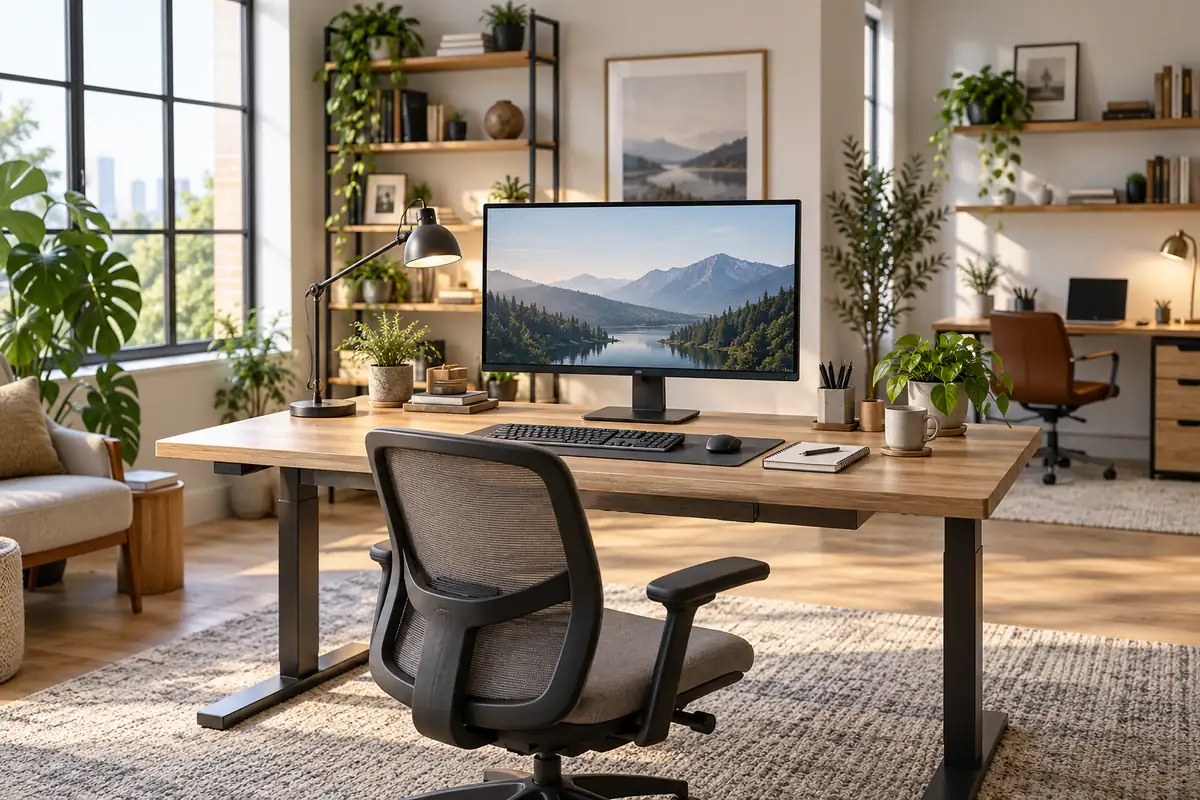
Best Home Office Desks for Productivity 2026
The IKEA MITTZON 55 1/8 x 31 1/2 is the best home office desk for most people because it combines a deep work surface, selectable assembly height, useful cable management and plenty of room for a monitor, keyboard and everyday accessories. It is a better all-purpose recommendation than automatically choosing a standing desk, especially if you prefer a stable fixed workstation without motors or electronics.
If height adjustment throughout the day matters, the UPLIFT V3 Standing Desk is the stronger choice. The Branch Daily Desk is ideal for a clean minimalist setup, IKEA’s MICKE works well in tight rooms and on smaller budgets, while the Castlery Seb Executive Desk offers a large solid-wood workspace with substantial built-in storage.
The right desk should fit your body, monitor arrangement and available room before it fits a design trend. Depth is especially important: OSHA recommends enough work-surface depth to position a monitor at least about 20 inches from your eyes while preserving comfortable space for the keyboard and pointing device.
Quick Answer: Best Home Office Desks
Best Overall: IKEA MITTZON Desk 55 1/8 x 31 1/2 — a deep, height-selectable fixed desk with integrated cable management and a 110-lb maximum load.
Best Adjustable-Height Desk: UPLIFT V3 Standing Desk — a dual-motor sit-stand desk with a wide height range, 355-lb lifting capacity and extensive configuration options.
Best Minimalist Desk: Branch Daily Desk — simple fixed-height construction in three practical sizes, with optional storage and cable-management accessories.
Best Budget Small-Space Desk: IKEA MICKE Desk 41 3/8 x 19 5/8 — a compact desk with built-in storage and rear cable routing for laptop-focused setups.
Best Premium Desk with Storage: Castlery Seb Executive Desk — a 70.9-inch solid-acacia desk with four drawers and generous workspace for a dedicated office.
How We Chose the Best Home Office Desks
We compared home office desks by usable width and depth, work-surface height, leg clearance, stability, cable management, storage, adjustability and current U.S. availability. We also considered whether each desk solves a genuinely different workspace problem rather than filling the list with several versions of the same sit-stand design.
Ergonomic fit mattered more than marketing language. OSHA recommends keeping the keyboard around elbow height, maintaining relaxed shoulders and neutral wrists, supporting the feet and leaving enough space under the desk for the legs. A fixed-height desk can work very well when the chair and workstation can be adjusted around it, while a height-adjustable desk gives more direct control over working height.
Discompare did not conduct laboratory durability testing of these desks. Recommendations are based on current manufacturer specifications, workstation guidance and current independent editorial testing.
Home Office Desks Compared
| Desk | Best For | Surface | Height | Adjustable? | Cable Management | Main Tradeoff |
|---|---|---|---|---|---|---|
| IKEA MITTZON | Best Overall | 55 1/8 x 31 1/2 in. | 25 5/8–33 1/2 in. | Selectable during assembly | Integrated tray and cable compartment | Height changes require reassembly |
| UPLIFT V3 | Sit-Stand Work | Multiple 42–80 in. widths | Approx. 22.6–48.7 in. with 1-in. top | Electric | FlexMount manager + cable wraps | Configuration cost rises quickly |
| Branch Daily Desk | Minimalist Setup | 36 x 24, 48 x 24 or 58 x 27 in. | 28.5 in. | No | Optional tray | Fixed height will not fit everyone equally |
| IKEA MICKE | Small Spaces / Budget | 41 3/8 x 19 5/8 in. | Fixed | No | Rear cable routing | Very shallow for larger monitor setups |
| Castlery Seb Executive | Premium Storage | 70.9 x 26.8 in. | 29.9 in. | No | Conventional fixed-desk routing | Large, heavy and expensive |
How Deep Should a Home Office Desk Be?
A desk around 24 inches deep can work for a simple workstation, but 30 to 32 inches gives you significantly more flexibility for monitors, keyboards and paperwork. Depth becomes especially important when the display sits on its original stand rather than a monitor arm.
OSHA recommends enough desk depth to position the monitor at least about 20 inches from your eyes and notes that the work surface should also accommodate the keyboard, pointing device and other regularly used materials. That makes an unusually shallow desktop harder to configure ergonomically.
A monitor arm can reduce the amount of desktop depth consumed by a large stand and may make a 24-inch desk more practical. It does not change the size of the room or the visual distance your eyes need from the display, so extremely shallow desks still require careful setup.
Practical rule: Choose roughly 24 inches of depth for compact laptop or single-monitor setups, and consider 27–32 inches when you use large displays, multiple monitors, deep monitor stands or substantial paperwork.
Compare Current Home Office Desk Prices
Desk prices vary substantially by size, desktop material, color, frame and accessories. UPLIFT in particular can move from a relatively simple laminate configuration to a much more expensive solid-wood workstation once larger tops and accessories are selected.
Use current price comparisons after choosing the desk dimensions you actually need. A shallow inexpensive desk that forces an uncomfortable monitor position is not necessarily better value than a slightly larger desk you can use comfortably for years.


1. IKEA MITTZON Desk 55 1/8 x 31 1/2 — Best Overall
The 31.5-inch-deep IKEA MITTZON is the best home office desk for most people because its dimensions and selectable assembly height make it easier to build a comfortable workstation without paying for an electric frame.
Best For: Full-time home offices, single- or dual-monitor setups and users who want a spacious fixed desk with strong cable management.
The recommended version measures 55 1/8 inches wide by 31 1/2 inches deep. That generous depth is the biggest reason we prefer it to many inexpensive computer desks. A monitor can sit farther back while leaving plenty of front-edge space for the keyboard, mouse, forearms and occasional documents.
MITTZON is technically height selectable rather than continuously height adjustable. Its underframe supports heights from 25 5/8 to 33 1/2 inches, but you choose the working height during assembly. Changing it later requires reassembling the legs.
That is still useful. Many fixed desks lock everyone into roughly the same 29- to 30-inch height. MITTZON gives you an opportunity to match the work surface more closely to your seated position before tightening everything into place.
Cable management is unusually well considered for a fixed desk. IKEA includes a tray accessible from above and the sides, plus a desktop compartment that can route cables into the tray. Two hooks can hold headphones or a bag, and the underframe leaves substantial open leg space.
The desk has a 110-lb maximum load, meets stated ANSI/BIFMA office and home-office standards and carries IKEA’s 10-year limited warranty.
Pros
✅ 31.5-inch depth gives monitors and peripherals plenty of room
✅ Work height can be selected during assembly
✅ Integrated cable tray and desktop cable compartment
✅ Open underframe preserves useful leg space
✅ 10-year limited warranty and stated ANSI/BIFMA compliance
Cons
❌ Height cannot be changed instantly after assembly
❌ 55-inch width may still feel tight for very large dual-monitor setups
❌ No built-in drawers
Who should skip it: If you want to alternate between seated and standing work throughout the day, choose an electric sit-stand desk instead.
Alternative: UPLIFT V3 for genuine push-button height adjustment.
2. UPLIFT V3 Standing Desk — Best Adjustable-Height Desk
UPLIFT V3 is the best adjustable-height choice here because it combines an unusually broad height range, high lifting capacity, strong stability and one of the most flexible configuration systems available.
Best For: People who want to alternate between sitting and standing, households where multiple users share a desk and equipment-heavy monitor setups.
The current two-leg V3 uses dual motors and a three-stage frame. With a typical 1-inch desktop, UPLIFT lists an assembled height range of approximately 22.6 to 48.7 inches. That wider range is valuable because height adjustment is useful for more than standing: it can also lower the seated work surface to a more appropriate elbow height for shorter users.
The two-leg frame is rated to lift 355 pounds including the desktop and can move at up to 2 inches per second under the manufacturer’s specified conditions. UPLIFT lists movement noise below 48 dB and backs the desk with a 15-year warranty.
Desktop configurations span compact through large workstations, with common widths from 42 to 80 inches and both 24- and 30-inch-deep options. That means you can configure a smaller workstation or build a wider setup for multiple displays without changing to an entirely different desk family.
Cable management is included rather than treated entirely as an accessory. The V3 comes with the FlexMount Cable Manager and multiple cable wraps, and the frame includes numerous accessory mounting points.
Independent testing supports the V3’s position. Forbes Vetted named it Best Desk Overall in its January 2026 desk guide, while WIRED highlighted its extensive customization and stability in current standing-desk testing. Tom’s Guide also rates the V3 among its strongest current standing-desk choices.
The main problem is configuration creep. A larger surface, premium material, advanced keypad, drawers, monitor arms and other accessories can rapidly increase the final cost. Start with the size and ergonomic features you genuinely need rather than treating every available add-on as essential.
Pros
✅ Wide seated-to-standing height range
✅ 355-lb lifting capacity supports substantial equipment setups
✅ Multiple desktop widths, depths and materials
✅ Included cable-management system
✅ 15-year warranty and extensive accessory ecosystem
Cons
❌ Premium configurations become expensive quickly
❌ Huge number of options can complicate ordering
❌ Electric frame adds motors and electronics that fixed desks do not need
Who should skip it: If you plan to remain seated and already know the correct desk height for your body, a simpler fixed-height or height-selectable desk may give you everything you need for less.
Alternative: IKEA MITTZON for a spacious workstation with selectable assembly height but no motors.

Upgrade your workspace with the UPLIFT V3 Walnut 2-Leg Standing Desk. With one-touch electric height adjustment, dual German motors for fast, quiet transitions, and a rock-solid steel frame that supports up to 355 lbs, it delivers stability, durability, and smoother sit-to-stand movement. Enjoy a cleaner, distraction-free setup with premium laminate and smart cable management—order yours today and elevate productivity and comfort.
3. Branch Daily Desk — Best Minimalist Home Office Desk
The Branch Daily Desk is our favorite minimalist option because it keeps the structure simple while offering enough size choices and optional accessories to build a clean, practical workstation.
Best For: Modern home offices, laptop or standard monitor setups and buyers who prefer a clean fixed desk over a motorized workstation.
Branch currently offers the Daily Desk in three useful footprints: 36 x 24 inches, 48 x 24 inches and 58 x 27 inches. All versions use a fixed 28.5-inch work height.
The smallest version fits rooms where a standard 48- or 60-inch desk would overwhelm the space. The 58-inch version is considerably better for a large monitor or multiple peripherals because it also increases depth to 27 inches.
Construction combines a laminated MDF work surface with powder-coated steel, and Branch rates the desk for up to 200 pounds. The company also offers compatible drawers, cable organizers, casters, monitor arms and other accessories, so the minimal base desk can be expanded without forcing storage on buyers who want clear leg space.
The biggest limitation is fixed height. Branch describes 28.5 inches as suitable for everyday work, but there is no single desk height that perfectly fits everyone. OSHA recommends adjusting the chair and work surface so elbows sit near keyboard height with relaxed shoulders and neutral wrists.
If the desk feels too high after the chair is positioned correctly, a footrest may help shorter users maintain foot support. In other cases, an appropriate keyboard tray or height-adjustable desk can solve the mismatch more directly.
Pros
✅ Three footprints cover compact through full home-office setups
✅ Clean design keeps leg space open
✅ Supports up to 200 pounds
✅ Optional drawers, cable management and monitor accessories
✅ 10-year warranty
Cons
❌ Fixed 28.5-inch height will not fit every user equally well
❌ Cable tray and storage are optional rather than standard
❌ Smallest version can become crowded with a large monitor setup
Who should skip it: Users who need regular seated-to-standing adjustment should choose UPLIFT V3 instead.
Alternative: IKEA MITTZON if you want more standard cable management and the ability to select a different fixed height during assembly.
Branch Daily Home Office Desk — Effortless Assembly. Durable, compact, and clutter-free with a built-in cable notch and laminated MDF top for long-lasting use. Set up in minutes with 5-minute assembly and enjoy a comfortable, productive workspace — order your Branch Daily Desk on Amazon today.
4. IKEA MICKE Desk 41 3/8 x 19 5/8 — Best Budget Desk for Small Spaces
IKEA MICKE is the best compact budget pick for laptop-centered work, but its shallow 19 5/8-inch depth makes it a poor universal recommendation for large external monitors.
Best For: Bedrooms, dorm-style spaces, occasional work-from-home setups and small apartments where floor space matters more than a large desktop.
The 41 3/8-inch width is enough for a laptop, keyboard, notebook and small accessories while remaining easy to fit against a short wall. A built-in drawer and storage compartment reduce the need for a separate pedestal, and the rear design helps route cables out of sight.
The limitation is depth. At only 19 5/8 inches, the desk is shallower than OSHA’s recommended minimum monitor viewing distance itself. That does not mean your eyes will automatically sit too close—the chair position and monitor placement also matter—but it leaves little room for a deep factory monitor stand plus a keyboard in front.
MICKE works best with a laptop, compact monitor, monitor arm or arrangement that allows the display to sit near the rear edge. A 27- or 32-inch monitor on a large conventional stand can consume a significant percentage of the usable desktop.
For people who genuinely have only a small wall or bedroom corner available, that compromise can be worthwhile. The mistake is buying MICKE because it is inexpensive and then expecting it to perform like a 30-inch-deep workstation.
Pros
✅ Compact 41 3/8-inch width fits small rooms
✅ Built-in storage adds function without another cabinet
✅ Rear cable-routing design helps reduce visible wires
✅ Affordable compared with premium office furniture
✅ Simple appearance works in bedrooms and mixed-use spaces
Cons
❌ 19 5/8-inch depth is restrictive for large monitors
❌ Fixed-height design offers limited ergonomic adjustment
❌ Built-in storage reduces some under-desk flexibility
Who should skip it: Dual-monitor users, people with deep monitor stands and anyone who needs substantial writing or paperwork space should choose a deeper desk.
Alternative: Branch Daily Desk in 36 x 24 inches if your room is small but you need a more usable desktop depth.
5. Castlery Seb Executive Desk — Best Premium Desk with Storage
The Castlery Seb Executive Desk is the best choice here for a dedicated office where you want a large solid-wood desk and substantial built-in storage rather than a minimalist tech-oriented workstation.
Best For: Dedicated home offices, paperwork-heavy work, larger monitor setups and buyers who want the desk to look like permanent furniture.
Seb measures 70.9 inches wide by 26.8 inches deep and 29.9 inches high. That makes it by far the widest fixed desk in this shortlist, with enough horizontal space for multiple work zones.
Castlery builds the desk from solid acacia and rates the maximum bearing support at approximately 220.5 pounds. Four drawers are integrated into the desk, with two shallower and two deeper drawer compartments for documents and office supplies.
The storage is useful when you want frequently accessed items within reach without adding a separate filing pedestal. It also has a visual advantage: equipment and paperwork can disappear into the desk rather than remaining on an open tabletop.
Storage has an ergonomic cost, however. Drawers and structural panels reduce the open area available under a desk compared with minimalist four-leg designs. Seb lists approximately 27.2 inches of leg-height clearance, so buyers should still confirm that their chair, thighs and preferred sitting posture fit comfortably.
The 26.8-inch desktop depth is adequate for many monitor setups but notably shallower than the 31.5-inch MITTZON. Buyers planning very large displays should consider monitor-arm placement before assuming the much wider desk also gives them the deepest workstation.
Seb is also heavy at roughly 172 pounds and requires full assembly. Measure the office, doorways, hallways and delivery route before ordering a piece of this size.
Pros
✅ Large 70.9-inch work surface
✅ Solid acacia construction
✅ Four integrated drawers
✅ Approximately 220.5-lb maximum bearing support
✅ Furniture-style design suits a dedicated office
Cons
❌ Expensive compared with utility-focused office desks
❌ Heavy and difficult to reposition
❌ Fixed 29.9-inch height
❌ Drawers reduce the openness available under the desk
Who should skip it: Small-space users, frequent movers and buyers who need sit-stand adjustment should choose a lighter, more flexible desk.
Alternative: Branch Daily Desk for a cleaner fixed-height setup, or UPLIFT V3 when adjustment matters more than built-in storage.
Home Office Desks We Considered but Did Not Pick
Vari ComfortEdge Standing Desk: WIRED currently rates it as a standout standing desk, but including several electric models here would duplicate our separate standing-desk coverage. UPLIFT V3 represents the category because of its wider customization range.
Branch Duo Standing Desk: Another excellent sit-stand option and a current favorite in independent testing, but it belongs more naturally in a dedicated standing-desk comparison.
Secretlab Magnus Pro: Its integrated cable-management trench and magnetic accessory system are exceptional, especially for gaming and equipment-heavy setups. It is more specialized than we need in a broad home-office desk guide.
Article Fantol Cabinet Desk: The fold-away design is clever for very small spaces, but its compact work surface is more restrictive for an external-monitor-centered workstation than our selected compact options.
Fixed Desk vs Standing Desk: Which Is Better?
A standing desk is better when you need frequent height changes; a fixed desk is better when one properly fitted working height meets your needs. Neither design automatically makes someone more productive.
Height-adjustable desks are useful because they can improve seated fit as well as permit standing. They also make sense in shared workspaces where two people have different body dimensions.
A fixed desk has advantages of its own. There are no motors, control boxes or moving legs, and the money saved on the frame can go toward a better chair, larger desktop or monitor arm.
Standing for an entire workday is not the goal. OSHA recommends changing posture and moving periodically rather than remaining continuously in one position. A sit-stand desk simply makes one type of posture change easier.
What Desk Height Is Ergonomic?
The correct desk height is the height that lets your keyboard and mouse sit near elbow level while your shoulders stay relaxed and your wrists remain neutral. A universal number is less useful than body fit.
OSHA’s workstation guidance recommends elbows close to the body, shoulders relaxed, forearms approximately parallel to the floor and feet supported by the floor or a footrest.
This is why a fixed 29-inch desk can work perfectly for one person and feel too high for another. If the desk cannot move, adjust the chair first. If raising the chair leaves the feet unsupported, add an appropriate footrest. A keyboard tray may also help when the work surface cannot be brought to a comfortable typing height.
Your chair is therefore part of the desk decision. Our upcoming guide to ergonomic office chairs covers the adjustments that work together with desk height.
Best Desk Size for One Monitor
A single-monitor workstation usually does not require an enormous desktop. Around 36–48 inches of width can work well when the monitor, laptop or desktop tower and essential accessories fit without crowding the keyboard and mouse area.
Depth deserves equal attention. A 24-inch desk is far easier to configure around a normal monitor than a 19-inch-deep desk, while approximately 27–32 inches gives you more freedom to move the display farther away or keep documents in front of the keyboard.
Best Desk Size for Dual Monitors
For dual monitors, start around 55–60 inches of desk width and adjust upward for large displays, speakers or a desktop computer. Monitor arms can make a significant difference by reclaiming the area occupied by large factory stands.
Two 27-inch screens can consume substantial horizontal space when placed side by side. A 55-inch MITTZON can accommodate many dual-monitor setups, but users who angle the monitors widely or add speakers may prefer a 60- to 72-inch surface.
The exact arrangement matters more than an arbitrary desk-width rule. Our upcoming guide to best home office monitor setups covers monitor arms, multiple-display layouts and viewing position in more detail.
Cable Management Matters More Than It Looks
Good cable management keeps the primary work area clear and makes equipment easier to change or troubleshoot. It does not need to mean hiding every centimeter of cable.
MITTZON is especially strong because a tray and cable compartment are built into the desk. UPLIFT V3 includes its FlexMount manager and cable wraps. Branch offers cable organization as an accessory, while MICKE routes cables through its rear design.
Start by separating permanent cables from temporary ones. Display, desktop-computer and power-strip cables can be routed under or behind the desk, while charging cables that move daily should remain accessible.
For storage beyond the desktop, our home organization tools guide covers bins, labels, closet systems and vertical storage rather than forcing everything into the office desk itself.
Built-In Storage vs Open Legroom
Built-in storage is worthwhile when you use the drawers every day, but it should not interfere with your sitting position.
Seb Executive demonstrates the tradeoff. Its four drawers reduce desktop clutter, but a minimalist desk such as Branch Daily leaves more open space beneath the work surface and lets you position separate storage elsewhere.
A desk does not need to contain every office supply. Frequently used items belong nearby; archives, extra paper and infrequently used equipment can move into dedicated office storage solutions.
What Is the Best Desk for a Small Home Office?
Choose Branch Daily 36 x 24 when usable depth matters, or IKEA MICKE when minimizing footprint and price matters more.
MICKE is narrower in depth and includes built-in storage, making it easy to fit against a bedroom wall. Branch’s 36-inch model sacrifices some horizontal width but keeps a more practical 24-inch depth for an external monitor.
Measure the room before choosing. Leave space for the chair to move backward and for drawers or doors to open. A compact desk that fits perfectly on paper can still make a narrow room difficult to use if chair clearance is ignored.
Do Standing Desks Improve Productivity?
A standing desk should be purchased for adjustability and movement options, not because it guarantees more productive work.
Research and ergonomic guidance support changing posture rather than staying seated or standing in one position indefinitely. An adjustable desk makes those changes easier and can also improve seated workstation fit.
Whether that translates into more completed work depends on the person, task and routine. Treat productivity claims cautiously and focus instead on measurable benefits such as correct work height, equipment placement and the ability to vary posture.
Home Office Desk Setup Checklist
Desk height: Keep the keyboard and mouse near elbow height with relaxed shoulders.
Chair: Support the back and feet while preserving comfortable thigh clearance.
Monitor: Position it at a comfortable viewing distance, generally at least about 20 inches away.
Depth: Leave room for the display, keyboard, mouse and materials without crowding.
Cables: Route permanent wiring away from the main work surface.
Storage: Keep daily tools accessible and move infrequent items away from the primary work zone.
Movement: Change posture and take periodic movement breaks instead of remaining in one position all day.
Keeping the area around the desk easy to clean also helps prevent cables, paper and dust from accumulating under a workstation. Our upcoming cordless vacuum cleaners guide covers compact cleaning options for floors and everyday household maintenance.
Best Home Office Desk by Use Case
| Use Case | Best Pick | Why |
|---|---|---|
| Most home offices | IKEA MITTZON | Deep surface, selectable height and built-in cable management |
| Sit-stand workstation | UPLIFT V3 | Wide electric height range and extensive customization |
| Minimalist office | Branch Daily Desk | Clean fixed design with several useful sizes |
| Small room / budget | IKEA MICKE | Compact footprint and integrated storage |
| Large premium office | Castlery Seb Executive Desk | Wide solid-wood surface and four built-in drawers |
Frequently Asked Questions
What is the best home office desk overall?
IKEA MITTZON 55 1/8 x 31 1/2 is our best overall choice because its deep work surface, selectable assembly height, integrated cable management and open leg space suit a wide range of home-office setups.
What size desk is best for working from home?
A desk around 48–60 inches wide and 24–30 inches deep works for many home offices. Large dual-monitor setups may benefit from additional width, while laptop-only work can fit comfortably on a smaller surface.
Is a 24-inch-deep desk deep enough?
Yes for many laptop and single-monitor setups. A 27–32-inch-deep desk gives you more flexibility for large monitor stands, paperwork and greater viewing distance.
What desk depth is best for dual monitors?
Around 27–32 inches is a comfortable starting point for many dual-monitor setups, although monitor arms can make a 24-inch desk easier to configure by removing bulky display stands from the desktop.
Is a standing desk better than a regular desk?
A standing desk is better when you value easy height adjustment and want to alternate between seated and standing positions. A correctly fitted fixed desk can be equally appropriate for users who do not need regular height changes.
What height should a home office desk be?
The best height depends on your body. Adjust the workstation so the keyboard is around elbow height, shoulders remain relaxed, wrists stay neutral and your feet are supported. A fixed desk may require chair, footrest or keyboard-tray adjustments.
What is the best desk for a small room?
IKEA MICKE is our best low-cost compact choice when footprint matters most. Branch Daily Desk 36 x 24 is the better small-space option when you need more desktop depth for an external monitor.
Is built-in desk storage worth it?
Yes when you regularly use the drawers and they do not interfere with legroom. If you prefer an open workstation, separate storage can preserve more space beneath the desk and make future layout changes easier.
Final Verdict: Which Home Office Desk Should You Buy?
IKEA MITTZON 55 1/8 x 31 1/2 is the best home office desk for most people. Its combination of depth, selectable work height and built-in cable management solves more everyday workstation problems than desks chosen primarily for appearance.
Choose UPLIFT V3 when electric height adjustment is central to the way you work. Choose Branch Daily Desk when you want a simple, minimalist fixed workstation. IKEA MICKE is the budget option for a genuinely tight room, provided its shallow depth suits your equipment.
The Castlery Seb Executive Desk is the specialist premium choice for a large dedicated office where solid wood and integrated storage matter more than height adjustment or portability.
Before buying any of them, measure the available room, check the monitor depth, determine an appropriate keyboard height and account for the chair’s movement behind the desk. Those details will affect your working experience more than a desk being marketed as “productive” or “ergonomic.”
Bottom line: Buy MITTZON for the best all-around fixed workstation, UPLIFT V3 for sit-stand adjustment, Branch Daily Desk for minimalism, MICKE for a compact budget setup or Seb Executive when you want a large furniture-style desk with built-in storage.
Sources
- U.S. Occupational Safety and Health Administration — Computer Workstations Purchasing Guide and Position Guidance
- IKEA — MITTZON Desk and MICKE Desk Product Specifications
- UPLIFT Desk — UPLIFT V3 Standing Desk Specifications
- Branch — Daily Desk Product Specifications
- Forbes Vetted — The Best Desks
Product Groups: IKEA MITTZON Desk 55 1/8 x 31 1/2, UPLIFT V3 Standing Desk, Branch Daily Desk, IKEA MICKE Desk 41 3/8 x 19 5/8, Castlery Seb Executive Desk