Why Is Swarovski So Popular in Europe?
Swarovski is popular in Europe because it combines more than 130 years of Austrian heritage with highly recognizable crystal craftsmanship, strong fashion and cultural connections, broad retail visibility, and a price structure that gives shoppers a taste of luxury without requiring traditional high-jewelry budgets.
That combination has proved commercially durable. Europe remains one of Swarovski’s core regions, accounting for roughly 45% of the company’s sales, with markets including the UK, Germany, and Switzerland recently reaching record levels. In the first half of 2026, Swarovski also reported 5% like-for-like growth in Europe.
The appeal goes well beyond sparkle. Swarovski sits in an unusual position between fashion jewelry and traditional luxury. Its Austrian identity feels established and authentic, while collaborations, bold modern collections, cultural events, and high-visibility stores keep the brand contemporary. That helps explain why Swarovski can be familiar to several generations of European shoppers without feeling like a purely heritage brand.
Short answer: Swarovski succeeds in Europe because it blends Austrian heritage, distinctive crystal design, recognizable branding, accessible luxury positioning, fashion credibility, and a physical presence that keeps the brand highly visible.
Why Swarovski Has Such a Strong European Identity
Swarovski’s European popularity starts with its origin. Daniel Swarovski established the business in Wattens, Austria, in 1895 after developing a machine capable of cutting crystal with unusually high precision. The company’s connection to Tyrol has remained central to its identity ever since.
That matters in Europe because Swarovski is not simply using Austrian imagery as a marketing theme. Its crystal production remains rooted in Wattens, and the company continues to present its Austrian heritage as a core part of its craftsmanship and brand story.
The company’s early links with European fashion also strengthened that identity. Swarovski supplied crystals to leading Parisian ateliers, and its relationship with couture later included names such as Christian Dior. Rather than remaining only a crystal manufacturer, Swarovski became associated with fashion, costume, jewelry, stage design, and eventually popular culture.
For European consumers, this gives the brand a combination that is difficult for newer jewelry labels to reproduce: recognizable design backed by a genuine regional history.
Seven Reasons Swarovski Remains Popular in Europe
| Reason | Why It Matters |
|---|---|
| Austrian heritage | A history dating to 1895 gives the brand authenticity and European cultural roots. |
| Distinctive crystal craftsmanship | Precision cutting and controlled production give Swarovski a recognizable visual identity. |
| Pop-luxury positioning | The brand offers aspirational design across a broader price spectrum than traditional high jewelry. |
| Fashion and cultural relevance | Runway, celebrity, entertainment, and cultural collaborations keep Swarovski visible. |
| Strong European retail presence | Boutiques and prominent shopping locations make the brand easy to discover and buy. |
| Gift appeal | Recognizable branding and broad product choices make Swarovski easy to understand as a gift. |
| Constant reinvention | New creative direction, bold collections, lab-grown diamonds, and collaborations prevent the brand from relying only on nostalgia. |
1. Swarovski Has More Than 130 Years of Brand Heritage
Heritage is one of Swarovski’s strongest advantages. The company dates to 1895, when Daniel Swarovski established the business in Wattens in the Austrian Alps. His goal was to use mechanized precision cutting to produce crystal with consistent brilliance at a scale that traditional hand cutting could not easily achieve.
The location became part of the product story. Swarovski crystal is still produced in Wattens, and the company’s long association with Austria reinforces the perception that buyers are purchasing from an established European house rather than an anonymous fashion-jewelry label.
Heritage alone does not guarantee popularity, but it gives Swarovski a foundation that younger competitors have to build through marketing rather than history.
2. The Crystal Has a Recognizable Look
Swarovski’s appeal depends heavily on visual consistency. The company controls its crystal formulations and uses specialized cutting and polishing processes designed to maximize light and color.
One important correction to older descriptions of Swarovski is that modern Swarovski crystal should not be described as containing approximately 32% lead oxide. Swarovski introduced its Advanced Crystal program in 2012 and later reduced lead content further. Its current professional specifications describe standard crystal under the Advanced Crystal standard as lead-free, with no intentionally added lead and lead content at 40 parts per million or lower.
The exact composition remains proprietary. Swarovski states that quartz, sand, minerals, and their proportions form part of its protected manufacturing knowledge.
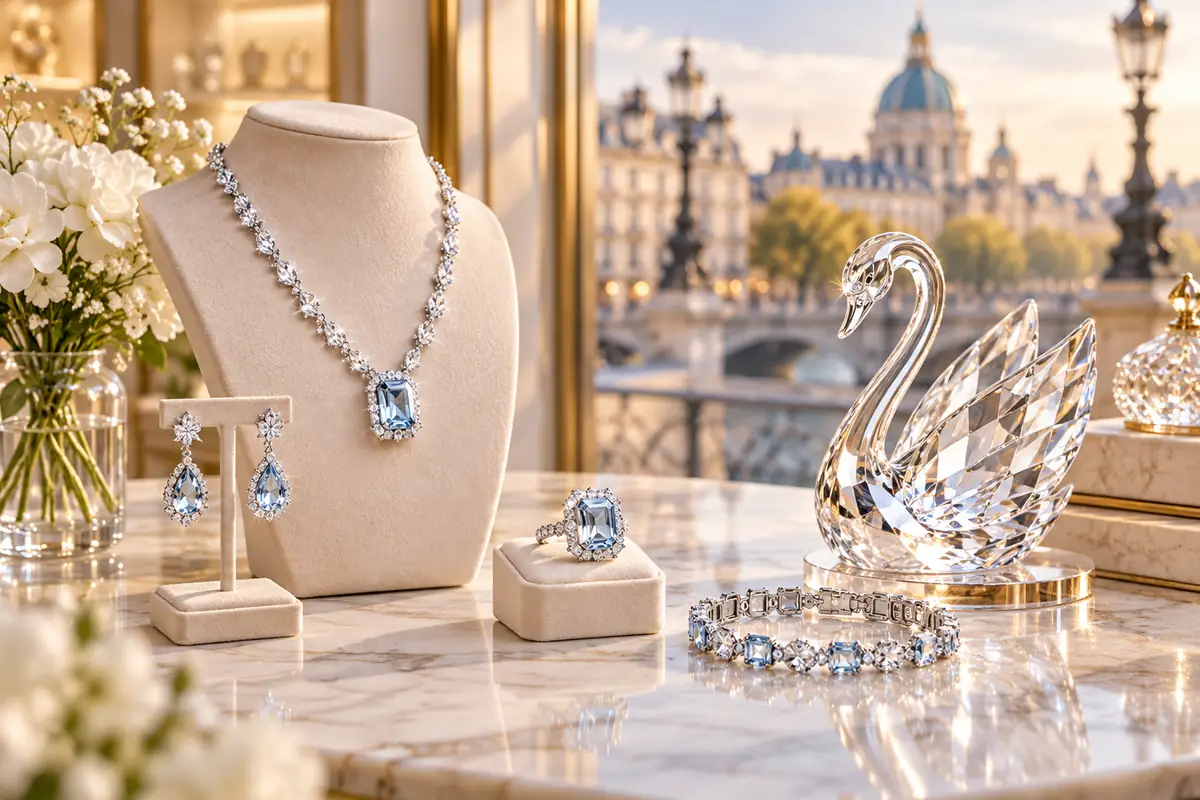
Important distinction: Swarovski crystal is manufactured crystal glass, not a naturally occurring gemstone and not a diamond. Swarovski also now sells separate fine-jewelry collections using laboratory-grown diamonds, which should not be confused with its traditional crystal products.
3. Swarovski Occupies an Unusual Place in the Luxury Market
Swarovski is difficult to classify using a simple luxury-versus-non-luxury label. The company itself now describes its positioning as “pop luxury”: a combination of heritage, craftsmanship, creativity, cultural relevance, and a broad range of price points.
That positioning helps explain its European appeal. Swarovski does not depend on the exclusivity model used by many traditional luxury houses. Customers can encounter the brand in major shopping streets, department stores, travel destinations, and online, while still receiving the visual language and presentation associated with luxury retail.
This creates a lower barrier to entry. A customer can buy a recognizable Swarovski gift or fashion-jewelry piece without entering the price territory of traditional fine-jewelry houses, while higher-end collections and Swarovski Created Diamonds give the company room to serve shoppers with larger budgets.
For a broader look at how Swarovski fits among other premium names, see our luxury brand ranking.
4. Europe Is Still a Core Market for Swarovski
There is measurable evidence behind the idea that Swarovski remains especially significant in Europe. In 2026, CEO Alexis Nasard told Vogue that Europe represented around 45% of Swarovski sales, with record performance in markets including the UK, Germany, and Switzerland.
The company’s more recent trading update supports that picture. Swarovski reported 5% like-for-like growth in Europe during the first half of 2026, while jewelry grew 11% organically worldwide.
These numbers are more useful than simply describing Swarovski as “popular.” They show that Europe remains commercially important even as the company expands in the United States, Asia, and other markets.
5. Fashion and Pop Culture Keep the Brand Relevant
A heritage label can easily become associated only with previous generations. Swarovski has avoided that problem by repeatedly placing crystal in contemporary fashion, entertainment, and celebrity culture.
Its historical relationships with European couture houses established the pattern, but the strategy continues today. Swarovski maintains collaborations and visibility across fashion weeks, red carpets, entertainment projects, design events, and branded cultural experiences.
Recent European examples include its long relationship with the Vienna Opera Ball, installations and retail experiences in Milan, fashion partnerships, and sponsorship of the Champs-Élysées holiday illuminations in Paris during the 2025 season.
The company has also deliberately shifted toward younger consumers under Global Creative Director Giovanna Engelbert. Bold color, oversized stones, geometric shapes, and highly recognizable collections make current Swarovski look substantially different from the understated crystal gifts many shoppers may remember from earlier decades.
6. Swarovski Turns Its Austrian Heritage Into an Experience
Swarovski’s European identity is reinforced by Swarovski Kristallwelten, or Swarovski Crystal Worlds, in Wattens. The attraction opened in 1995 for the company’s centenary and combines art installations, gardens, design, crystal exhibitions, and retail.
More than 17 million visitors have visited Swarovski Crystal Worlds since it opened. That makes the site more than a corporate museum: it functions as a major tourism and brand-experience destination in Austria.
This is particularly valuable because it connects the company to place. Shoppers visiting Austria can encounter Swarovski as part of Tyrolean culture and tourism, while stores in Innsbruck and Vienna extend that connection into two major visitor destinations.
7. Swarovski Is Easy to Give as a Gift
Giftability is another practical reason the brand has remained resilient. Swarovski is recognizable enough that recipients generally understand the brand immediately, but its product range covers many occasions and budgets.
Jewelry, ornaments, figurines, watches, accessories, and decorative pieces give shoppers choices for birthdays, anniversaries, weddings, Christmas, Valentine’s Day, and other occasions. The packaging and retail presentation also give relatively accessible purchases a stronger sense of occasion.
This occupies a useful space between inexpensive fashion accessories and fine jewelry. For many shoppers, Swarovski communicates more significance than an unknown jewelry brand without forcing the buyer into precious-stone pricing.
Is Swarovski Really a Luxury Brand?
Swarovski is best understood as a premium or pop-luxury brand rather than a direct equivalent to traditional high-jewelry maisons.
That distinction matters. Traditional fine-jewelry houses often center their value on precious metals, mined or laboratory-grown gemstones, rarity, hand craftsmanship, and exclusivity. Much of Swarovski’s fashion-jewelry business instead derives value from proprietary crystal, precision manufacturing, design, brand reputation, presentation, and cultural visibility.
At the same time, calling Swarovski simply “cheap jewelry” is equally misleading. The company deliberately operates in premium retail environments, invests heavily in design and cultural positioning, and has expanded into fine jewelry using laboratory-grown diamonds and precious metals.
The result is a broad luxury spectrum rather than one fixed category.
How Swarovski Has Changed in Recent Years
Modern Swarovski is more fashion-focused than the brand many European consumers knew a decade ago. Since Giovanna Engelbert became Global Creative Director in 2020, the company’s jewelry has moved toward bolder forms, larger crystals, strong color, and collections designed to be recognizable at a glance.
CEO Alexis Nasard has reinforced that direction through the company’s “pop luxury” positioning. The goal is to retain the heritage and craftsmanship associated with luxury while remaining current, visible, and easier to access than brands built around scarcity.
The commercial results suggest that the repositioning is gaining traction. Swarovski reported €1.969 billion in revenue for 2025 and continued organic growth during the first half of 2026, including growth in Europe.
The expansion of Swarovski Created Diamonds is another sign of the shift. These collections use laboratory-grown diamonds rather than Swarovski crystal and extend the company into a different part of the jewelry market.
Common Misconceptions About Swarovski
“Swarovski was founded in 1892.”
Not quite. Daniel Swarovski patented an electric cutting machine in the early 1890s, but Swarovski identifies 1895 as the founding year of the company in Wattens, Austria.
“Swarovski crystal contains 32% lead.”
This is outdated for modern Swarovski crystal. The current Advanced Crystal standard is described by Swarovski as lead-free, with no intentionally added lead and lead levels of 40 ppm or lower for standard crystal.
“Swarovski crystal is basically a diamond.”
No. Traditional Swarovski crystal is manufactured crystal glass. Its brilliance comes from material formulation, precision cutting, polishing, coatings, and optical design. Swarovski Created Diamonds are a separate product category made with laboratory-grown diamonds.
“Swarovski is popular only because it is cheaper than fine jewelry.”
Price accessibility is part of the appeal, but it does not explain the whole brand. Heritage, distribution, fashion collaborations, cultural visibility, design consistency, tourism, and recognizable packaging all contribute to its position.
Is Swarovski Worth Buying?
Swarovski can be worth buying if you value design, recognizable branding, precision-cut crystal, gift presentation, and fashion appeal more than intrinsic precious-material value.
A Swarovski crystal piece should not be evaluated like a solid-gold diamond item because the materials and value proposition are different. Buyers primarily interested in precious-metal content, gemstone rarity, or investment value should look toward fine jewelry instead.
For fashion jewelry and gifts, however, Swarovski offers something many competitors struggle to combine: consistent visual identity, more than a century of brand recognition, widespread retail support, and designs that range from understated to intentionally extravagant.
Frequently Asked Questions
Why is Swarovski so popular in Europe?
Swarovski combines Austrian heritage, distinctive precision-cut crystal, strong fashion connections, wide retail availability, recognizable branding, and a price range that makes luxury-style jewelry accessible to a broader audience.
Is Swarovski an Austrian brand?
Yes. Swarovski was established in Wattens, Austria, in 1895. The company continues to produce Swarovski crystal at its historic Wattens manufacturing site.
Is Swarovski considered luxury?
Swarovski currently describes its positioning as “pop luxury.” It combines luxury-style design, heritage, craftsmanship, and presentation with wider distribution and a broader range of prices than traditional high-jewelry houses.
Are Swarovski crystals real diamonds?
No. Traditional Swarovski crystal is precision-manufactured crystal glass. Swarovski Created Diamonds are separate collections that use laboratory-grown diamonds.
Does Swarovski crystal contain lead?
Modern Swarovski Advanced Crystal is classified by the company as lead-free. Swarovski states that its standard formula has no intentionally added lead and contains 40 ppm of lead or less.
Why is Swarovski more expensive than ordinary glass jewelry?
The price reflects proprietary crystal production, precision cutting and polishing, design, quality control, brand value, retail presentation, and the company’s long-established reputation rather than simply the cost of raw glass.
Is Swarovski still popular with younger shoppers?
The company has deliberately shifted toward younger audiences through bolder jewelry, fashion collaborations, celebrity campaigns, redesigned stores, and its current pop-luxury positioning. Recent European growth suggests the broader brand remains commercially relevant.
Final Verdict: Why Swarovski Still Works in Europe
Swarovski’s European popularity is not the result of one secret crystal formula or simply lower prices. Its strength comes from combining several advantages that reinforce one another.
The brand is genuinely European, with roots in Austria dating to 1895. Its precision-cut crystal has a distinctive visual identity. Its products are aspirational without depending entirely on high-jewelry pricing, and its boutiques make the brand visible rather than deliberately scarce. Meanwhile, fashion collaborations, celebrity culture, new creative direction, lab-grown diamond collections, and major cultural events keep Swarovski connected to the present.
That mix of heritage and accessibility is difficult to reproduce. Swarovski can sell an attainable gift, a statement necklace, a collectible crystal object, or high-value fine jewelry while still carrying the same swan logo and Austrian story.
For European shoppers, that makes Swarovski less a substitute for traditional fine jewelry and more a category of its own: a recognizable form of modern, expressive luxury built around crystal and light.
Sources
- Swarovski — The History of Swarovski — current brand history
- Swarovski — Product FAQ and Advanced Crystal documentation — current crystal composition and manufacturing information
- Vogue Business — Can Swarovski Make “Pop Luxury” Work at Scale? — 2026
- Swarovski Crystal Business — HY1 2026 Trading Update — 2026
- Swarovski Kristallwelten — visitor and destination information — current