
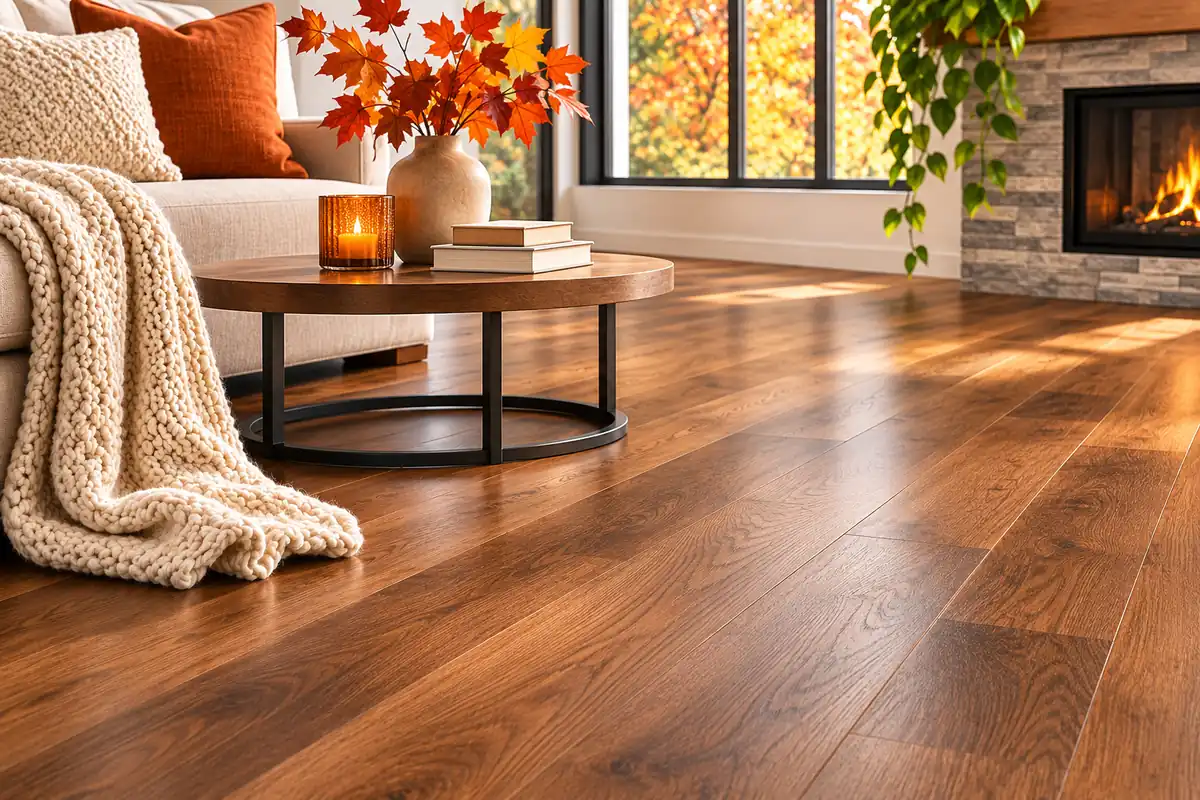
Hardwood Flooring Trends for Fall 2026
The biggest hardwood flooring trends for fall are warm natural oak, rich brown finishes, wider planks, matte surfaces, and visible wood grain. For most homeowners, warm natural oak with a low-sheen finish is the strongest long-term choice. It complements modern and traditional interiors without relying on an overly distinctive color or pattern.
Other trends offer different benefits. Chocolate and walnut tones create a cozy atmosphere, while wide planks make natural wood grain more prominent. Herringbone and chevron layouts introduce visual interest, and lightly textured wood gives a room a more organic appearance.
However, choosing hardwood flooring requires more than following design trends. Wood species, installation method, moisture conditions, finish durability, and maintenance all affect the final result. Some popular looks can be achieved by refinishing existing floors, while others require new materials and professional installation.
This guide explores seven hardwood flooring trends for fall 2026, explains their advantages and limitations, and helps you decide which styles are worth considering for your home. We also compare solid and engineered hardwood, discuss renovation costs, and explain how to protect wood floors as the weather changes.
Quick Answer: Best Hardwood Flooring Trends
Best Timeless Look: Warm Natural Oak — soft honey and natural wood tones complement many interior styles and are less trend-dependent than heavily colored stains.
Best Cozy Fall Style: Rich Walnut and Chocolate Brown — deeper wood colors add warmth and contrast to living rooms, studies, and bedrooms.
Best Modern Format: Wide-Plank Hardwood — longer, wider boards emphasize natural grain and create a more continuous floor appearance.
Best Everyday Finish: Matte and Low-Sheen Hardwood — understated finishes reduce pronounced reflections and highlight the wood’s natural appearance.
Best Statement Design: Herringbone and Chevron — geometric wood layouts make entryways, dining rooms, and feature spaces more distinctive.
Why Hardwood Flooring Trends Are Changing
Natural colors, larger planks, and restrained finishes are becoming increasingly important in hardwood flooring design.
The National Wood Flooring Association’s 2027 industry outlook, published in October 2026, found that 61% of surveyed industry respondents expected increasing demand for natural wood colors. Wide planks followed at 54%, longer boards at 50%, and matte finishes at 48%.
The same industry outlook reported expectations of declining demand for cool gray and red-toned floors. These figures reflect industry forecasts rather than guaranteed consumer purchases, but they identify a clear direction in current design preferences.
Anderson Tuftex’s October 2026 flooring survey provides another perspective. Among its surveyed high-net-worth U.S. homeowners, 37% preferred warm natural or honey wood tones, while 13% favored medium and chocolate browns. The survey also found interest in wide-plank flooring.
Importantly, this research surveyed a particular homeowner segment and interior designers. Its findings should not be treated as representative of every American household.
For homeowners, the useful takeaway is straightforward: natural wood character and adaptable finishes are gaining attention. These choices can work well beyond fall, making them especially relevant when investing in flooring intended to last for years.
7 Hardwood Flooring Trends for Fall 2026
1. Warm Natural Oak and Honey Tones — Best Timeless Look
Best for: Living rooms, bedrooms, kitchens, and homeowners seeking a versatile floor color.
Warm natural oak is our strongest overall flooring trend because it offers warmth without requiring a dramatic design statement.
Honey, wheat, beige, and softly caramel-colored oak finishes bring out the wood’s natural appearance. They work particularly well with cream walls, neutral furniture, black fixtures, and earthy textiles.
Unlike heavily gray-stained flooring, a balanced natural finish can coordinate with both warm and cool decorative elements. This flexibility makes it appealing for homeowners who change furniture or wall colors over time.
White oak is a common material for achieving this look. Its grain and color characteristics suit natural finishes, although the final appearance depends on the cut, stain, and protective coating.
For example, Anderson Tuftex introduced its Artisan Oak engineered hardwood collection in 2026. The collection uses white oak with a hand-hewn appearance and a range of natural colors.
That collection illustrates how manufacturers are combining contemporary plank formats with more traditional wood character.
The main consideration is undertone. A warm oak floor can look neutral in one room and noticeably yellow in another. Natural daylight, artificial lighting, and surrounding wall colors all influence the result.
Best approach: Choose a balanced oak tone with visible grain and test a large sample in your room before approving the final finish.
Trade-off: Very golden or orange stains may dominate the color scheme. A lighter natural finish generally offers more flexibility.
2. Walnut, Chestnut, and Rich Brown Floors — Best Cozy Statement
Best for: Studies, bedrooms, formal living rooms, and interiors that need stronger visual contrast.
Rich brown hardwood flooring creates a different atmosphere from light natural oak. Chocolate, walnut, chestnut, and tobacco-inspired finishes can give a room a warmer, more grounded appearance.
These colors work particularly well with off-white walls, cream upholstery, brass details, and warm lighting. They also complement traditional and transitional interiors.
Current flooring collections include deeper brown shades alongside lighter natural tones. This reflects an interest in warmth without returning entirely to the highly red or orange finishes of previous decades.
Actual walnut is one way to achieve a rich brown floor, but oak can also be finished in a darker color. The species still matters because wood grain, hardness, and staining behavior differ.
Mercier’s 2026 Emblem collection, for example, incorporates warm caramel and tobacco-inspired colors in oak and hard maple. It demonstrates how a darker look does not necessarily require choosing walnut as the underlying species.
However, darker flooring has practical disadvantages. Dust, light-colored pet hair, and fine scratches may become more visible, particularly on very smooth, dark surfaces.
Room size and lighting also matter. A deep brown floor can feel elegant in a well-lit space, but may make a small, dim room feel visually heavier.
Best approach: Choose medium-to-rich brown wood with visible grain rather than an almost-black, uniformly stained finish.
Trade-off: Darker colors may require more frequent visible dust removal to maintain their appearance.
3. Wide and Long Hardwood Planks — Best Modern Format
Best for: Open-concept living areas, larger bedrooms, and modern interiors.
Wide-plank hardwood flooring remains a major design direction because larger boards show more continuous natural grain and reduce the number of visible seams.
Traditional narrow-strip floors create a repeated pattern of individual boards. Wider planks produce a calmer visual effect, particularly in open-plan rooms.
Contemporary engineered hardwood collections often feature boards around seven to ten inches wide, although product dimensions vary considerably.
Anderson Tuftex’s Artisan Oak includes approximately 7.5-inch-wide boards. Other premium collections introduced during 2026 use wider formats and extended board lengths.
However, plank width affects more than appearance. Wider solid wood boards can experience greater dimensional movement across their width as indoor moisture conditions change.
Engineered hardwood uses a real wood surface over a layered core. Its construction can provide improved dimensional stability, making certain wide-plank formats more practical under suitable installation conditions.
This does not mean engineered hardwood is waterproof or immune to moisture damage.
Wide boards also require careful subfloor preparation. Uneven surfaces and inappropriate moisture conditions can create installation problems, regardless of how attractive the planks look in a showroom.
Best approach: Consider moderately wide planks for smaller rooms and wider formats for larger spaces. Ask the installer to verify subfloor conditions and moisture requirements.
Trade-off: Premium wide planks may cost more, and installation requirements can be more demanding.
4. Matte and Low-Sheen Hardwood Finishes — Best Everyday Finish
Best for: Family living spaces, natural-looking interiors, and homeowners who dislike glossy floors.
Matte and low-sheen finishes are among the most practical hardwood flooring trends because they create a softer appearance without competing visually with furniture and decorative elements.
High-gloss flooring reflects strong light and emphasizes shine. Matte and satin finishes reduce those pronounced reflections, allowing wood color and grain to remain more prominent.
The NWFA’s recent industry outlook identifies matte sheen as an important direction, with 48% of surveyed industry respondents expecting increased demand.
However, sheen should not be confused with durability. A matte finish is not automatically more scratch-resistant than a glossy one.
Durability depends on the specific coating, application, maintenance, and conditions of use.
For homeowners refinishing existing floors, changing the sheen may be possible without replacing the wood. A flooring professional can evaluate whether the surface requires full sanding or qualifies for an appropriate maintenance coat.
The existing finish must be identified first. Products designed for polyurethane-finished floors may not be compatible with waxed or natural-oil finishes.
Best approach: Choose a matte or satin finish that complements the wood species and has maintenance requirements suitable for your household.
Trade-off: Matte finishes still need regular cleaning. Certain textures or coatings may show oils, spills, or cleaning residue differently.
5. Wire-Brushed Wood and Visible Grain — Best Natural Texture
Best for: Organic-modern, farmhouse, casual, and character-rich interiors.
Wood texture is becoming as important as color in many hardwood flooring collections.
Wire brushing removes some softer surface fibers, emphasizing the natural grain. The result can create a more tactile appearance than a completely smooth floor.
Other finishes use subtle hand-scraping or textured factory processes to bring out natural wood characteristics.
Houzz’s coverage of 2026 flooring introductions identified a growing preference for natural-looking surfaces with visible texture. Several engineered hardwood collections reflect this direction.
Lightly textured flooring works especially well with linen upholstery, natural stone, warm neutrals, and simple furniture.
It can also help make some small surface marks less visually prominent. However, this should not be interpreted as a guarantee of greater scratch resistance.
Textured floors require careful cleaning because dirt can collect in more pronounced grain and surface grooves.
Very heavily distressed flooring may also be difficult to change later without removing more of the surface material.
Best approach: Choose restrained texture that highlights real wood grain rather than excessive distressing.
Trade-off: Pronounced surface texture can make cleaning more demanding and may limit future refinishing options.
6. Herringbone and Chevron Hardwood — Best Statement Pattern
Best for: Entryways, dining rooms, formal living spaces, and distinctive renovation projects.
Herringbone and chevron flooring bring geometric structure to wood floors without relying on an unusual color.
Both patterns create visual movement, but their layouts differ.
In herringbone, rectangular boards meet at right angles to create a broken zigzag arrangement. Chevron flooring uses boards cut at angles to form continuous V-shaped lines.
These patterns can make a simple room feel more architectural. They work particularly well in entryways and spaces where the flooring remains visible rather than being covered by large rugs.
New engineered hardwood collections continue to introduce patterned formats. For example, 2026 industry coverage identified new herringbone options in the CALI and MSI flooring ranges.
However, patterned hardwood installation is more involved than a conventional straight-plank layout.
Installers need accurate measurements, careful alignment, additional cuts, and a suitable subfloor. Material waste and labor costs may increase.
The pattern can also become visually busy in small rooms with substantial furniture or several competing design elements.
Best approach: Consider herringbone in a feature area, then use a coordinated straight-plank floor elsewhere if a full-home installation is outside your budget.
Trade-off: Installation is more complex and generally more expensive than a standard plank layout.
7. Character-Grade Hardwood and Natural Variation — Best Organic Look
Best for: Family rooms, rustic-modern interiors, and homeowners who appreciate natural material differences.
Character-grade hardwood emphasizes the features that make individual boards look different.
These may include knots, mineral streaks, color variations, and distinctive grain patterns. Instead of making every plank appear identical, the flooring highlights natural wood character.
This approach works particularly well with warm oak finishes and lightly textured surfaces.
A floor with natural variation can make a large room feel less uniform and more inviting. It can also create visual interest without requiring herringbone or other complex installation patterns.
However, wood grading terminology varies between manufacturers. One company’s character grade may include different features from another company’s rustic or natural grade.
Some collections contain larger knots, filled imperfections, or stronger color variation than buyers expect from a small showroom sample.
For that reason, review several full-size boards rather than selecting flooring from a single small sample.
Ask whether the collection includes filled knots, open character marks, or other features that affect cleaning and appearance.
Best approach: Select natural variation that feels intentional and complements the rest of your interior.
Trade-off: Strong color variation and prominent knots may not suit homeowners who prefer completely uniform floors.
Hardwood Flooring Trends Compared
The best style depends on your room, renovation plans, and willingness to maintain the floor. This comparison separates the design benefits from practical limitations.
| Flooring Trend | Best For | Maintenance Consideration | Can Existing Floors Be Updated? |
|---|---|---|---|
| Warm Natural Oak | Timeless, versatile rooms | Finish-compatible routine care | Often, if the wood can be refinished |
| Rich Brown Floors | Warm and formal interiors | Dust and scratches may be more visible | Potentially, through suitable staining |
| Wide Planks | Open-plan spaces | Moisture and subfloor stability | No, usually requires replacing boards |
| Matte Finishes | Natural-looking family spaces | Coating-specific cleaning | Often, with compatible refinishing |
| Wire-Brushed Texture | Organic-modern and farmhouse design | Dirt can collect in grooves | Specialist assessment required |
| Herringbone / Chevron | Feature rooms and entryways | Normal wood care; more installation complexity | No, normally requires new layout |
| Character-Grade Hardwood | Casual, natural interiors | Knots and textured details need attention | Only if the existing wood has suitable character |
Solid vs. Engineered Hardwood: Which Should You Choose?
Both solid and engineered hardwood can provide genuine wood surfaces, but their construction affects installation options and future refinishing.
Solid Hardwood Flooring
Solid hardwood consists of a single piece of wood through the thickness of the board.
It is commonly selected for traditional residential installations and can often be sanded and refinished multiple times, depending on the remaining material and condition.
However, solid wood responds to changes in temperature and moisture. The installation method and room conditions must be suitable for the product.
Wide solid boards can be particularly sensitive to moisture changes, making professional installation planning important.
Engineered Hardwood Flooring
Engineered hardwood uses a genuine hardwood surface over a layered core.
This construction can improve dimensional stability and supports many of the wider plank formats available in current collections.
However, the wood veneer varies in thickness between products. Some engineered floors can be refinished, while others have insufficient wear-layer material for conventional sanding.
Ask about the actual wear-layer thickness, installation method, and written refinishing guidance before buying.
Important: Engineered hardwood is not automatically waterproof. Spills, flooding, excessive subfloor moisture, and unsuitable indoor humidity can still cause damage.
Best buying approach: Choose solid hardwood when its installation conditions and future refinishing potential suit your project. Consider engineered hardwood for wider formats or installations where its layered construction offers practical advantages. Follow the exact manufacturer’s requirements in either case.
Should You Refinish or Replace Your Hardwood Floors?
Refinishing an existing hardwood floor is often the more economical way to introduce a new color or sheen when the boards remain structurally sound.
If your floor has a suitable sandable surface, professional refinishing may allow you to remove the existing finish, alter the stain color, and apply a new protective coating.
This can transform an older reddish or gray floor into a warmer natural appearance, although the wood species and previous treatments affect the result.
However, changing the width or installation pattern requires a different approach. Refinishing cannot turn narrow boards into wide planks or rearrange straight boards into herringbone.
Refinishing May Make Sense When:
- The existing boards are structurally sound.
- The floor has enough remaining wood or wear-layer thickness for sanding.
- You want to change the stain color or finish sheen.
- Damage is mainly superficial and repairable.
- The existing plank width and layout still suit your room.
Replacement May Be Better When:
- There is extensive water damage, rot, or major structural deterioration.
- Engineered flooring has a veneer too thin to refinish safely.
- You want significantly wider boards or a new geometric layout.
- The existing floor has widespread damage that is impractical to repair.
- The subfloor or installation system requires substantial reconstruction.
Before deciding, ask a qualified flooring contractor to inspect the boards, subfloor, moisture conditions, and current finish. These factors determine whether the project is a straightforward cosmetic update or a more substantial renovation.
How Much Does Hardwood Flooring Cost?
Hardwood flooring costs depend on material, square footage, installation pattern, regional labor rates, subfloor condition, and finishing requirements.
According to Angi’s August 2026 U.S. cost guide, new hardwood flooring installation commonly ranges from approximately $6 to $25 per square foot, including materials and labor across a broad range of projects.
Its October 2026 refinishing guide estimates approximately $3 to $8 per square foot for typical professional refinishing.
These are general U.S. planning ranges, not quotes for a specific home. Actual costs can be substantially different depending on the floor and location.
Factors That Can Increase Installation Costs
- Wood species: Premium or less common species can cost more than standard domestic oak.
- Plank dimensions: Wide or exceptionally long boards may carry higher material costs.
- Patterned installation: Herringbone and chevron require more precise cutting and labor.
- Subfloor preparation: Leveling, moisture correction, and repairs add to project costs.
- Existing floor removal: Disposal and preparation may not be included in an initial quote.
- Finishing: On-site staining and coatings add labor, materials, and curing time.
Request an itemized quote showing flooring material, installation, moisture preparation, trim work, finishing, disposal, and any additional services.
For comparison shopping, use the exact flooring collection, thickness, grade, and finish. A lower price per square foot can be misleading if the quoted product has different construction or installation requirements.
Choosing Hardwood Flooring for Different Rooms
A successful flooring design should suit how each room is used, not simply follow one visual style throughout the home.
Living Rooms and Open-Concept Spaces
Warm natural oak and wide planks are strong choices for living rooms because they work with many furniture styles and emphasize continuity across larger areas.
Choose a finish that suits the available light, seating layout, and daily traffic.
Bedrooms
Both light natural oak and medium brown floors can work well in bedrooms.
Consider how the floor coordinates with bedding, wall colors, and rugs. A matte finish may provide a softer appearance than a high-gloss surface.
Kitchens
Hardwood can create a coordinated look between kitchens and adjoining living spaces, but moisture management is essential.
Clean spills promptly, use appropriate mats where needed, and follow the flooring manufacturer’s installation and care requirements.
High-moisture exposure can damage both solid and engineered wood, so kitchen suitability should be evaluated carefully.
Entryways and Mudrooms
Herringbone can create an attractive entryway feature, but entry areas also experience dirt, moisture, and abrasive particles carried in from outdoors.
Use suitable entrance mats and consider whether another flooring material is more practical for spaces exposed to frequent standing water.
Basements and Moisture-Prone Spaces
Basements require special attention to subfloor moisture and installation conditions.
Certain engineered hardwood products may be approved for below-grade applications, but suitability must be confirmed for the exact product and installation system.
For locations with frequent water exposure, a moisture-tolerant alternative may be more appropriate than genuine hardwood.
Laminate and luxury vinyl can imitate wood flooring, but they should be identified accurately rather than described as solid or engineered hardwood.
How to Maintain Hardwood Floors During Fall
Fall introduces additional moisture, dirt, leaves, and temperature changes into the home. Proper care helps protect the floor’s finish and reduce unnecessary wear.
The National Wood Flooring Association recommends managing indoor environmental conditions because wood gains moisture in humid surroundings and loses moisture when the air becomes dry.
Its general problem-prevention guidance identifies approximately 60–80°F and 30–50% relative humidity as a useful indoor range, subject to the requirements of the specific flooring manufacturer.
Large moisture changes can contribute to cupping, gaps, and other movement-related problems.
1. Keep Dirt and Grit Away From the Surface
Fine dirt can act as an abrasive when people walk across hardwood floors.
Place entrance mats near exterior doors and remove loose debris regularly with a microfiber dust mop or suitable vacuum.
If you use a cordless vacuum, choose a floorhead and settings approved for your flooring. Our cordless vacuum cleaners comparison explains how different models handle hard floors, carpets, and fine debris.
2. Control Moisture Before It Causes Damage
Wipe up spills promptly. Avoid leaving wet footwear, dripping umbrellas, or saturated mats directly on the wood.
Monitor indoor humidity as heating systems begin operating in colder weather.
Always follow the specific floor manufacturer’s humidity and temperature guidance if it differs from a general industry recommendation.
3. Use Finish-Compatible Cleaning Products
Hardwood flooring cleaners are not universally interchangeable.
Products formulated for polyurethane-finished floors may be unsuitable for natural-oil, waxed, unfinished, or other specialty surfaces.
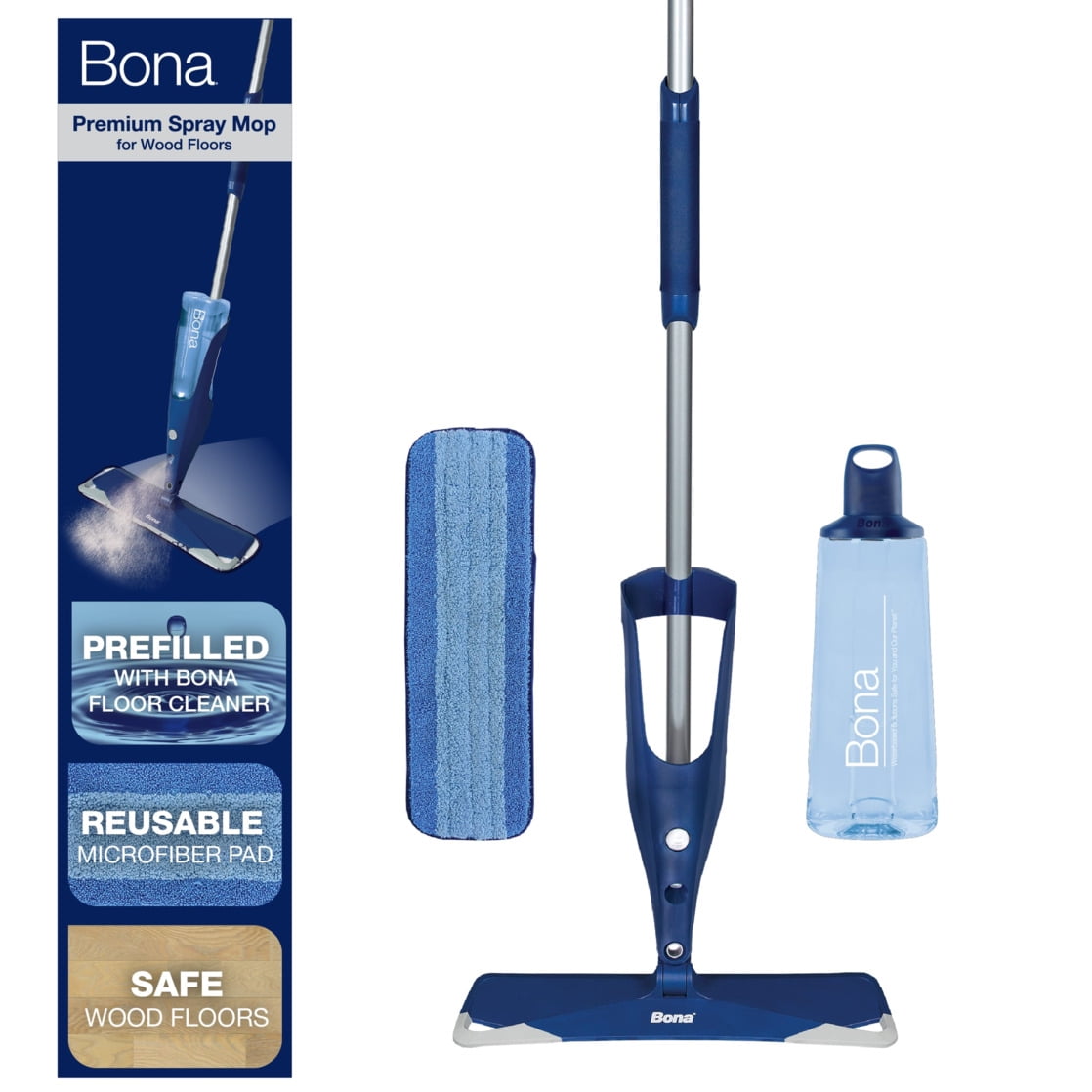
For example, the Bona Premium Spray Mop for Hardwood Floors is designed for controlled, light-mist cleaning with a reusable microfiber pad.
The U.S. kit includes a refillable cartridge and cleaner formulated for compatible unwaxed, unoiled, polyurethane-finished hardwood floors.
Its main advantage is convenient routine cleaning without using a bucket or saturating the floor. However, it should not be used on an incompatible finish merely because the surface is wood.
Best for: Routine maintenance of compatible sealed hardwood floors.
Who should skip it: Owners of unfinished, waxed, or natural-oil floors unless the specific flooring and cleaner manufacturers confirm compatibility.
4. Refill Instead of Replacing the Entire Cleaning System
Reusable cleaning tools can reduce how frequently you need to replace bottles and disposable accessories.
The Bona Hardwood Floor Cleaner Refill 128 oz provides a ready-to-use cleaning solution for refilling compatible spray bottles and mop cartridges.
Bona describes the formula as water-based, pH-neutral, and suitable for unwaxed, unoiled, polyurethane-finished wood floors.
The refill is intended for everyday dirt and grime, not for removing the existing finish or repairing deep scratches.
Do not confuse this ready-to-use refill with a concentrated product that requires dilution.
For other reusable household cleaning tools, our eco-friendly cleaning products guide

5. Protect the Floor From Furniture and Seasonal Changes
Use appropriate protective pads beneath furniture legs and inspect them periodically for trapped dirt.
Avoid dragging heavy furniture across the surface. Move items carefully and use suitable protection when rearranging a room.
Fall is also a useful time to reorganize entryways and storage areas so wet footwear and cleaning supplies have designated locations.
Our home organization tools guide
For a broader room-by-room maintenance routine, the home cleaning checklist
Floor-care reminder: Avoid steam cleaning and excessive moisture unless the flooring manufacturer explicitly approves the method. Always identify the existing finish before choosing a cleaner or maintenance treatment.
Frequently Asked Questions
What hardwood flooring trends are popular for fall 2026?
Major trends include warm natural oak, rich brown finishes, wide planks, matte surfaces, wire-brushed textures, herringbone patterns, and character-grade wood. Recent industry reporting shows increasing interest in natural colors and visible wood grain rather than heavily gray or uniformly stained finishes.
Are gray hardwood floors going out of style?
Industry forecasts show declining interest in cool gray hardwood tones compared with warmer natural colors. However, gray floors can still work well in suitable interiors. If you are planning a long-term renovation, a balanced natural wood tone may offer greater flexibility as decorating preferences change.
Is solid or engineered hardwood better for wide planks?
Engineered hardwood can offer improved dimensional stability because it uses a layered core beneath a real wood surface. This makes it useful for many wide-plank products. Solid hardwood may also work when the installation conditions and manufacturer requirements are appropriate. Neither material is automatically waterproof.
Are matte hardwood floors easier to maintain?
Matte finishes create less pronounced reflections than glossy surfaces and can provide a more understated appearance. However, maintenance depends on the actual finish chemistry, texture, and wear characteristics. A matte coating is not automatically more durable or easier to clean than a glossy one.
Can you change hardwood floor color without replacing the boards?
Often, yes. If the floor has enough sandable material and remains in suitable condition, professional refinishing may allow you to change its stain color and protective finish. However, some engineered floors cannot be sanded safely, and existing wood species can limit the final color. A flooring professional should assess the surface first.
Is herringbone hardwood flooring more expensive?
Herringbone usually costs more to install than straight planks because it requires careful layout, additional cuts, precise alignment, and potentially more material waste. The actual difference depends on the room, materials, and local contractor pricing. Request a separate installation quote before choosing the pattern.
How do you protect hardwood floors during fall and winter?
Use entry mats, remove loose dirt regularly, wipe up moisture promptly, protect floors from furniture scratches, and maintain suitable indoor humidity. Choose cleaning products approved for the exact floor finish. Avoid excessive water and steam cleaning unless the flooring manufacturer specifically permits them.
Final Recommendations: Which Hardwood Flooring Trend Should You Choose?
The best hardwood flooring trend for most homes is warm natural oak with a matte or low-sheen finish. This combination emphasizes real wood character while working with many interior styles.
For a richer and more traditional appearance, medium walnut and chocolate brown tones provide warmth and contrast. Wide planks are a strong choice for open living spaces, while lightly textured surfaces suit homeowners who prefer a more organic look.
Herringbone and chevron are excellent options when the flooring is intended to become a design feature. However, their additional installation complexity should be considered carefully.
Character-grade wood offers another way to create visual interest without using a distinctive layout or heavily colored stain.
Best Timeless Choice: Warm Natural Oak
Best Cozy Interior: Medium and Rich Brown Hardwood
Best Modern Format: Wide and Long Planks
Best Everyday Appearance: Matte or Low-Sheen Finish
Best Natural Texture: Lightly Wire-Brushed Wood
Best Statement Pattern: Herringbone or Chevron
Best Organic Character: Natural or Character-Grade Hardwood
Before committing to a renovation, decide whether your existing floor can be refinished. Review full-size samples in your own lighting, compare material construction and finish requirements, and obtain installation quotes from qualified professionals.
A well-selected hardwood floor should complement your home for years, not simply reflect one season’s design trends.
Sources
- National Wood Flooring Association — 2027 NWFA Industry Outlook: Optimism Despite Uncertainty
- Anderson Tuftex — The 2027 Floor Forecast
- Houzz — What’s New in Flooring for 2026
- Floor Covering News — What’s New for Fall
- National Wood Flooring Association — Problem Prevention: Moisture Management and Scratch Prevention
Product Groups: Bona Premium Spray Mop for Hardwood Floors, Bona Hardwood Floor Cleaner Refill 128 oz