Best Home Organization Tools & Supplies 2026
The best home organization tools do not simply give you more places to hide clutter. They make frequently used items easier to reach, protect things you store long term, recover wasted space, and create a system that is simple enough to maintain after the initial cleanup.
For most households, we recommend starting with the IRIS USA WeatherPro 46 QT Storage Container for protected seasonal storage, then adding systems according to the problem you need to solve. IKEA TROFAST is excellent for frequently accessed items, Rubbermaid Configurations can dramatically improve an inefficient closet, Elfa’s over-the-door system uses vertical space that would otherwise be wasted, and the Brother P-touch CUBE Plus helps keep bins, shelves, and shared storage clearly identified.
There is one rule worth following before buying any of them: declutter and measure first, buy organizers second. Adding more containers to a room without deciding what should actually stay usually gives you better-organized clutter rather than a genuinely functional home.
Quick Answer: Best Home Organization Tools
Best Overall Storage Bin: IRIS USA WeatherPro 46 QT — a clear, stackable gasket box with four buckle latches for seasonal clothing, linens, decorations, and general household storage.
Best Modular Storage System: IKEA TROFAST — interchangeable bins and frames that work especially well for toys, crafts, hobbies, laundry supplies, and other frequently accessed items.
Best Closet Organization System: Rubbermaid Configurations 4–8 Ft Deluxe Closet Kit — adjustable shelving and hanging space that can be reconfigured as your wardrobe changes.
Best Vertical Organizer: Elfa White Over the Door Rack — a customizable rack that turns unused door space into accessible storage.
Best Labeling Tool: Brother P-touch CUBE Plus PT-P710BT — Bluetooth and USB labeling with durable laminated tapes up to 24 mm wide.
Before Buying Organizers: Declutter and Measure First
Buying storage should be one of the final steps in organizing a room, not the first. Before ordering bins, shelves, baskets, or closet hardware, decide what actually needs to remain in the space.
Separate frequently used items from seasonal or long-term storage. Donate, recycle, sell, or discard things you no longer need. Then measure the exact areas where storage will go, including width, depth, and height.
Do not measure only the empty shelf. Check practical obstacles such as hinges, handles, baseboards, door swing, vents, electrical outlets, closet rods, and plumbing. A bin can technically fit inside a cabinet and still be impossible to pull out once the door or hinge is taken into account.
It also helps to classify storage by access frequency:
- Daily use: open or easy-pull storage where contents are immediately accessible.
- Weekly use: drawers, baskets, shelves, or labeled bins that remain easy to reach.
- Seasonal use: closed stackable containers placed higher, lower, or farther back.
- Long-term storage: protected containers with clear labels and predictable dimensions.
That simple hierarchy prevents a common mistake: using deep sealed boxes for items you need every morning or open baskets for things that will sit untouched in a basement for eleven months.
Home Organization Tools Compared
| Product | Best For | Storage Style | Access | Expandable? | Main Drawback |
|---|---|---|---|---|---|
| IRIS USA WeatherPro 46 QT | Seasonal and protected storage | Closed clear container | Occasional | Stackable | Not ideal for frequently accessed items |
| IKEA TROFAST | Toys, crafts and everyday supplies | Open modular bins | Frequent | Yes | Casual appearance may not suit every room |
| Rubbermaid Configurations Deluxe | Closets | Shelving + hanging system | Daily | Yes | Requires wall installation |
| Elfa Over the Door Rack | Unused vertical space | Adjustable baskets / utility board | Frequent | Yes | Expensive for an over-door organizer |
| Brother P-touch CUBE Plus | Labels and identification | Labeling system | — | Multiple tape types | Requires proprietary tape cartridges |
Compare Current Home Organization Prices
Storage products are frequently discounted, and the cost can vary substantially by container pack size, TROFAST configuration, closet width, Elfa components, and label tape. Compare current offers after measuring the space and deciding which system actually solves the problem.
A cheaper organizer that does not fit or cannot adapt to your storage needs is usually more expensive in the long run than buying the right dimensions once.



1. IRIS USA WeatherPro 46 QT Storage Container — Best Overall Storage Bin
Best For: Seasonal clothing, spare linens, holiday decorations, hobby supplies, basement storage, and household items that do not need daily access.
A good storage tote is still one of the most useful home organization tools because it works in almost every room. The IRIS USA WeatherPro 46 QT adds a few practical upgrades over a basic snap-lid plastic bin.
The lid uses a gasket designed to help block moisture and dust, while four buckle latches hold the lid securely in place. The transparent body makes contents visible without opening every container, which is especially useful when several identical boxes are stacked together.
IRIS also designs the lid for stacking. Standardizing around one or two tote sizes can make a storage area much more efficient than collecting random containers with different footprints that cannot sit securely on one another.
What the WeatherPro name does not mean is that you should treat the container as a waterproof safe. A gasket helps protect contents from ordinary dust and moisture exposure, but that is different from a formal waterproof or submersion rating.
For valuable documents, electronics, irreplaceable photos, or anything stored where flooding is possible, use a storage solution rated for that specific risk.
The clear plastic is another tradeoff. Visibility is convenient, but transparent boxes do not hide visual clutter and may not be ideal for light-sensitive contents. In an exposed living space, opaque boxes or cabinets may look cleaner.
Pros
✅ Gasketed lid helps block dust and moisture
✅ Four buckle latches secure the lid
✅ Clear body makes contents easy to identify
✅ Stackable design works well for standardized storage
✅ Useful in closets, garages, basements and utility rooms
Cons
❌ Not a formal waterproof storage solution
❌ Closed bins are inconvenient for items used every day
❌ Clear plastic does not hide visual clutter
Who should skip it: If children, hobbies, or household supplies need to be accessed several times a day, an open modular system such as TROFAST will be easier to maintain.
Alternative: IKEA TROFAST for frequently accessed categories that benefit from pull-out bins.
Keep gear, documents, and pantry items safe and dry with the IRIS USA 46‑Quart WEATHERPRO Storage Box—weatherproof seal, secure buckles, and stackable design provide heavy‑duty protection. Made with BPA‑ and acid‑free materials and built for stability, it’s perfect for home, truck, or camping storage. Order yours today and simplify organization—add to cart now to start protecting what matters.
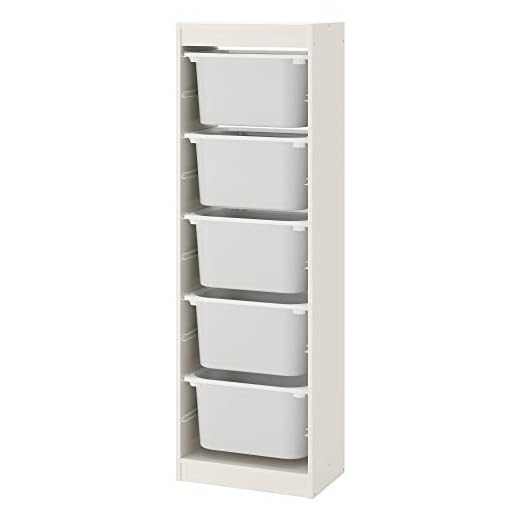
2. IKEA TROFAST Storage Combination with Boxes — Best Modular Storage System
Best For: Toys, craft materials, hobby equipment, laundry supplies, entryway accessories and other categories where people need to see, remove and return items frequently.
TROFAST is usually associated with children’s rooms, but its basic organizational idea works well beyond toy storage. A rigid frame holds removable boxes or trays that slide in and out, allowing each category to have a clearly defined home.
Apartment Therapy named TROFAST its Best Storage System in the 2026 Organization Awards, highlighting how easily the system can be adapted beyond its original children’s-storage role.
IKEA currently offers numerous combinations with different frame sizes, colors, plastic bins and mesh options. That modularity is the main advantage. A shallow container can hold small craft supplies while a deeper box handles bulkier toys or household items, and the configuration can change as your needs change.
The removable bins are particularly practical for activities. Instead of carrying individual art supplies to a table, for example, you can remove the relevant box, use the contents, and return the entire category afterward.
This is also why TROFAST works better for high-frequency storage than sealed totes. It minimizes the number of steps between using an item and putting it away.
The tradeoff is aesthetics. TROFAST still has a casual, utility-first appearance. In a formal living room, dining room or adult bedroom, furniture-style cabinetry may blend into the decor more naturally.
Pros
✅ Modular boxes and trays can be reconfigured
✅ Easy access encourages items to be put back
✅ Multiple frame sizes fit different spaces
✅ Works for more than children’s toys
✅ Strong choice for craft and hobby categories
Cons
❌ Open-access storage offers less protection from dust
❌ Casual design does not suit every room
❌ Different TROFAST configurations vary significantly in dimensions
Who should skip it: Choose closed containers when the contents are seasonal, rarely accessed, or need more protection from dust.
Alternative: IRIS WeatherPro for long-term or seasonal storage.
Get organized with the IKEA TROFAST Storage Combo with Boxes.
Perfect for playrooms, craft corners, or anywhere that needs tidy, accessible storage — durable, modular and child-friendly from IKEA Sweden.
Order yours today and simplify cleanup with style — grab the TROFAST combo now and make storage effortless!
3. Rubbermaid Configurations 4–8 Ft Deluxe Closet Kit — Best Closet Organization System
Best For: Reach-in or walk-in closets with inefficient single-rod layouts and approximately 4 to 8 feet of usable width.
A closet system can create more usable storage without making the closet physically larger. Rubbermaid’s Configurations Deluxe kit uses expanding shelves, telescoping hanging rods and adjustable mounting hardware to divide vertical space more effectively.
The 4–8 ft kit is designed for closets between four and eight feet wide and at least 14 inches deep. Rubbermaid specifies approximately 20 feet of shelving space and 12 feet of hanging capacity when the system’s components are fully configured.
The strongest feature is adjustability. Shelves and hanging rods can be moved later without cutting new components or rebuilding the entire system. That matters because closets rarely stay static: long coats, folded clothes, shoes, bags and seasonal wardrobes all need different amounts of vertical space.
Good Housekeeping selected the Rubbermaid Configurations Deluxe as its Best Modular Closet System in its 2026 closet-system testing, highlighting the flexibility and relatively approachable cost.
Installation still needs planning. Measure the closet carefully, locate appropriate wall supports or studs as required, account for doors and corners, and follow Rubbermaid’s mounting instructions. A second person can make installation easier, especially when leveling long rails.
Do not assume that adding maximum shelving is always better. Leave enough open space for the clothing and objects you actually own rather than creating shelves that are technically efficient but too tightly spaced to use comfortably.
Pros
✅ Fits many 4–8 ft reach-in and walk-in closets
✅ Approximately 20 ft of shelving and 12 ft of hanging capacity
✅ Shelves and rods can be repositioned as needs change
✅ Expandable components reduce the need for cutting
✅ More affordable than many custom closet systems
Cons
❌ Installation requires accurate measuring and wall mounting
❌ Wire shelving is more functional than furniture-like
❌ Installation may be easier with two people
Who should skip it: Renters who cannot mount hardware into walls or people who only need a small temporary closet upgrade may be better served by freestanding shelves or removable accessories.
Alternative: Elfa’s over-the-door rack if you need additional storage without rebuilding the whole closet.
Get the Rubbermaid Configurations Deluxe Closet Kit 4-8ft to maximize storage from wall to wall with adjustable shelves and telescoping rods. With easy, no-cut installation and a rust-free epoxy finish, it’s a durable, tool-free solution for closets, mudrooms, garages, or basements. Order now and enjoy flexible, hassle-free organization in minutes.
4. Elfa White Over the Door Rack — Best Space-Saving Vertical Organizer
Best For: Laundry rooms, utility closets, entryways, bedrooms and other areas where a door has usable vertical space but the floor and shelves are already full.
One of the simplest ways to create storage in a small home is to use surfaces you already have. The Elfa White Over the Door Rack turns the back of a suitable door into a customizable storage zone instead of adding another cabinet or cart to the floor.
The current system combines an approximately 80-inch vertical rack with a utility board and four adjustable baskets. The baskets can be repositioned or removed as storage needs change, and the steel components use an epoxy-bonded finish.
The over-door configuration installs without the kind of full wall-mounting project required by a closet system. Elfa also offers related components and wall-mounted configurations if you later want to extend the idea elsewhere.
This type of vertical storage is especially useful for categories with many small items: cleaning products, accessories, pet supplies, craft materials, gloves, hats or laundry products. Keeping those items visible often works better than placing them in one deep basket on a high shelf.
The main consideration is door compatibility. Measure door thickness, width, molding clearance and nearby walls before buying. Also check whether a fully loaded rack would interfere with the door’s swing or hardware.
Price is the other drawback. There are many cheaper over-door organizers. Elfa earns its place because of adjustability and system expansion, not because it is the cheapest way to hang baskets behind a door.
Pros
✅ Uses often-wasted vertical door space
✅ Four adjustable baskets
✅ Components can be repositioned as needs change
✅ No full closet renovation required
✅ Useful across laundry, utility, bedroom and entry spaces
Cons
❌ Expensive compared with basic over-door organizers
❌ Door clearance must be checked carefully
❌ Visible storage can look busy if categories are not maintained
Who should skip it: If the door already has tight clearance, unusual molding, weak hardware or limited swing space, choose a wall-mounted or freestanding organizer instead.
Alternative: Rubbermaid Configurations if the entire closet needs redesign rather than a small vertical-space upgrade.
5. Brother P-touch CUBE Plus PT-P710BT Label Maker — Best Labeling Tool
Best For: Storage bins, shelves, pantry-style containers, paperwork, cables, hobby supplies and shared household systems where several people need to know where things belong.
A label maker does not create storage capacity, but it can make an organization system much easier to maintain. This becomes especially important when bins are opaque, several containers look identical or multiple people share the same storage area.
The Brother P-touch CUBE Plus PT-P710BT connects through Bluetooth to compatible mobile devices and through USB to computers. It uses Brother’s laminated TZe tapes and supports labels up to 24 mm, or about one inch, wide.
Brother’s software allows fonts, borders, symbols and more detailed label layouts than a traditional handheld label maker. The printer also includes an automatic cutter and a built-in rechargeable battery.
WIRED selected the P-touch CUBE Plus as its Best Upgrade label maker in August 2026, noting its polished output and ability to handle tape from 6 mm to 24 mm wide. The laminated TZe tape is also designed for more demanding use than basic paper labels.
The downside is cost. You pay more for the printer and continue buying proprietary tape cartridges. If you only need to label six storage boxes once, a permanent marker, removable label holder or reusable adhesive label may be more sensible.
A label maker becomes worthwhile when you maintain many categories over time: holiday storage, children’s items, tools, documents, pantry bins, craft supplies or equipment shared by multiple family members.
Pros
✅ Bluetooth mobile-device printing
✅ USB connection for computer-based designs
✅ Supports laminated TZe tape up to 24 mm wide
✅ Automatic cutter
✅ Built-in rechargeable battery
Cons
❌ More expensive than basic handheld labelers
❌ Requires Brother TZe tape cartridges
❌ Overkill for a very small labeling project
Who should skip it: If you have only a few containers to identify, use inexpensive reusable labels instead.
Alternative: A marker-and-label system can be enough when appearance and long-term durability are not priorities.
Ready to organize in seconds? The Renewed Brother P-touch CUBE Plus PT-P710BT lets you design and print crisp, custom labels up to 1" wide from your phone or desktop via Bluetooth — with a rechargeable battery and two starter tapes included. Choose from built-in templates or create your own using Brother’s apps and a wide range of TZe tape styles.
Buy the Renewed Brother P-touch CUBE Plus PT-P710BT today and start labeling smarter.
Closed Storage vs Open Storage: Which Works Better?
Closed storage works best for things you access occasionally; open storage works best for things you need frequently. Neither format is universally better.
Closed bins such as WeatherPro protect items from ordinary dust and make stacking easier. They are ideal for holiday decorations, spare linens, off-season clothing, keepsakes and hobby supplies that may not be touched for months.
Open systems such as TROFAST reduce friction. You can see or quickly reach a category, remove what you need and return it without opening several lids. That makes open storage much easier for toys, daily craft materials and household supplies.
The goal is not to hide everything. It is to make the number of steps required to retrieve and return an item appropriate to how often you use it.
Clear Bins vs Opaque Bins
Clear bins make identification easy, which is useful in garages, closets and storage rooms. You can often find the right container without relying on a label.
Opaque storage has other advantages. It hides visual clutter, looks calmer in exposed living spaces and can protect light-sensitive items better than transparent plastic.
A practical compromise is to use clear containers in hidden storage zones and attractive opaque boxes or cabinets in areas that form part of the room’s decor. Label opaque containers clearly so visibility is not lost.
How to Organize a Small Home Without Adding More Furniture
Before buying another cabinet, look for unused vertical and hidden space. Small homes often have storage potential that does not consume additional floor area.
Useful zones include:
- The back of compatible doors
- Upper closet shelves
- Vertical wall space
- Space under suitable beds
- The full height above short closet rods
- Narrow wall sections near an entryway
- Unused space above an existing storage unit
Door systems such as Elfa are particularly useful because they turn an existing surface into storage. Closet kits do the same vertically by adding a second hanging level or additional shelving rather than expanding the closet’s footprint.
Be careful not to interpret “use every inch” literally. A functional home still needs empty visual space, easy walkways and room to remove objects without dismantling an entire stack.
When Is a Full Closet System Worth It?
A full closet system becomes worthwhile when the existing layout is the problem rather than the number of clothes you own.
A common builder-grade closet has one shelf and one hanging rod running across the width. That leaves a large amount of unused vertical space below short shirts and above items stored on the floor.
An adjustable system can divide that height into additional hanging zones, shoe storage and shelves. The investment is particularly worthwhile when you expect to use the same closet for several years and your wardrobe is already reasonably decluttered.
If the real issue is simply too much clothing, adding another twelve feet of hanging space delays the underlying decision rather than solving it.
Are Labels Actually Necessary?
Labels help most when the contents are not immediately visible or when several people use the same system.
A transparent bin full of obvious holiday ornaments may not need a detailed label. An opaque box marked “Winter Gloves & Scarves — Adult” becomes far more useful when it sits beside six similar containers.
Labels also create a return rule. Instead of deciding where an object belongs every time you put it away, the category has already been defined.
Avoid over-labeling. If a drawer has only one obvious purpose, adding labels to every compartment can make the organization system more complicated without making it more functional.
Drawer Organizers: Measure Before You Buy
Drawer organizers are useful, but this is another category where dimensions matter more than appearance. Measure the inside width, depth and usable height of the drawer—not the outside furniture dimensions.
Then group the items you actually plan to keep. Buying a fixed cutlery-style organizer before understanding the category often leaves awkward unused gaps or compartments that do not match what you own.
Expandable and modular dividers can be more flexible, but they should still fit tightly enough that they do not slide around each time the drawer opens.
Home Office Organization
A home office needs a slightly different approach because storage competes with ergonomics and access to technology. Frequently used documents, chargers and supplies should remain accessible without consuming the entire desk surface.
Start with the workstation itself. Our upcoming guide to home office desks for productivity covers desk layouts and work surfaces, while our guide to ergonomic office chairs focuses on seating.
Paper archives, supplies and equipment that do not need to sit on the desktop should move into dedicated office storage solutions. Separating working space from storage prevents organization products from simply consuming the area where work is supposed to happen.
For shared routines and voice-controlled reminders, smart speakers for connected homes can support household organization digitally, but they do not replace a physical storage system for the objects themselves.
Five Organization Mistakes That Waste Money
1. Buying Storage Before Decluttering
Storage capacity tends to fill. Decide what deserves space first, then buy enough organization for what remains.
2. Ignoring Interior Dimensions
A container can fit on a shelf externally while providing much less useful interior space because of tapered walls, lid geometry or handles. Measure the objects as well as the shelf.
3. Collecting Too Many Incompatible Bin Sizes
Random containers rarely stack efficiently. Where possible, standardize dimensions within each storage zone.
4. Filling Every Empty Space
An organization system needs some unused capacity. Completely full drawers, shelves and bins become difficult to maintain as soon as one new item enters the category.
5. Choosing Appearance Over Access
An attractive organizer that makes frequently used items difficult to retrieve will eventually be bypassed. Match the container to how often the contents are used.
Best Home Organization Tool by Need
| Organization Need | Best Pick | Why |
|---|---|---|
| Seasonal storage | IRIS WeatherPro 46 QT | Gasketed, latched and stackable |
| Frequently accessed categories | IKEA TROFAST | Removable modular bins |
| Inefficient closet | Rubbermaid Configurations | Adjustable shelves and hanging space |
| Limited floor space | Elfa Over the Door Rack | Uses vertical door space |
| Shared or opaque storage | Brother P-touch CUBE Plus | Durable, readable labels |
Frequently Asked Questions
What are the most useful home organization tools?
The most useful tools solve different problems: stackable closed bins for seasonal storage, open modular bins for daily-use categories, an adjustable closet system, vertical door storage and labels for containers whose contents are not immediately obvious.
Should you declutter before buying storage bins?
Yes. Decide what you are keeping and group those items before buying containers. Otherwise, you may spend money storing things you no longer need or purchase bins that do not match the amount and shape of what remains.
Are clear or opaque storage bins better?
Clear bins are better when visibility and quick identification matter. Opaque bins hide visual clutter and may suit exposed living areas better. Label opaque containers so you do not lose the identification advantage of clear storage.
What is the best way to organize a small home?
Declutter first, then use vertical and hidden storage before adding more furniture. Door racks, adjustable closet systems, wall storage and carefully sized under-bed containers can add capacity without consuming much additional floor space.
Are closet organization systems worth it?
They can be when the existing closet wastes vertical space. Adjustable shelving and double-hanging areas can substantially improve usable capacity, especially when the closet has already been decluttered.
How do you use vertical space for storage?
Look at doors, walls and unused closet height. Over-door baskets, wall-mounted shelving and adjustable closet systems can create storage without adding another freestanding cabinet to the room.
Are label makers worth buying?
A label maker is worthwhile when you maintain many opaque bins, shelves or shared household categories. For a few containers, reusable handwritten labels are usually cheaper and work just as well.
How do you choose drawer organizers?
Measure the usable interior width, depth and height of the drawer, then group the items you plan to store. Choose an organizer whose compartments match those items rather than buying by the exterior drawer dimensions alone.
Final Verdict: Which Home Organization Tools Are Worth Buying?
The best home organization tools create an obvious home for the things you have already decided to keep. IRIS WeatherPro is our most versatile choice for seasonal and protected storage, while IKEA TROFAST is better when easy everyday access matters.
Rubbermaid Configurations can create significantly more useful capacity in an inefficient closet. Elfa’s Over the Door Rack is the strongest pick when floor space is scarce, and the Brother P-touch CUBE Plus is useful when labels are the missing piece keeping a larger system understandable.
None of these products should be the first purchase in a cluttered room. Start by removing what no longer belongs, group what remains, measure the available space, and then select a storage solution for that exact category.
Bottom line: Use IRIS WeatherPro for long-term storage, TROFAST for frequently used items, Rubbermaid Configurations for inefficient closets, Elfa for unused vertical space and Brother CUBE Plus when a clear labeling system will help everyone put things back where they belong.
Sources
- IRIS USA — WeatherPro 46 QT Gasket Storage Container
- Apartment Therapy — Organization Awards: Best Storage System
- Rubbermaid — Configurations Expandable Deluxe Closet Kit
- Good Housekeeping — Best Closet Organization Systems
- WIRED — The Best Label Makers for an Organized Home
Product Groups: IRIS USA WeatherPro 46 QT Storage Container, IKEA TROFAST Storage Combination with Boxes, Rubbermaid Configurations 4-8 Ft Deluxe Closet Kit, Elfa White Over the Door Rack, Brother P-touch CUBE Plus PT-P710BT Label Maker