
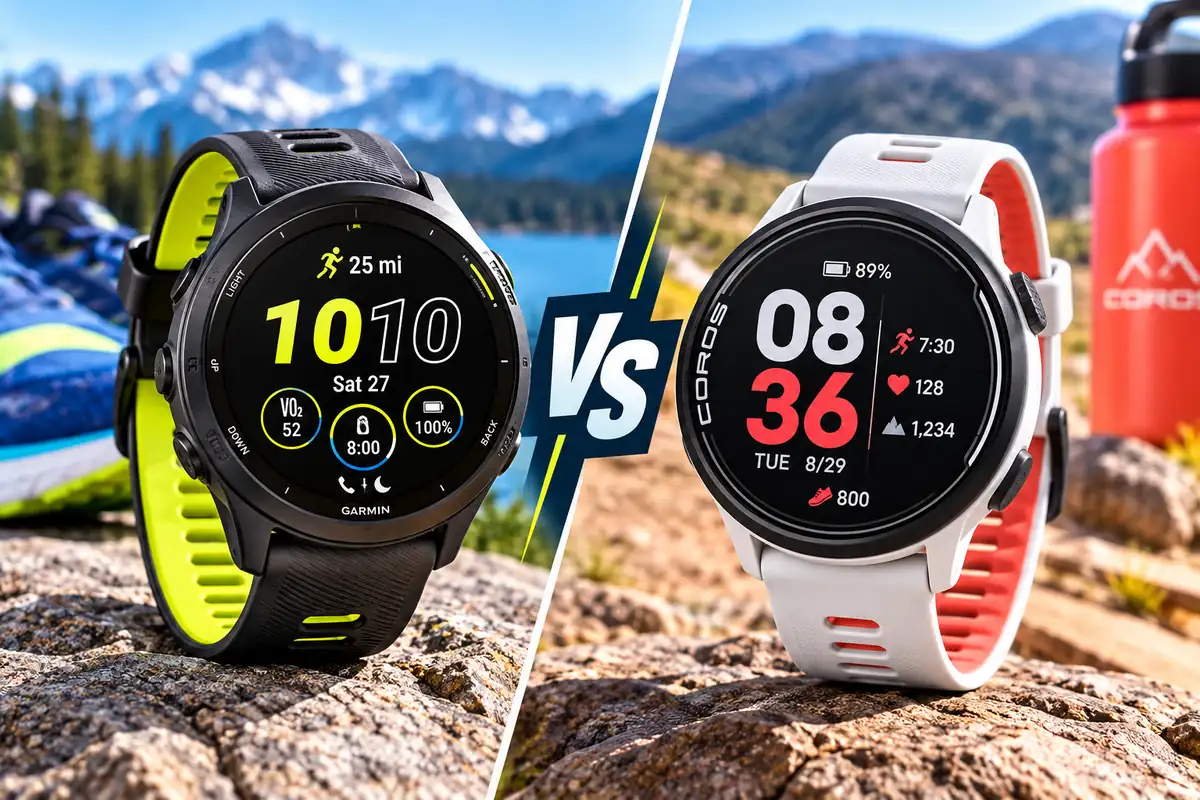
Garmin Forerunner 265 vs COROS PACE 3
The Garmin Forerunner 265 is the better choice if you want deeper training guidance, a bright AMOLED display, better phone-free music support, Garmin Pay, and a richer smartwatch ecosystem. The COROS PACE 3 is the better value if low weight, long GPS battery life, and a simpler running-focused experience matter more.
There is one important catch in 2026: neither watch is the newest model in its family. Garmin now positions the Forerunner 265 as a previous-generation model after introducing the Forerunner 570. COROS has moved on to the PACE 4.
That does not make either watch obsolete. Both still receive software support, and both remain capable running and triathlon watches. It does mean price matters more than it did when they launched.
Our recommendation is straightforward. Buy the Forerunner 265 when you find it at a meaningful discount and want Garmin’s training ecosystem. Buy the PACE 3 if you want a lightweight running watch around $199 and do not care about AMOLED, payments, or streaming-service music downloads.
Quick Winner: Garmin Forerunner 265 vs COROS PACE 3
Best Overall Feature Set: Garmin Forerunner 265 — stronger training guidance, AMOLED, Garmin Pay, richer music support, and a broader smartwatch ecosystem.
Best Value: COROS PACE 3 — officially priced at $199 with dual-frequency GPS, multisport tracking, navigation, music, and strong battery life.
Best Battery: COROS PACE 3 — up to 38 hours in standard GPS mode versus 20 hours for the Forerunner 265 in GPS-only mode.
Best Training & Recovery Ecosystem: Garmin Forerunner 265 — Training Readiness, Training Status, HRV Status, recovery time, Body Battery, and Daily Suggested Workouts provide more interpretation around your data.
Best Lightweight Race Watch: COROS PACE 3 — only 30 g with its nylon band, compared with 47 g for the standard Forerunner 265.
Should You Still Buy Either Watch in 2026?
Yes, but neither should be bought without comparing its successor first.
Garmin still supports the Forerunner 265 with software updates, and the watch remains available through Garmin and retailers. However, Garmin now classifies the 265 among its previous models. The newer Forerunner 570 adds updated hardware, a larger and brighter AMOLED display, an aluminum bezel, speaker and microphone functions, and Garmin’s newer sensor platform.
The Forerunner 570 also starts much higher at $549.99. That leaves room for the 265 to make sense when retailer discounts create a substantial price gap.
The value question is harder for COROS. PACE 3 now costs $199, but the newer PACE 4 starts at $249. For only $50 more at official pricing, PACE 4 adds an AMOLED screen, newer heart-rate hardware, up to 41 hours of GPS battery life, and global maps.
PACE 3 still receives software updates, so this is not an abandoned product. It remains a strong budget choice. However, anyone spending close to $200 should compare the current PACE 4 before checking out.
For a wider view of the newest alternatives, our best running watches guide compares current-generation models across several price ranges.
Garmin Forerunner 265 vs COROS PACE 3: Specs
| Feature | Garmin Forerunner 265 | COROS PACE 3 | Winner |
|---|---|---|---|
| Price Reference | $449.99 list/launch reference; live discounts vary | $199 current official price | COROS |
| Case | 46.1 × 46.1 × 12.9 mm | 41.9 × 41.9 × 11.7 mm | Preference |
| Weight | 47 g | 30 g nylon / 38 g silicone | COROS |
| Display | 1.3″ AMOLED, 416 × 416 | 1.2″ transflective MIP | Garmin |
| Touchscreen | Yes | Yes | Tie |
| Advanced GPS | Multi-band GNSS | Dual-frequency GNSS | Tie |
| Smartwatch Battery | Up to 13 days | Up to 15 days with sleep + daily stress | COROS |
| Standard GPS Battery | Up to 20 hours GPS-only | Up to 38 hours standard GPS | COROS |
| Highest-Accuracy GPS Battery | Up to 14 hours multi-band | Up to 15 hours dual-frequency | COROS, slight |
| Water Rating | 5 ATM | 5 ATM | Tie |
| Full Offline Maps | No | No | Tie |
| Phone-Free Music | Local music + supported music-provider downloads | Local MP3 files | Garmin |
| Contactless Payments | Garmin Pay | No equivalent | Garmin |
| Triathlon | Yes | Yes | Tie |
Price and Value
COROS PACE 3 is the clear value winner at official pricing.
COROS reduced the PACE 3’s U.S. price to $199. That buys you dual-frequency GPS, optical heart-rate tracking, a barometric altimeter, breadcrumb navigation, multisport and triathlon modes, local music, and unusually strong battery life.
Garmin launched the Forerunner 265 at $449.99, and Garmin’s product comparison still references that price. However, the 265 is now a previous-generation model, so live retailer pricing matters far more than MSRP.
At close to $450, we would not choose the 265 over newer alternatives. At a substantial discount, it becomes much easier to recommend because the underlying training platform is still excellent.
Garmin Forerunner 265 Current Prices

COROS PACE 3 Current Prices

Design, Weight and Comfort
COROS wins if you want the least noticeable watch on your wrist.
PACE 3 weighs only 30 g with its nylon band. Even the silicone-band configuration is only about 38 g. The case is also smaller and thinner than the standard Forerunner 265.
That difference is noticeable during races, hot-weather training, and overnight wear. A lighter watch also tends to move less on smaller wrists, which can help maintain consistent skin contact for optical heart-rate readings.
The Forerunner 265 weighs 47 g. That is still light for a full-featured GPS watch, but it feels more substantial than PACE 3.
Garmin has one major fit advantage: the Forerunner 265S. The smaller 42 mm model gives runners with smaller wrists another option rather than forcing everyone into the 46 mm standard case.
Winner: COROS PACE 3 for minimum weight. Garmin gets the edge in size choice because of the 265S.
Display: AMOLED vs MIP
The Forerunner 265 has the much better-looking screen.
Its 1.3-inch AMOLED panel uses a 416 × 416 resolution and supports an optional always-on mode. Colors are richer, maps of workout data are easier to read, and everyday menus feel closer to a modern smartwatch.
PACE 3 uses a 1.2-inch transflective memory-in-pixel display. It is functional, always visible, and works especially well outdoors, but it looks dated beside Garmin’s AMOLED panel.
MIP is not inherently bad. It uses relatively little power and remains readable in bright sun. If you view the watch mostly during runs, you may prefer that efficiency over richer graphics.
For everyday wear, however, Garmin is significantly more polished.
Winner: Garmin Forerunner 265.
GPS Accuracy: Is Garmin or COROS Better?
There is no defensible universal GPS winner between these two watches.
Forerunner 265 supports multi-band satellite positioning. PACE 3 offers dual-frequency GNSS. Both technologies are designed to improve positioning in difficult environments such as dense cities, tree cover, and terrain where satellite signals can reflect or become partially blocked.
Independent testing has found strong GPS performance from both models. PACE 3 has tracked closely against higher-priced Garmin watches in dual-frequency mode, while independent Forerunner 265 testing has also found stable multi-band performance across normal road and urban running.
The more meaningful difference is battery. PACE 3 can run its highest-accuracy dual-frequency mode for up to 15 hours. Garmin rates the 265 for up to 14 hours using all systems plus multi-band.
For most road runners, the GPS difference should not decide this comparison. Fit, settings, route environment, and satellite mode can affect both watches.
Winner: Tie.
Heart-Rate Tracking
Both watches use optical wrist sensors, and neither should be treated as infallible.
Independent testing of both models has generally found useful running heart-rate data, particularly during steady efforts. Wrist sensors can become less reliable during intervals, rapid intensity changes, strength training, cold conditions, or whenever the watch loses consistent contact with the skin.
That matters if you train precisely by heart-rate zone.
Both ecosystems support external heart-rate sensors. A compatible chest strap remains the more sensible option when accurate heart-rate response during threshold sessions, intervals, or racing is particularly important.
Winner: Tie for most runners.
Running and Training Features
Garmin wins this category because it does more with the data after your workout.
Garmin Forerunner 265
Training Readiness is the standout feature. Garmin builds the score from factors including sleep score, recovery time, HRV status, acute training load, recent sleep history, and recent stress.
You also get Training Status, recovery time, HRV Status, Body Battery, race predictions, PacePro pacing guidance, Daily Suggested Workouts, Garmin Coach, Morning Report, running dynamics, and detailed training-load information.
The advantage is not that Garmin records radically different basic running data. It is the amount of interpretation layered on top.
That makes the Forerunner 265 especially useful for runners following structured marathon or half-marathon training who want the watch to help answer: How hard should I train today?
COROS PACE 3
COROS is not basic. Its EvoLab system includes Training Load, Base Fitness, Training Status, recovery guidance, Running Fitness, race predictions, Training Effect, and structured training plans.
COROS Training Hub is also useful for athletes who prefer analyzing training on a larger desktop interface. Recent updates have continued expanding the PACE 3 with features such as Live Tracking, revised sleep tools, cycling data, and software refinements.
The difference is presentation. COROS generally feels more training-first and less crowded. Garmin gives you more wellness and readiness context around the training data.
Winner: Garmin Forerunner 265.
Battery Life: COROS Wins Clearly
PACE 3 has the stronger battery for runners who log long GPS sessions or dislike charging.
COROS rates PACE 3 for up to 38 hours using standard GPS. All-systems mode is rated for up to 25 hours, while dual-frequency mode reaches up to 15 hours.
Forerunner 265 is rated for up to 20 hours in GPS-only mode, 16 hours with Garmin’s SatIQ AutoSelect mode, and 14 hours using all systems plus multi-band.
In smartwatch use, the difference is smaller. Garmin claims up to 13 days. PACE 3 is currently rated for up to 15 days when sleep and daily stress tracking are enabled.
Both can comfortably handle normal marathon training. The COROS advantage becomes more important for long-course events, ultrarunning, travel, and runners who simply do not want to think about charging every few days.
Winner: COROS PACE 3.
Navigation: Neither Watch Has Full Maps
Do not buy either of these exact watches expecting the mapping experience of a premium outdoor watch.
Forerunner 265 can follow courses and provide route guidance, but it does not include the full-color built-in maps found on premium Garmin models such as the Forerunner 970.
PACE 3 offers breadcrumb navigation, turn-by-turn directions, elevation profiles, distance-to-destination information, and route-following tools. It also does not provide the full global map experience of newer COROS watches.
This distinction has become more important in 2026 because PACE 4 now supports global maps. That gives buyers another reason to compare the newer $249 COROS before purchasing PACE 3.
If full mapping is essential, neither watch in this comparison is our first choice.
Winner: Tie.
Music and Smart Features
Garmin is significantly better if you want the watch to replace your phone during a run.
Forerunner 265 stores music and supports downloads from compatible third-party providers. Depending on the service and subscription, this includes options such as Spotify, Deezer, Amazon Music, and YouTube Music. Pair Bluetooth headphones and you can listen without carrying your phone.
Garmin Pay also lets you make contactless payments through supported banks and cards. Connect IQ adds another layer of downloadable watch faces, apps, and data fields.
PACE 3 can also play music to Bluetooth headphones, but the implementation is more manual. COROS currently supports locally stored MP3 files. You transfer those files from a computer to the watch. COROS does not support third-party music-streaming apps on the PACE 3.
PACE 3 handles notifications and basic daily functions well, but it deliberately feels more like a sports watch than a smartwatch.
If smart features matter as much as running features, our best smartwatches guide covers devices designed more heavily around everyday apps and connectivity.
Winner: Garmin Forerunner 265.
Triathlon and Multisport
Both are legitimate triathlon watches.
Forerunner 265 includes dedicated triathlon and multisport profiles, transition tracking, open-water swimming, cycling, and running. Garmin also lets you create custom multisport activities.
COROS PACE 3 supports dedicated triathlon mode with swim, bike, run, and transition tracking. COROS also supports multisport sessions and navigation within supported multisport activities.
Garmin provides the deeper surrounding ecosystem, but the basic requirement—recording a complete triathlon from one watch—is covered by both.
Winner: Tie for most triathletes.
Garmin Connect vs COROS App
Garmin has the larger ecosystem. COROS has the cleaner one.
Garmin Connect brings activity history, training readiness, wellness metrics, challenges, course creation, equipment, coaching, third-party integration, and extensive health data into one system.
The downside is complexity. There are more menus, more metrics, and more places to explore.
COROS puts training at the center. EvoLab and Training Hub make load, fitness, recovery, plans, and workout analysis relatively easy to follow without adding as many lifestyle layers.
Runners who enjoy data exploration will probably prefer Garmin. Runners who want to record training, review the important metrics, and move on may prefer COROS.
If you need activity tracking rather than a dedicated running/triathlon watch, see our best fitness trackers guide before paying for features you may never use.
Who Should Buy the Garmin Forerunner 265?
Buy the Forerunner 265 if training guidance matters more than maximum battery life. Garmin provides more context around readiness, recovery, load, and suggested training.
Buy it if you want AMOLED. The difference in screen quality is substantial.
Buy it if you run without your phone and want better music support. Garmin’s compatible music-provider ecosystem is easier than manually transferring MP3 files.
Buy it if Garmin Pay matters. COROS has no comparable payment feature on PACE 3.
Buy it if you already use Garmin. Keeping years of activities, health data, courses, sensors, and Garmin Connect history in one ecosystem can matter more than a specification-sheet win.
Skip it at close to full MSRP. The newer Forerunner 570 makes far more sense if the price gap is small.
Who Should Buy the COROS PACE 3?
Buy PACE 3 if value is your priority. At $199, it remains a lot of running watch for the money.
Buy it if you hate heavy watches. The 30 g nylon configuration is excellent for races and overnight wear.
Buy it if battery life matters. Its 38-hour standard GPS rating comfortably beats the Forerunner 265.
Buy it if you prefer a simpler sports-watch interface. COROS provides serious training tools without as much smartwatch and wellness complexity.
Skip it if AMOLED or full maps matter. PACE 4 solves both problems for only $50 more at official pricing.
What Should You Buy Instead?
COROS PACE 4
PACE 4 is the most important alternative to PACE 3.
It starts at $249 and keeps the series lightweight while adding a 1.2-inch AMOLED display, newer heart-rate hardware, 41 hours of GPS battery life, and global maps. If the $50 difference fits your budget, we would choose PACE 4 over PACE 3 for most new buyers.
Garmin Forerunner 570
Forerunner 570 is Garmin’s newer mid-range running and triathlon option. It adds a larger, brighter display, newer hardware, an aluminum bezel, and speaker/microphone features.
Its $549.99 MSRP is substantially higher, which means a discounted Forerunner 265 can still be the smarter value.
Garmin Forerunner 970
Move to the Forerunner 970 if you want a more premium Garmin with built-in maps, greater storage, and higher-end materials.
For a comparison against another premium smartwatch, see our Garmin Forerunner 970 vs Apple Watch Ultra 3 guide.
Frequently Asked Questions
Is Garmin Forerunner 265 better than COROS PACE 3?
The Forerunner 265 is better for training guidance, AMOLED display quality, music, payments, and smart features. PACE 3 is better for value, low weight, and GPS battery life.
Which has better battery life?
COROS PACE 3. It is rated for up to 38 hours in standard GPS mode and 15 hours in dual-frequency mode. Forerunner 265 is rated for up to 20 hours GPS-only and 14 hours with all systems plus multi-band.
Which is better for marathon training?
We prefer the Forerunner 265 for runners who want detailed readiness, recovery, suggested workouts, PacePro, and a larger Garmin training ecosystem. PACE 3 remains an excellent choice if you already follow your own plan and mainly need reliable recording and core training metrics.
Which is better for triathlon?
Both support dedicated triathlon and multisport tracking. Garmin has the richer surrounding training ecosystem, while COROS offers much longer standard GPS battery life and lower weight.
Does COROS PACE 3 have maps?
PACE 3 provides breadcrumb navigation and route guidance, not the full global map experience now available on PACE 4. If full maps matter, PACE 4 is the better COROS choice.
Can both watches play music without a phone?
Yes. Garmin supports local audio plus downloads through compatible music providers. COROS PACE 3 supports locally transferred MP3 files but does not support music-streaming apps.
Is the Forerunner 265 still worth buying in 2026?
Yes at the right price. Its AMOLED display, multi-band GPS, Training Readiness, music, Garmin Pay, and triathlon features remain strong. Compare its live price with the newer Forerunner 570 before buying.
Is COROS PACE 3 worth buying now that PACE 4 exists?
PACE 3 is still attractive at $199, especially if you prefer its simple MIP display and want to spend as little as possible. PACE 4 is only $50 more at official pricing and adds AMOLED, newer hardware, longer GPS battery, and global maps, so it is the better new purchase for many runners.
Final Verdict: Garmin Forerunner 265 or COROS PACE 3?
The Garmin Forerunner 265 wins on features. The COROS PACE 3 wins on value and efficiency.
Choose the Forerunner 265 if you want your watch to do more than record workouts. Training Readiness, Training Status, Daily Suggested Workouts, richer recovery data, Garmin Pay, better phone-free music, and AMOLED make it the more complete wearable.
Choose PACE 3 if the watch’s job is primarily to help you train and race. It is dramatically lighter, lasts much longer in standard GPS mode, provides strong GPS and multisport tracking, and costs only $199.
The biggest buying question in 2026 is no longer simply Garmin versus COROS. It is whether these older watches are discounted enough to beat their successors.
For PACE 3, the $249 PACE 4 is difficult to ignore. For the Forerunner 265, the much more expensive Forerunner 570 leaves more room for a discounted 265 to remain a very good buy.
Best Overall Feature Set: Garmin Forerunner 265
Best Value: COROS PACE 3
Best Battery: COROS PACE 3
Best Display: Garmin Forerunner 265
Best Training & Recovery Tools: Garmin Forerunner 265
Best Lightweight Race Watch: COROS PACE 3
GPS: Tie
Triathlon: Tie
Sources
- Garmin — Forerunner 265 Product Comparison and Specifications.
- Garmin Support — Update and Learn More About the Software on Your Forerunner 265.
- COROS — PACE 3 GPS Sport Watch Specifications.
- COROS Help Center — PACE 3 Battery Specifications and Price Adjustment.
How we research: Discompare compares current manufacturer specifications, official pricing, software-support information, independent testing, battery modes, training features, and practical buyer trade-offs. We do not claim hands-on testing unless explicitly stated. GPS, battery, heart-rate performance, prices, software features, and availability can vary with settings, environment, firmware, retailer, and usage. Discompare may earn a commission from eligible retailer or price-comparison links.
Product Groups: Garmin Forerunner 265, COROS PACE 3