
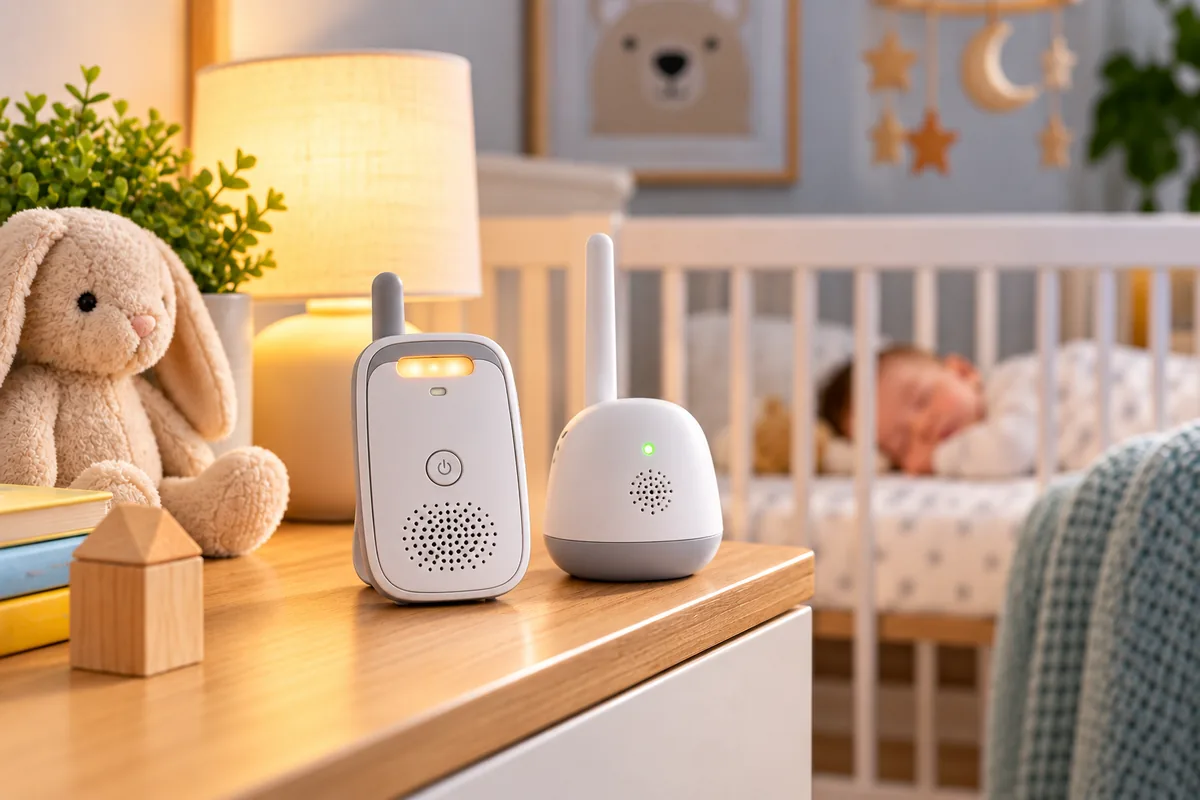
Best Audio Baby Monitors 2026
The best audio baby monitors keep nursery monitoring simple. You can hear when your baby wakes without adding a camera, smartphone app, cloud account, or Wi-Fi connection.
For 2026, we selected five sound-only monitors for different needs. VTech DM1211 is our all-around pick. Motorola PIP12 Travel works well away from home, while PIP15-2 Multi covers two rooms. VTech DM112-2 gives two caregivers separate parent units, and Motorola AM21 keeps the price low.
An audio monitor is still only an aid. It does not replace responsible adult supervision. Also, power cords must stay safely outside a child’s reach.
Need video, night vision, or remote phone access instead? Compare our best baby monitor cameras.
Quick Answer: Best Audio Baby Monitors
Best overall: VTech DM1211 combines DECT 6.0, up to 1,500 feet of stated range, talk-back, vibration alerts, sound-level LEDs, and a rechargeable parent unit.
Best for travel: Motorola PIP12 Travel gives both units rechargeable power, USB-C charging, a travel pouch, and up to 10 hours of rated battery life.
Best for two rooms: Motorola PIP15-2 Multi includes two baby units and can listen to both rooms, focus on one, or cycle between them.
Best for two caregivers: VTech DM112-2 includes two rechargeable parent units, so two adults can monitor from different parts of the home.
Best budget pick: Motorola AM21 provides basic DECT audio monitoring and up to 1,000 feet of stated range for about $25.
How We Chose These Audio Baby Monitors
We focused on sound-only monitors rather than repeating our video-monitor recommendations. The main criteria were audio features, connection type, range, portability, battery design, alerts, extra units, and current price.
Range claims received extra scrutiny. Manufacturer numbers usually describe favorable or clear-line-of-sight conditions. Walls, floors, metal objects, electronics, and building materials can reduce real indoor range substantially.
We also considered independent testing where available. BabyGearLab currently places the VTech DM1211 first among its tested audio baby monitors, with particularly strong results for ease of use and range.
Finally, we checked cord-safety guidance. Audio monitors may be simpler than video systems, but their power cables can still present a strangulation hazard.
Audio Baby Monitors Compared
| Monitor | Best For | Connection | Stated Range | Talk-Back | Portable Battery | Extra Units | Regular Price | Main Trade-Off |
|---|---|---|---|---|---|---|---|---|
| VTech DM1211 | Overall home use | DECT 6.0 | Up to 1,500 ft | Yes | Parent unit, up to 8 hr | 1 parent + 1 baby unit | $39.95 | Baby unit still needs power |
| Motorola PIP12 Travel | Travel | Dedicated wireless audio | Up to 1,500 ft | Yes | Both units, up to 10 hr | 1 parent + 1 baby unit | $49.99 | Costs more than basic home monitors |
| Motorola PIP15-2 Multi | Two rooms | DECT | Up to 1,500 ft* | Yes | Rechargeable, up to 9 hr | 2 baby units included | $69.99 | Overkill for one room |
| VTech DM112-2 | Two caregivers | DECT 6.0 | Up to 1,000 ft | No | Parent units, up to 8 hr | 2 parent units included | $41.95 | Fewer comfort features than DM1211 |
| Motorola AM21 | Budget monitoring | DECT | Up to 1,000 ft | No | Portable parent unit | 1 parent + 1 baby unit | $24.99 | Very basic feature set |
*Motorola states that the PIP15-2 Multi’s 1,500-foot maximum assumes clear line of sight. Its documentation gives a much shorter typical indoor figure, so treat the headline range as a best-case specification.

1. VTech DM1211 — Best Overall Audio Baby Monitor
Best for: Everyday home use, larger homes, parents who want useful alerts, and buyers who prefer a simple non-Wi-Fi monitor.
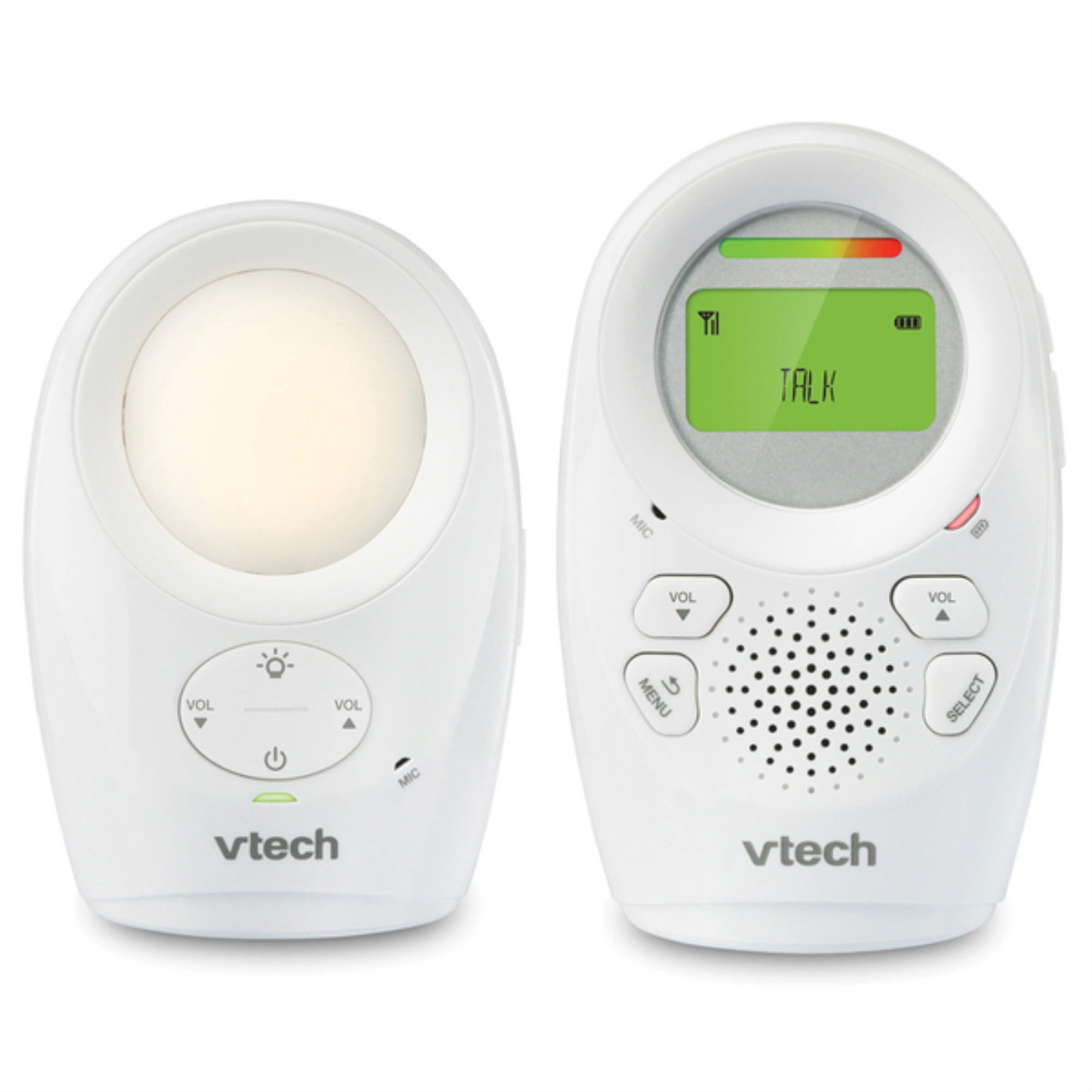
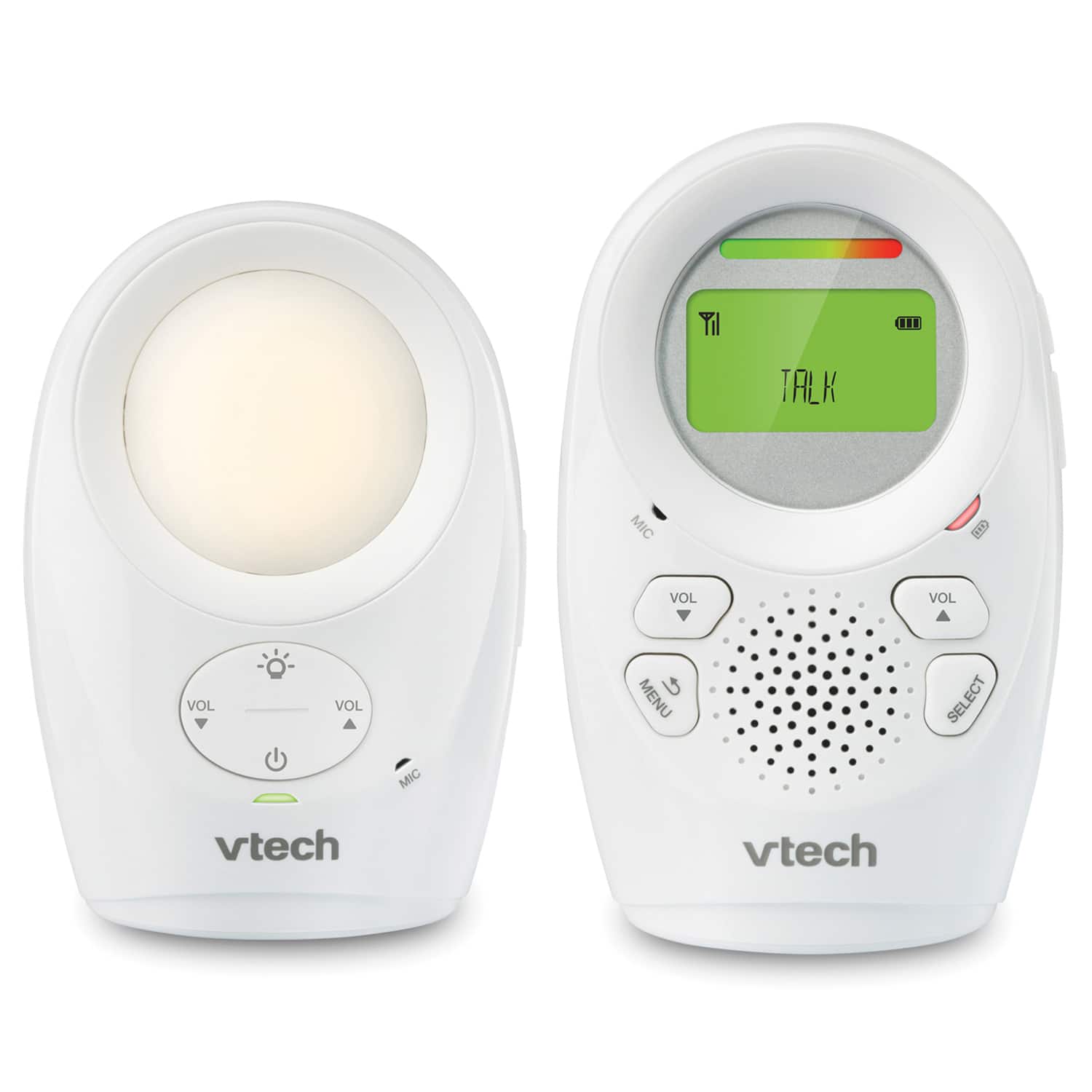
The VTech DM1211 offers more useful features than many basic audio monitors without becoming complicated. It connects through DECT 6.0 rather than your home Wi-Fi.
VTech states a maximum range of up to 1,500 feet. More importantly, independent testing from BabyGearLab also found the DM1211 particularly strong for real-world range compared with other audio monitors.
The parent unit includes a rechargeable battery rated for up to eight hours of cord-free use. A belt clip makes it easier to carry while moving around the house.
You also get two-way talk. That can be useful as a baby becomes a toddler and can respond to a familiar voice from another room.
Five LED levels show how loud the nursery is. Therefore, you can still notice activity when the speaker is muted. The parent unit can also vibrate when it detects sound.
The baby unit includes a night light. At $39.95 direct, the DM1211 remains relatively inexpensive despite those extra features.
Pros
✅ DECT 6.0 connection with no Wi-Fi account
✅ Up to 1,500 feet of stated range
✅ Two-way talk and vibration alerts
✅ Five-level visual sound indicator
✅ Strong independent range and usability results
Cons
❌ No video or remote app access
❌ Baby unit still depends on a power connection
❌ Eight-hour parent battery is shorter than some travel-focused alternatives
Skip it if: You specifically need a battery-powered baby unit for hotels or temporary rooms.
Alternative: Motorola PIP12 Travel makes both sides of the system easier to use away from a permanent nursery.
2. Motorola PIP12 Travel — Best Audio Baby Monitor for Travel
Best for: Hotels, grandparents’ homes, vacations, temporary sleeping spaces, and families that do not want to dismantle their home monitor.
The PIP12 Travel is designed around portability rather than being a normal nursery monitor placed in a travel pouch as an afterthought.
Both the baby and parent units can operate from rechargeable batteries. Motorola rates them for up to 10 hours of use, which reduces dependence on a nearby outlet during temporary setups.
USB-C charging is another practical advantage. Motorola supplies charging hardware for both units, while a rain-resistant drawstring pouch keeps the system together during travel.
The two units also attach magnetically when stored. Joining them automatically powers them down to conserve battery.
Motorola states a maximum range of up to 1,500 feet and includes an out-of-range alert. However, real indoor range will depend on walls and local interference.
The PIP12 also supports two-way talk, five volume levels, a visual mute indicator, and what Motorola calls HD audio.
At $49.99, it costs more than a basic monitor. The extra money makes the most sense when portable operation is genuinely useful.
Pros
✅ Rechargeable baby and parent units
✅ Up to 10 hours of rated battery life
✅ USB-C charging
✅ Travel pouch included
✅ Magnetic storage design with automatic power-off
Cons
❌ Costs more than basic sound monitors
❌ No video feed
❌ Maximum range should not be treated as guaranteed indoor range
Skip it if: The monitor will stay permanently plugged in at home.
Alternative: VTech DM1211 provides a stronger home-focused feature set for less money.

3. Motorola PIP15-2 Multi — Best Audio Monitor for Two Rooms
Best for: Siblings, two bedrooms, nursery-plus-playroom setups, and households that need to listen to more than one space.
The PIP15-2 Multi includes two baby units. That is the main reason to choose it over buying a normal one-room audio monitor.
The parent unit can listen to both rooms, focus on a single room, or cycle between the two. Motorola says the system can support as many as four baby units when expanded.
You also get two-way talk, room-temperature monitoring, a night light, lullabies, and sound-detection alerts.
The units use rechargeable batteries and USB-C charging. Motorola rates portable use at up to nine hours.
The published maximum range is up to 1,500 feet with clear line of sight. Motorola also notes that obstructions can reduce the signal substantially and gives a typical indoor figure of up to about 165 feet on its current product documentation.
That distinction matters. Range specifications are useful for comparing products, but your floor plan is more important than the number on the box.
At $69.99, the PIP15-2 Multi is the most expensive monitor in this group. However, it includes two nursery units rather than one.
Pros
✅ Two baby units included
✅ Can listen to both rooms or cycle between them
✅ Temperature monitoring and two-way talk
✅ Rechargeable design with USB-C
✅ Can expand to additional baby units
Cons
❌ Highest price in this guide
❌ Unnecessary if you monitor only one room
❌ Real indoor range can be far below the clear-line-of-sight maximum
Skip it if: You only have one sleeping space to monitor.
Alternative: VTech DM1211 gives you a simpler one-room system at a lower price.
4. VTech DM112-2 — Best Audio Baby Monitor for Two Caregivers
Best for: Two adults who want separate receivers, multi-floor homes, and households where passing one parent unit back and forth is inconvenient.
The DM112-2 solves a different problem from Motorola’s two-room system. VTech gives you one nursery unit but two parent units.
That setup can work well when one receiver stays upstairs while another stays near a kitchen, office, or living space.
Both parent units use rechargeable batteries. VTech rates portable operation at up to eight hours.
The system uses DECT 6.0 and has a stated maximum range of up to 1,000 feet. Each receiver also includes a five-level LED sound indicator and belt clip.
However, this particular model is simpler than the DM1211. It does not provide the same talk-back and vibration feature set.
At $41.95, it costs only slightly more than the DM1211. The decision therefore comes down to whether two receivers are more useful than the DM1211’s additional features.
Pros
✅ Two parent units included
✅ DECT 6.0 connection
✅ Five-level visual sound indicators
✅ Up to eight hours of rated portable use
Cons
❌ One baby unit only
❌ No two-way talk on this configuration
❌ Shorter stated range than DM1211
Skip it if: Two adults do not need separate receivers.
Alternative: Choose DM1211 for talk-back, vibration alerts, and the longer stated range.
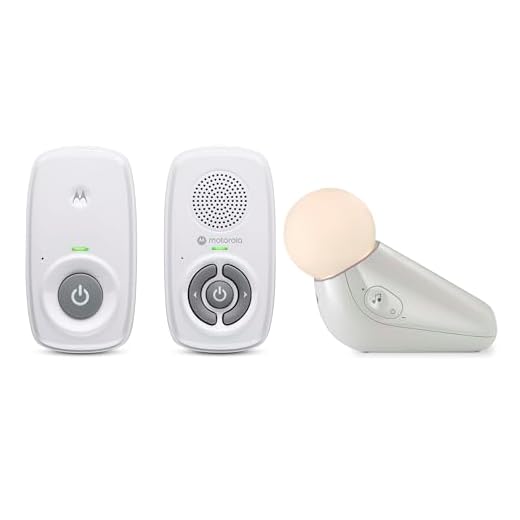
5. Motorola AM21 — Best Budget Audio Baby Monitor
Best for: Tight budgets, grandparents’ homes, backup monitoring, and buyers who only need basic sound transmission.
The Motorola AM21 keeps the concept simple. One baby unit transmits audio to one portable parent unit using a DECT connection.
No Wi-Fi network, smartphone, account, or app is required. Motorola states a maximum range of up to 1,000 feet.
The parent unit includes adjustable volume and can run portably. The design lacks many extras found on the other products here.
That simplicity can be an advantage. If the only requirement is hearing when a child wakes, paying for temperature sensors, multiple rooms, or app connectivity may add no real value.
At $24.99 direct, the AM21 is the least expensive main recommendation in this guide.
Pros
✅ Low $24.99 regular price
✅ No Wi-Fi or app required
✅ DECT audio connection
✅ Straightforward controls
Cons
❌ Very limited feature set
❌ No video or remote app access
❌ No talk-back on the standard AM21 configuration
Skip it if: You want vibration alerts, two-way talk, multiple rooms, or longer portable battery operation.
Alternative: VTech DM1211 adds several useful features for a relatively small price increase.
Audio vs. Video Baby Monitors: Which Should You Choose?
Audio monitors solve a simpler problem. They let you hear activity without requiring a screen or internet connection.
Choose an Audio Monitor If You Want Simplicity
A sound-only monitor is usually less expensive. Setup can be as simple as plugging in the nursery unit and turning on the receiver.
There is also no video feed to check repeatedly. Some parents prefer that approach when hearing cries or movement is enough for their routine.
Choose a Video Monitor If You Need Visual Checks
A camera can help you distinguish between normal sleep movement and a child who actually needs attention.
Video monitors can also add night vision, pan and tilt, multiple camera feeds, smartphone access, and smart alerts.
Those features add cost and complexity. Wi-Fi models also introduce account, network, and privacy considerations.
For those features, use our best baby monitor cameras guide instead of choosing an audio monitor and expecting camera-like capabilities.
What Is DECT on a Baby Monitor?
DECT is a digital wireless technology commonly used for cordless voice communication. Several audio baby monitors use it to connect the nursery unit directly with the parent receiver.
The important difference for buyers is that DECT monitors do not rely on the household Wi-Fi network. They also do not need a smartphone app or cloud account for basic operation.
That makes setup straightforward. It also means the monitor can continue operating if your internet service goes down.
However, avoid treating terms such as “secure” or “private” as proof that any wireless product is literally impossible to intercept. The practical benefit is that these systems avoid an internet-facing camera feed and cloud account.
How Much Baby Monitor Range Do You Really Need?
Manufacturer range figures should be treated as maximums rather than guaranteed indoor performance.
A monitor advertised for 1,500 feet may achieve that distance outdoors with clear line of sight. The same unit can cover far less distance inside a house.
Walls, floors, reinforced concrete, large metal objects, and other electronics can weaken radio signals. Motorola’s own installation guidance specifically warns that environmental conditions can reduce range.
Therefore, consider your layout. A small apartment may need very little range, while a large multi-floor house places more demands on the radio connection.
Two Parent Units vs. Two Baby Units
These sound similar, but they solve completely different problems.
Choose Two Parent Units for Two Caregivers
VTech DM112-2 includes one nursery transmitter and two receivers.
This works well when two adults want independent access or when one receiver stays permanently on another floor.
Choose Two Baby Units for Two Rooms
Motorola PIP15-2 Multi includes two nursery units and one parent receiver.
That is more useful for siblings, separate bedrooms, or a nursery plus another child space.
Choose based on where you need extra hardware, not simply which package contains more pieces.
Do You Need Two-Way Talk?
Two-way talk lets you speak through the nursery unit from the parent receiver.
It may have limited value with a very young baby. However, it can become more useful with toddlers who understand a caregiver’s voice.
It can also save a trip to the room when the goal is simply offering reassurance.
If you never expect to use that feature, a simpler model such as the AM21 may be enough.
Why Visual and Vibration Alerts Can Be Useful
An audio monitor does not have to depend only on its speaker.
VTech’s multi-level LEDs show the amount of detected sound. That can be useful when the receiver is muted or the television is on.
DM1211 also adds a vibration alert. This provides another way to notice activity without increasing the speaker volume.
These features are especially helpful in noisier parts of a home. However, they do not turn an audio monitor into a medical alerting system.
What Makes a Good Travel Baby Monitor?
Travel changes the priorities. Range is still useful, but power and packing become more important.
A conventional baby unit may need to stay plugged into a wall. That can be awkward when a hotel outlet is in the wrong location.
This is why the PIP12 Travel stands out. Both sides can operate from rechargeable batteries, and USB-C simplifies charging.
A dedicated travel monitor also means you can leave the permanent nursery system installed at home.
Baby Monitor Cord Safety: Keep Cords at Least 3 Feet Away
Audio monitors can have the same cord hazard as video baby monitors.
The U.S. Consumer Product Safety Commission says monitor cords should remain at least three feet away from every part of the crib, bassinet, play yard, or other infant sleep space.
Never place a monitor inside the crib or on its edge. Also reconsider placement as a child grows and becomes able to roll, crawl, stand, or reach farther.
Safety rule: Keep every baby-monitor cord at least three feet from the entire sleep space and outside the child’s reach. See CPSC baby-monitor cord guidance.
Motorola’s own monitor instructions also state that a baby monitor is an aid and not a substitute for responsible adult supervision.
Frequently Asked Questions
What is the best audio baby monitor?
VTech DM1211 is our best overall pick. It combines DECT 6.0, strong range, two-way talk, vibration alerts, visual sound indicators, and a rechargeable parent unit at a reasonable price.
Do audio baby monitors need Wi-Fi?
The models in this guide do not. They use dedicated wireless connections such as DECT instead of your home Wi-Fi network.
Is an audio baby monitor enough?
It can be if your main goal is hearing when your baby wakes or cries. Choose video when visual checks, night vision, multiple camera angles, or smartphone access matter to you.
How far does an audio baby monitor work?
It depends on the product and building. Manufacturer figures such as 1,000 or 1,500 feet are maximum stated ranges. Walls, floors, metal, and interference can reduce indoor performance substantially.
Which audio baby monitor is best for travel?
Motorola PIP12 Travel is our travel pick because both units are rechargeable, battery life reaches up to 10 hours, USB-C charging is included, and the system comes with a travel pouch.
Can one audio baby monitor cover two rooms?
Yes, if the system supports multiple baby units. Motorola PIP15-2 Multi includes two nursery units and can monitor both rooms from one parent device.
How far should a baby monitor cord be from the crib?
CPSC says monitor cords should stay at least three feet from every part of the crib or other infant sleep space. Never place the monitor or cord inside the crib.
Can a baby monitor replace adult supervision?
No. Baby monitors are monitoring aids. Manufacturer safety instructions explicitly state that they are not substitutes for responsible adult supervision.
Final Verdict: Which Audio Baby Monitor Should You Buy?
VTech DM1211 is the strongest all-around choice for ordinary home use. It combines useful alerts, two-way talk, a rechargeable receiver, and strong range without adding Wi-Fi or a camera.
Choose Motorola PIP12 Travel when portable power and easy packing matter most. PIP15-2 Multi is the better option for two separate rooms.
VTech DM112-2 makes sense when two caregivers need their own receivers. Finally, Motorola AM21 is the straightforward budget choice when you only need basic audio monitoring.
Quick decision: Choose DM1211 for everyday home use, PIP12 for travel, PIP15-2 for two rooms, DM112-2 for two caregivers, and AM21 when keeping cost and complexity low matters most.
Sources
- VTech — DM1211 and DM112-2 product specifications
- Motorola Nursery — PIP12 Travel, PIP15-2 Multi and AM21 product information
- BabyGearLab — Audio Baby Monitor Testing and Rankings
- Babylist — Best Baby Monitors of 2026
- U.S. Consumer Product Safety Commission — Baby Monitor Cord Safety Guidance
How we research: Discompare reviews current manufacturer specifications, pricing, independent monitor testing, and U.S. safety guidance. We compare connection type, sound features, range, battery design, extra units, portability, and important trade-offs. Manufacturer range figures are treated as maximum stated distances rather than guaranteed indoor coverage. A baby monitor is an aid and does not replace responsible adult supervision. Prices and availability can change. Discompare may earn a commission from eligible retailer or price-comparison links.
Product Groups: VTech DM1211 Audio Baby Monitor, Motorola PIP12 Travel Audio Baby Monitor, Motorola PIP15-2 Multi Audio Baby Monitor, VTech DM112-2 Audio Baby Monitor, Motorola AM21 Audio Baby Monitor