
Best Pressure Washers 2026: Electric, Gas & Cordless Picks
The best pressure washer for most homeowners is the Greenworks GPW3002A. It delivers enough cleaning power for driveways, patios, decks, siding, and other demanding residential jobs without the fuel, noise, exhaust, and engine maintenance of a gas machine. If you regularly clean large areas of heavily stained concrete or need maximum cleaning speed, the Simpson PowerShot PS3228-S is our gas pick. For buyers who want to work away from an electrical outlet, the EGO POWER+ HPW3204-2 is the strongest cordless option in this guide.
Choosing a pressure washer is not as simple as buying the model with the highest PSI. Flow rate, nozzle choice, hose reach, portability, power source, maintenance, and the surface you are cleaning all affect how useful a machine will be. A 3,300-PSI gas washer can save time on neglected concrete, but it can be excessive for routine patio furniture or siding. A compact electric model may be slower yet far easier to store and maintain.
We compared six current pressure washers using manufacturer specifications, current U.S. availability, safety features, warranty information, and reputable independent testing. Discompare did not conduct its own physical pressure-washer testing for this guide.
Quick Answer: The Best Pressure Washers
Best Overall: Greenworks GPW3002A — powerful enough for demanding homeowner jobs without the maintenance of a gas engine.
Best Gas: Simpson PowerShot PS3228-S — 3,300 PSI and 2.5 GPM for large driveways, restoration work, and tougher cleaning.
Best Cordless: EGO POWER+ HPW3204-2 — battery-powered freedom with up to 3,200 PSI at 1.2 GPM.
Best Value: Westinghouse ePX3050 — a compact 2,100-max-PSI electric washer at a much lower MSRP than the premium picks.
Best Portable: Kärcher K1800PS CUBE — only 16.3 pounds without accessories and less than 12 inches tall.
How We Chose the Best Pressure Washers
We focused on the factors that determine how well a pressure washer works in a real household: pressure, water flow, cleaning speed, power source, hose and cord reach, mobility, storage, nozzle selection, electrical protection, warranty, and current U.S. availability.
We also treated maximum specifications carefully. A manufacturer’s highest PSI and highest GPM figures are not always achieved at the same time. For example, Greenworks rates the GPW3002A at 3,000 PSI with 1.1 GPM of flow, while its 2.0-GPM maximum occurs at 100 PSI. Those figures should not be multiplied together as though the washer continuously produces 3,000 PSI at 2.0 GPM.
Independent pressure-washer testing was used to check whether the products make sense for the roles assigned here. Rankings are editorial and are not based on which retailer has the lowest current price.
Best Pressure Washers at a Glance
| Model | Type | Best For | Pressure / Flow | Hose | Weight | Main Trade-Off |
|---|---|---|---|---|---|---|
| Greenworks GPW3002A | Corded electric | Most homeowners | 3,000 PSI at 1.1 GPM; 2.0 GPM at low pressure | 25 ft | About 51 lb in independent testing | Heavy and expensive for an electric |
| Simpson PowerShot PS3228-S | Gas | Heavy-duty cleaning | 3,300 PSI / 2.5 GPM | 25 ft | 77 lb | Noise, fuel, maintenance, and weight |
| EGO POWER+ HPW3204-2 | Cordless battery | Outlet-free cleaning | Up to 3,200 PSI at 1.2 GPM; 2.0 GPM max | High-pressure hose included | 36.2 lb without batteries | High purchase price and finite runtime |
| DEWALT DWPW2600 | Corded electric | Storage and transport | 2,600 max PSI / 1.1 GPM | 25 ft | 27.3 lb | Less cleaning output than larger machines |
| Westinghouse ePX3050 | Corded electric | Value | 2,100 max PSI / 1.76 max GPM; 1,800 rated PSI / 1.2 rated GPM | 20 ft | 17 lb current specification | Slower for large, deeply stained areas |
| Kärcher K1800PS CUBE | Corded electric | Portability | 1,800 PSI / 1.2 GPM | 20 ft | 16.3 lb without accessories | Light-duty output |
Current Prices for Our Top Pressure Washer Picks
Pressure-washer pricing changes frequently, especially around spring and summer promotions. Use the live offers below to compare current U.S. retailer prices rather than relying on temporary sale prices quoted in the article.


1. Greenworks GPW3002A — Best Overall Pressure Washer
Best for: homeowners who want strong cleaning performance without owning and maintaining a gas engine.
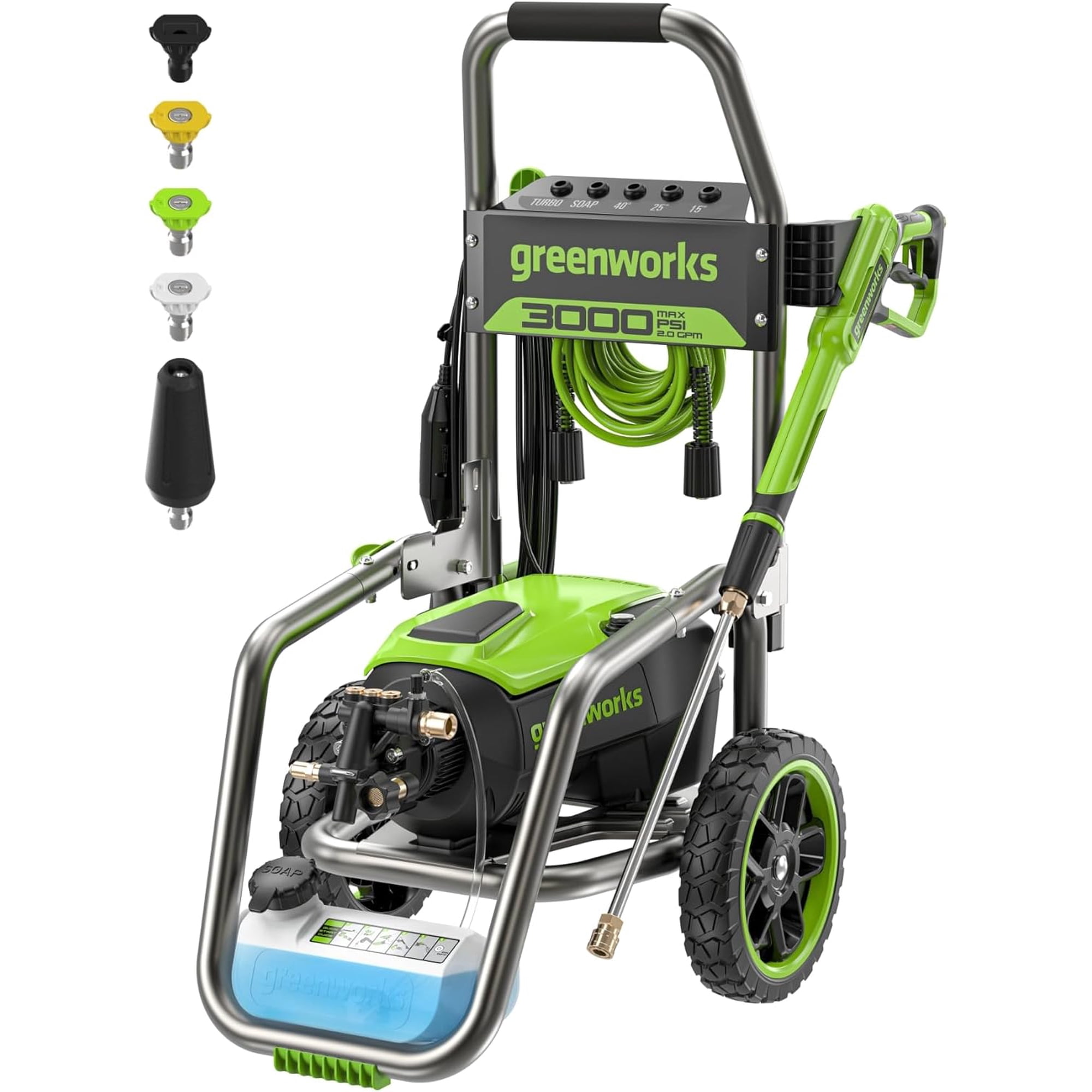
The Greenworks GPW3002A is the best balance of power and convenience in this group. It is a current second-generation 3,000-PSI electric model with a 14-amp brushless motor, five included nozzles, a 25-foot high-pressure hose, and a 35-foot power cord with inline GFCI protection.
Its published performance deserves a closer look. Greenworks specifies 3,000 max PSI at 1.1 GPM, while the washer reaches up to 2.0 GPM at 100 PSI. That still gives it substantial residential cleaning capability, but the figures should not be interpreted as 3,000 PSI and 2.0 GPM occurring simultaneously.
For most homeowners, electric power is an advantage. There is no gasoline to store, no oil-change routine associated with a combustion engine, and no engine exhaust. You connect the garden hose, connect the power cord to a suitable exterior outlet, and start cleaning.
The GPW3002A is not a small electric washer. Independent testing lists it around 51 pounds, so buyers looking for something they can casually lift onto a shelf may prefer the DEWALT or Kärcher. Its manufacturer list price is also much closer to premium territory than entry-level electric washers.
Pros
✅ Strong residential electric performance
✅ Inline GFCI on the 35-foot power cord
✅ Brushless motor and five included nozzles
✅ No gas-engine maintenance
Cons
❌ Heavy for a corded electric washer
❌ Premium manufacturer pricing
❌ Still requires access to both water and an electrical outlet
Who should skip it: buyers with very limited storage space or homeowners who need maximum cleaning speed over large areas of neglected concrete.
Alternative: choose the Simpson PS3228-S for heavier work or the Westinghouse ePX3050 for lower-cost routine cleaning.
Professional-grade, eco-friendly, powerful portable washer
2. Simpson PowerShot PS3228-S — Best Gas Pressure Washer
Best for: large driveways, heavily stained hard surfaces, restoration work, and users who value cleaning speed over convenience.
The Simpson PowerShot PS3228-S is the machine to choose when an electric washer would do the job but take longer. Its Honda GX200 engine drives an AAA triplex pump rated at 3,300 PSI and 2.5 GPM, giving it both pressure and water volume for demanding cleaning.
That 2.5-GPM flow is particularly important on large jobs because cleaning performance is not determined by PSI alone. Once dirt has been loosened, water flow helps move material away and cover more surface area. This is why a strong gas unit can make sense for long driveways, concrete pads, commercial-style property maintenance, and restoration work.
The trade-offs are equally clear. The PS3228-S weighs 77 pounds and requires gasoline, engine maintenance, more storage space, and more noise tolerance than an electric model. Gas pressure washers must also never be operated indoors or in enclosed spaces because their engines produce carbon monoxide.
Simpson lists a three-year limited commercial engine warranty, five-year limited pump warranty, and ten-year limited frame warranty for this model. The current PS3228-S is a 49-state configuration and is not offered for sale in California.
Pros
✅ 3,300 PSI and 2.5 GPM
✅ Honda GX200 engine
✅ AAA triplex pump
✅ Excellent fit for large and demanding cleaning jobs
Cons
❌ 77-pound weight
❌ Fuel, noise, exhaust, and engine maintenance
❌ No built-in detergent tank
❌ Current PS3228-S is not sold in California
Who should skip it: anyone who mainly cleans outdoor furniture, small patios, vehicles, or occasional sections of siding.
Alternative: Greenworks GPW3002A provides strong homeowner performance with substantially simpler ownership.
A professional-grade, gas-powered cold-water pressure washer built for contractors and heavy-duty cleaning (decks, driveways, siding, fencing, equipment, graffiti). 49-state compliant — not for sale in California.
Suitable for heavy cleaning tasks from stripping paint to vehicle washing.
3. EGO POWER+ HPW3204-2 — Best Cordless Pressure Washer
Best for: homeowners who want serious cleaning capability without being tethered to an electrical outlet.
The EGO POWER+ HPW3204-2 shows how far cordless pressure washers have progressed. EGO rates it for up to 3,200 PSI at 1.2 GPM, with a 2.0-GPM maximum under a different flow configuration. The kit includes two 56V 6.0Ah batteries and a charger.
EGO claims up to 60 minutes of runtime using the two included 6.0Ah batteries. Eco, High, and Turbo modes allow the operator to trade cleaning output against runtime, while the wand-integrated display shows mode and battery information.
Its most useful feature may be flexibility rather than maximum pressure. The HPW3204-2 can connect to a garden hose or draw water from a suitable freshwater source through its included siphon hose. That makes it useful for cleaning in areas where neither a nearby faucet nor a convenient electrical outlet is available.
There is a substantial price premium for that freedom. The tool weighs 36.2 pounds before batteries, and runtime still limits very long cleaning sessions. If you already have an outlet close to every area you clean, the Greenworks offers a more straightforward ownership proposition.
Pros
✅ Up to 3,200 PSI at 1.2 GPM
✅ No power cord
✅ Up to 60 minutes claimed runtime with included batteries
✅ Can siphon from an appropriate freshwater source
Cons
❌ Expensive compared with corded electric models
❌ Runtime depends on battery capacity and operating mode
❌ Heavy once two batteries are installed
Who should skip it: budget-focused buyers and anyone who always cleans within easy reach of an exterior outlet.
Alternative: Greenworks GPW3002A if a cord is not a practical limitation.
- Power: Up to 3200 PSI using the combined power of two 56V ARC Lithium batteries; flow up to 1.2 GPM (typical) and up to 2.0 GPM max.
- Battery & runtime: Includes 6.0 Ah batteries; single charge provides up to 60 minutes of runtime. Works with all EGO 56V ARC batteries and the included batteries are compatible with other EGO tools.
- Modes & controls: Wand-integrated display with battery charge status; selectable ECO, High, and Turbo cleaning modes.
- Cordless portability: Connects to a garden hose or draws from any fresh water source with the included siphon hose.
- Setup & transport: Quick-connect hose and wand fittings for fast setup/breakdown; telescopic handle for easy transport and compact storage.
- Included accessories: Flexible high-pressure hose, siphon hose, quick-connect short pressure washer gun, quick-connect wand lance, stainless-steel wand, foam cannon, and filter.
- Nozzles: 15°, 25°, 40°, turbo nozzle, and rinse nozzle included.
- Warranty: 5-year tool warranty and 3-year battery warranty.
4. DEWALT DWPW2600 — Best for Storage and Transport
Best for: homeowners who want a capable electric washer that is easier to carry, transport, and store than a full-size upright cart.
The DEWALT DWPW2600 is built around a compact roll-cage-style body rather than the traditional tall pressure-washer layout. DEWALT rates it at 2,600 max PSI and 1.1 GPM, with a 13-amp motor and a weight of 27.3 pounds.
The design is the main reason to buy it. The frame can be stored vertically or horizontally, the wand and accessories fit inside the body, and the pressure hose stores beneath the handle. DEWALT includes a 25-foot kink-resistant hose, 35-foot power cord, foam cannon, and four nozzles.
That makes the DWPW2600 easier to fit into a crowded garage, workshop shelf, vehicle, or storage room than large upright washers. It is powerful enough for many residential surfaces without pretending to compete with the Simpson on high-volume heavy cleaning.
Pros
✅ Compact, stackable design
✅ Only 27.3 pounds
✅ Integrated accessory storage
✅ Three-year limited warranty
Cons
❌ Lower flow than heavy-duty gas models
❌ More expensive than entry-level electric washers
❌ Small wheels are less useful on rough terrain than large pneumatic tires
Who should skip it: buyers whose main priority is the fastest possible cleaning of large concrete areas.
Alternative: Kärcher K1800PS CUBE if portability matters more than maximum output.
A portable, cordless pressure washer (DEWALT 20V Max) that delivers cleaning power equivalent to 10× a garden hose. Designed for jobsite or home use, it can draw water from any fresh-water source using the included suction hose when a garden hose isn’t available, and can also be connected to a garden hose. Ideal for mobile cleaning where conventional water access is limited.
5. Westinghouse ePX3050 — Best Value Pressure Washer
Best for: occasional household cleaning where low purchase cost and compact size matter more than maximum cleaning speed.
The Westinghouse ePX3050 offers a much lower entry point than the premium models. Its current manufacturer page lists a $199 MSRP and specifies 2,100 max PSI and 1.76 max GPM, with more representative rated figures of 1,800 PSI and 1.2 GPM.
Those rated figures illustrate why pressure-washer specifications require context. The largest number printed on the box does not describe every operating condition. Even so, the ePX3050 has enough output for many routine patio, fence, outdoor furniture, walkway, and similar household jobs.
It includes a 35-foot GFCI-equipped power cord, 20-foot high-pressure hose, detergent capability, and three quick-connect nozzles. The current manufacturer specification lists a 17-pound dry weight, making it much easier to move than the Greenworks or Simpson.
The compromise is time. Large areas of deeply stained concrete will generally favor a machine with more sustained pressure and flow.
Pros
✅ Affordable manufacturer MSRP
✅ Compact and lightweight
✅ 35-foot GFCI-equipped power cord
✅ Enough performance for many routine home-cleaning jobs
Cons
❌ Rated performance is lower than the maximum headline figures
❌ Slower on large or heavily stained surfaces
❌ 20-foot hose provides less reach than some larger models
Who should skip it: homeowners who routinely clean large driveways, commercial areas, or heavily weathered concrete.
Alternative: Greenworks GPW3002A for a significant step up in electric cleaning capability.
6. Kärcher K1800PS CUBE — Best Portable Pressure Washer
Best for: small homes, limited garage storage, and lighter cleaning jobs where easy carrying matters.
The Kärcher K1800PS CUBE takes the opposite approach from a large gas washer. It produces 1,800 PSI at 1.2 GPM, weighs 16.3 pounds without accessories, and stands only 11.8 inches high.
Its cube-shaped body contains a storage bin for the hose, cord, and accessories, while a removable detergent tank and foot-operated power switch make setup straightforward. Kärcher also uses standard quick-connect nozzles and M22 hose connections rather than locking owners into unusual proprietary accessories.
This is not the machine to buy for restoring a long neglected driveway. Its value comes from being easy to carry, easy to store, and powerful enough for typical light-to-medium outdoor cleaning. Kärcher backs it with a two-year bumper-to-bumper warranty and Rapid Exchange Program.
Pros
✅ Only 16.3 pounds without accessories
✅ Very compact storage footprint
✅ Integrated accessory bin and detergent tank
✅ Standard quick-connect and M22 compatibility
Cons
❌ 1,800 PSI and 1.2 GPM are intended for lighter jobs
❌ Only a 20-foot pressure hose
❌ Not a practical substitute for a heavy-duty gas washer
Who should skip it: anyone buying primarily for large concrete areas or major restoration work.
Alternative: DEWALT DWPW2600 for more pressure while retaining a storage-friendly design.
A compact, CETA-certified electric pressure washer delivering 1,800 PSI TruPressure and 1.2 GPM for effective, trustworthy cleaning in a lightweight cube form.
Key features
- Performance: 1,800 PSI (TruPressure) and 1.2 GPM; independently tested and CETA certified.
- Nozzles: Includes three tips — 15°, turbo, and 65° — for a range of cleaning tasks.
- Easy operation: On/off foot switch for convenient power control without bending.
- Portability: Lightweight, compact cube design for easy carrying and storage.
- Detergent tank: 0.3 gallon detachable detergent reservoir for soap use.
- Typical uses: Pavement, patios, decks, cars, homes, fencing, and similar surfaces.
Pressure Washers We Considered but Did Not Select
Ryobi electric pressure washers: Ryobi continues to offer competitive homeowner models, including newer brushless machines, but the Greenworks GPW3002A has a clearer role as the high-output electric recommendation in this guide. If you specifically want the brand, see our Ryobi electric pressure washer guide.
Sun Joe SPX3000: this long-running electric model remains widely available and useful for lighter residential work, but newer competitors now offer stronger performance, newer designs, or clearer value propositions.
Craftsman CMEPW1900: current independent testing continues to show it as a useful budget electric option, but the Westinghouse ePX3050 fills the value role here with a compact current specification set.
Westinghouse WPX3400: its 3,400-PSI, 2.6-GPM specification makes it interesting for heavy-duty work, but current independent testing is still being updated. We prefer the established Simpson recommendation until more comparable test evidence is available.
Electric vs Gas vs Cordless Pressure Washers
For most homeowners, the power source is the first decision to make. Electric machines are usually easier to own, gas machines are generally better suited to sustained heavy cleaning, and battery-powered models trade higher cost and limited runtime for freedom from an outlet.
| Type | Best For | Advantages | Drawbacks |
|---|---|---|---|
| Corded Electric | Typical household cleaning | Low maintenance, no fuel, easier starting, generally quieter | Requires suitable outlet and power cord |
| Gas | Large driveways and demanding jobs | High pressure and flow, fast large-area cleaning | Noise, exhaust, fuel, engine maintenance, weight |
| Cordless Battery | Locations without convenient outlets | Cord-free operation and flexible placement | Higher price, battery weight, limited runtime |
If you are updating several areas of your home rather than buying one outdoor tool, our guide to popular home and garden appliances covers additional categories.
How Much PSI and GPM Do You Actually Need?
PSI measures water pressure. GPM measures how much water the machine moves. Both matter, but neither should be treated as a universal score.
High pressure helps break contaminants loose. Higher water flow can rinse debris away and clean a wider area more quickly. The correct combination depends on the surface, nozzle, working distance, detergent, and level of dirt.
Cars and Painted Vehicles
A pressure washer is not automatically the safest tool for automotive paint. Consumer Reports advises against pressure-washing cars because concentrated water can damage paint and potentially expose metal to corrosion.
If a vehicle or equipment manufacturer specifically permits pressure washing, follow its instructions, keep a safe distance, use a wide spray pattern, and use the lowest effective pressure. There is no single PSI number that can be declared safe for every paint system, trim piece, seal, wheel, and vehicle.
Decks and Fences
Wood can be scarred or splintered by excessive pressure or by holding the nozzle too close. Start with a wide spray pattern, test an inconspicuous area, and let detergent and dwell time do part of the work rather than immediately increasing pressure.
Siding
Siding requires restraint because high-pressure water can enter behind panels or damage more fragile materials. Consumer Reports notes that some siding types, including shingles, should not be pressure washed. Follow the siding manufacturer’s cleaning instructions first.
Driveways and Concrete
Concrete is where a higher-output machine is easiest to justify. Larger driveways and deeply embedded stains benefit from both pressure and water flow, especially when paired with an appropriate surface-cleaner attachment.
A premium electric pressure washer can handle many residential concrete jobs. Gas becomes more attractive as the area grows or when completing the job quickly is important.
Heavy Restoration and Paint Preparation
These jobs are where a machine such as the Simpson PS3228-S makes the most sense. High flow and sustained pressure can reduce working time, but surface damage becomes easier as output rises. Follow the coating, substrate, and pressure-washer manufacturer’s preparation instructions rather than assuming maximum pressure is appropriate.
Pressure Washer Safety
Pressure washers can cause serious injury. Never aim the spray at a person or animal, do not use a gas-powered pressure washer indoors, and verify that an electric model has the required electrical protection before use.
Electrical safety deserves particular attention. The U.S. Consumer Product Safety Commission issued multiple pressure-washer recalls and warnings during 2026 involving electric units that lacked integral ground-fault circuit-interrupter protection. Some recalls also cited power cords that were too short, potentially encouraging unsafe extension-cord use.
Before buying an electric pressure washer, check the product documentation and plug assembly for the required protection rather than assuming every inexpensive online model meets the same standard.
Avoid Zero-Degree Spray Tips
Consumer Reports recommends against using zero-degree pressure-washer nozzles. A zero-degree tip concentrates the stream into a pinpoint and can penetrate skin, damage protective footwear, and cause unnecessary property damage. A wider nozzle can perform the work with less concentrated force, even if cleaning takes longer.
Follow These Basic Safety Practices
- Never point the wand at people, animals, electrical equipment, or the pressure washer itself.
- Wear eye protection, closed-toe footwear, and other protective equipment appropriate to the job.
- Never operate a gasoline engine indoors, in a garage, or in another enclosed space.
- Keep electrical connections away from standing water.
- Relieve pressure and shut down the machine before servicing it or changing attachments.
- Use only detergents approved for your machine and intended surface.
- Do not use a ladder while controlling a high-pressure spray wand.
- Read the manufacturer’s operating and surface-safety instructions before starting.
What to Look for When Buying a Pressure Washer
PSI and GPM
Do not compare PSI without checking flow. Also check whether published maximum PSI and GPM figures occur under the same operating conditions. Rated or pressure-specific flow information is more useful than combining unrelated maximum numbers.
Motor or Engine Type
An electric motor requires less routine maintenance and makes sense for most residential buyers. Gas engines make more sense for sustained heavy workloads where increased cleaning speed offsets extra maintenance. Battery models work best when mobility has real value.
Hose and Cord Length
A longer pressure hose increases the area you can clean without moving the machine. With corded electric models, also look at power-cord length and integrated GFCI protection.
Nozzle Selection
Different spray angles change how concentrated the water stream is. Wide-angle tips are appropriate for more delicate cleaning, while narrower tips increase cleaning intensity. Avoid zero-degree tips for normal homeowner use because of the injury and damage risk.
Detergent System
Soap can reduce how much mechanical pressure is needed to remove organic dirt, vehicle grime, and other contaminants. Check whether the washer has a tank, foam cannon, downstream injection, or another manufacturer-approved method for applying detergent.
Wheels, Weight, and Storage
A 77-pound gas washer behaves very differently from a 16-pound cube-shaped electric model. Consider stairs, lawn terrain, garage space, shelving, and whether the unit needs to travel in a vehicle.
Warranty and Service
Pressure washers combine pumps, motors or engines, hoses, seals, electrical components, and fittings. Warranty coverage and access to replacement parts can matter more than receiving one additional nozzle in the box.
Surface-Cleaner Compatibility
A suitable surface cleaner can make large patios and driveways faster to clean and can produce more even results than repeatedly sweeping a narrow spray wand across concrete. Check fitting size, pressure limits, and flow requirements before buying an accessory.
Frequently Asked Questions
What is the best pressure washer for most homeowners?
The Greenworks GPW3002A is our best overall choice because it provides strong residential cleaning performance without requiring gasoline or gas-engine maintenance. Buyers with lighter cleaning needs can save money with a smaller electric model.
Is an electric or gas pressure washer better?
Electric is better for most homeowners because it is easier to start, maintain, and store. Gas is better when you regularly clean large or heavily soiled areas and the faster cleaning provided by higher sustained pressure and flow justifies the added noise, fuel, maintenance, and weight.
How much PSI do I need for a driveway?
There is no single required PSI for every driveway. Concrete condition, stains, nozzle, detergent, surface-cleaner attachment, flow rate, and working distance all matter. Higher-output machines can clean large or neglected concrete faster, but maximum pressure should not be used automatically.
What PSI is safe for washing a car?
There is no universal PSI that is safe for every vehicle. Consumer Reports advises against pressure-washing cars because high-pressure water can damage paint. If the vehicle manufacturer allows pressure washing, follow its instructions and use a wide spray, appropriate distance, and the lowest effective pressure.
Is 3,000 PSI too powerful for a house?
A machine capable of 3,000 PSI can still be used at lower effective pressure with the correct nozzle, distance, and settings, but some siding and building materials should not be pressure washed at all. Follow the surface manufacturer’s cleaning instructions before using a pressure washer on a house.
What is the difference between PSI and GPM?
PSI measures water pressure, while GPM measures water flow. Pressure helps break dirt loose; flow helps rinse debris away and cover area. Both influence cleaning performance, and the highest published PSI and GPM may not occur simultaneously.
What is the difference between a pressure washer and a power washer?
The terms are often used interchangeably in everyday shopping, but technically a pressure washer normally uses pressurized cold water, while a power washer adds heated water. Hot-water equipment is more common in specialized or commercial cleaning applications.
Final Verdict: Which Pressure Washer Should You Buy?
Greenworks GPW3002A is the best pressure washer for most homeowners. It provides substantially more capability than entry-level electric models while avoiding the fuel, exhaust, starting procedure, and engine maintenance associated with gas.
The Simpson PowerShot PS3228-S remains the better tool when you routinely face large, demanding jobs and cleaning speed matters enough to justify gas ownership. EGO HPW3204-2 is the premium cordless choice when outlet-free operation is genuinely useful rather than merely convenient.
DEWALT DWPW2600 is easier to transport and store, Westinghouse ePX3050 provides a lower-cost route into useful homeowner pressure washing, and Kärcher K1800PS CUBE is the best fit for buyers who prioritize portability and small-space storage.
Whichever model you choose, match the pressure, nozzle, and detergent to the surface rather than automatically using the machine’s maximum setting. The right pressure washer is the one that cleans effectively without creating unnecessary maintenance, safety risk, or surface damage.
Best Overall: Greenworks GPW3002A
Best Gas: Simpson PowerShot PS3228-S
Best Cordless: EGO POWER+ HPW3204-2
Best Value: Westinghouse ePX3050
Best Portable: Kärcher K1800PS CUBE
Sources
- Consumer Reports — Best Electric and Battery-Powered Pressure Washers of 2026 — 2026
- Greenworks — GPW3002A product specifications and warranty information
- Simpson — PowerShot PS3228-S product specifications and warranty information
- EGO — HPW3204-2 product specifications and battery information
- U.S. Consumer Product Safety Commission — Pressure washer recalls and electrical-safety notices — 2026
Product Groups: Greenworks GPW3002A, Simpson PowerShot PS3228-S, EGO POWER+ HPW3204-2, DEWALT DWPW2600, Westinghouse ePX3050, Karcher K1800PS Cube