DeWalt vs Milwaukee is one of the hardest power-tool comparisons because both brands now offer large cordless ecosystems, high-output batteries, compact tools, jobsite equipment, and professional-grade flagship models.
For 2026, Milwaukee is our narrow overall winner for professionals starting a cordless platform from scratch. Its M18 and M12 systems are especially strong for trade-specific and compact tools, while many Milwaukee power tools also carry longer warranty coverage.
DeWalt still wins important categories. Its DCD1007 hammer drill has outstanding heavy-load performance, FLEXVOLT gives the platform a distinct high-voltage expansion path, and the 20V MAX range now covers hundreds of compatible products.
If you already own several healthy DeWalt or Milwaukee batteries, however, switching brands may cost more than the performance difference is worth. Battery ownership should be part of the decision.
Quick Answer: DeWalt vs Milwaukee
Best overall ecosystem: Milwaukee wins by a narrow margin thanks to the depth of M18 and M12, strong trade-specific tools, competitive flagship performance, and generally longer tool warranties.
Best heavy-duty hammer drill: DeWalt DCD1007 wins our drill matchup after edging Milwaukee’s 2904 in recent independent application testing.
Best impact driver: Milwaukee M18 FUEL 2953 is shorter and lighter than DeWalt DCF860 and won the direct speed comparison we reviewed.
Best circular saw: Milwaukee 2834 wins for cutting performance, while DeWalt DCS590 remains attractive if lower weight and ergonomics matter more.
Best high-voltage expansion: DeWalt FLEXVOLT gives buyers a clear route from 20V MAX into 60V MAX tools while retaining battery compatibility in supported tools.
How We Compared DeWalt and Milwaukee
We compared the brands as cordless ecosystems rather than judging them from a single drill or saw.
Our criteria include battery compatibility, current platform size, flagship tool performance, compact-tool depth, high-demand tools, warranty terms, ergonomics, trade-specific options, advanced batteries, and long-term platform value.
We also used recent direct application tests where possible. Manufacturer torque and power claims are useful, but different brands do not necessarily measure those figures in identical ways.
That is why a tool with the larger published torque number does not automatically win a real driving or cutting test.
DeWalt vs Milwaukee at a Glance
| Category | DeWalt | Milwaukee | Edge |
|---|---|---|---|
| Main cordless platform | 20V MAX, 300+ products | M18, 275+ solutions | Tie |
| Compact ecosystem | 12V MAX XTREME | M12, 150+ solutions | Milwaukee |
| High-voltage expansion | 20V/60V FLEXVOLT | M18 high-output / FORGE architecture | DeWalt |
| Hammer drill matchup | DCD1007 | M18 FUEL 2904 | DeWalt |
| Impact driver matchup | DCF860 | M18 FUEL 2953 | Milwaukee |
| Circular saw matchup | DCS590 | M18 FUEL 2834 | Milwaukee |
| Typical tool warranty | 3 years on many power tools | 5 years on many portable power tools | Milwaukee |
| Best existing-platform choice | Stay DeWalt if invested | Stay Milwaukee if invested | Depends |
DeWalt 20V MAX vs Milwaukee M18
These are the two core professional cordless platforms.
One common mistake is assuming DeWalt’s 20V MAX label means it operates in a higher voltage class than Milwaukee M18.
It does not.
DeWalt states that 20V MAX batteries measure up to 20 volts at maximum initial charge and operate at 18 volts nominally. Therefore, DeWalt 20V MAX and Milwaukee M18 belong to the same nominal voltage class.
DeWalt 20V MAX
DeWalt currently advertises more than 300 products in its 20V MAX system.
The platform spans drills, impact tools, saws, grinders, nailers, lighting, outdoor equipment, dust-control tools, and specialty construction equipment.
Its biggest ecosystem advantage is how easily FLEXVOLT batteries can cross back into supported 20V MAX tools.
Milwaukee M18
Milwaukee’s current system spans more than 275 M18 solutions.
The line is particularly deep in trade-focused tools, including plumbing, electrical, mechanical, metalworking, fastening, cutting, outdoor equipment, and jobsite accessories.
All M18 batteries are designed to work with M18 tools and chargers, although high-demand tools perform best with batteries capable of supplying higher power.
Verdict: Tie
Both main systems are large enough to support a professional fleet.
The more meaningful difference is what sits around them: Milwaukee’s M12 range and DeWalt’s FLEXVOLT range.
DeWalt FLEXVOLT vs Milwaukee M18 FORGE
These systems solve high-demand cordless work in different ways.
DeWalt FLEXVOLT Changes Voltage
FLEXVOLT batteries automatically change operating voltage depending on the compatible tool.
The same battery can power supported 20V MAX tools and higher-voltage 60V MAX tools.
This gives DeWalt a distinct high-voltage platform for larger saws, grinders, rotary hammers, outdoor equipment, and other demanding applications.
A standard 20V MAX battery cannot simply run a 60V FLEXVOLT tool, however. The compatibility advantage works through FLEXVOLT batteries.
Milwaukee Keeps High-Demand Tools Inside M18
Milwaukee has continued increasing output from the M18 architecture rather than creating a separate handheld 60V class.
Its REDLITHIUM FORGE batteries provide the highest-performing battery tier within M18.
The FORGE XC8.0, for example, is designed for high-output applications while remaining compatible with the wider M18 system.
Verdict: DeWalt for High-Voltage Expansion
Milwaukee’s approach keeps battery compatibility simple across M18.
DeWalt gets the edge when buyers specifically want a battery that bridges conventional 20V tools and higher-voltage 60V equipment.
Milwaukee M12 vs DeWalt 12V MAX
This is one of Milwaukee’s clearest ecosystem advantages.
DeWalt’s 12V MAX XTREME tools are compact and useful for tight spaces, overhead work, drilling, fastening, cutting, and light mechanical tasks.
Milwaukee M12 goes considerably deeper.
The current M12 system includes more than 150 solutions, covering compact drills and impacts as well as ratchets, rivet tools, inspection tools, specialty plumbing tools, lighting, cutting tools, and other trade-specific products.
Why M12 Matters
A compact tool is not simply a weaker version of an 18V tool.
For electricians, plumbers, HVAC technicians, mechanics, and maintenance teams, a smaller platform can provide tools designed around confined spaces and repetitive one-handed use.
Verdict: Milwaukee
DeWalt 12V MAX is capable.
Milwaukee’s M12 breadth makes the stronger case if compact and specialty tools are central to your work.
Hammer Drill: DeWalt DCD1007 vs Milwaukee M18 FUEL 2904
This is the matchup where DeWalt takes a clear category win.
DeWalt DCD1007
The DCD1007 is a 3-speed XR hammer drill with an all-metal transmission and anti-rotation technology.
DeWalt publishes a maximum rated brake torque figure of 2,100 in-lb.
That number should not be directly treated as equivalent to Milwaukee’s torque specification because cross-brand test methods can differ.
The more useful evidence comes from application testing.
In a 2026 Pro Tool Reviews head-to-head, the DCD1007 finished ahead across the tested structural screw, spade-bit, self-feed, and concrete-drilling workloads.
DeWalt DCD1007 Pros
✅ Excellent heavy-load drilling performance
✅ 3-speed transmission
✅ Anti-rotation system
✅ Strong choice for large bits and demanding drilling
DeWalt DCD1007 Cons
❌ Larger than Milwaukee’s 2904
❌ Heavier for overhead or repetitive drilling
❌ Maximum torque claims should not be compared across brands in isolation

Milwaukee M18 FUEL 2904
Milwaukee’s 2904 is a more compact hammer drill with up to 2,100 RPM and a published 1,400 in-lb torque rating.
Its 7-inch head length gives it an advantage when working between framing, inside cabinets, and in other tight spaces.
Milwaukee also uses AutoStop control to shut the drill down when the system detects potentially dangerous bind-up rotation.
Milwaukee 2904 Pros
✅ Compact 7-inch head
✅ Lighter and easier to handle
✅ AutoStop bind-up control
✅ Excellent professional drilling capability
Milwaukee 2904 Cons
❌ Fell slightly behind DeWalt in the reviewed heavy-load tests
❌ Less appealing if maximum drilling speed under load is the priority
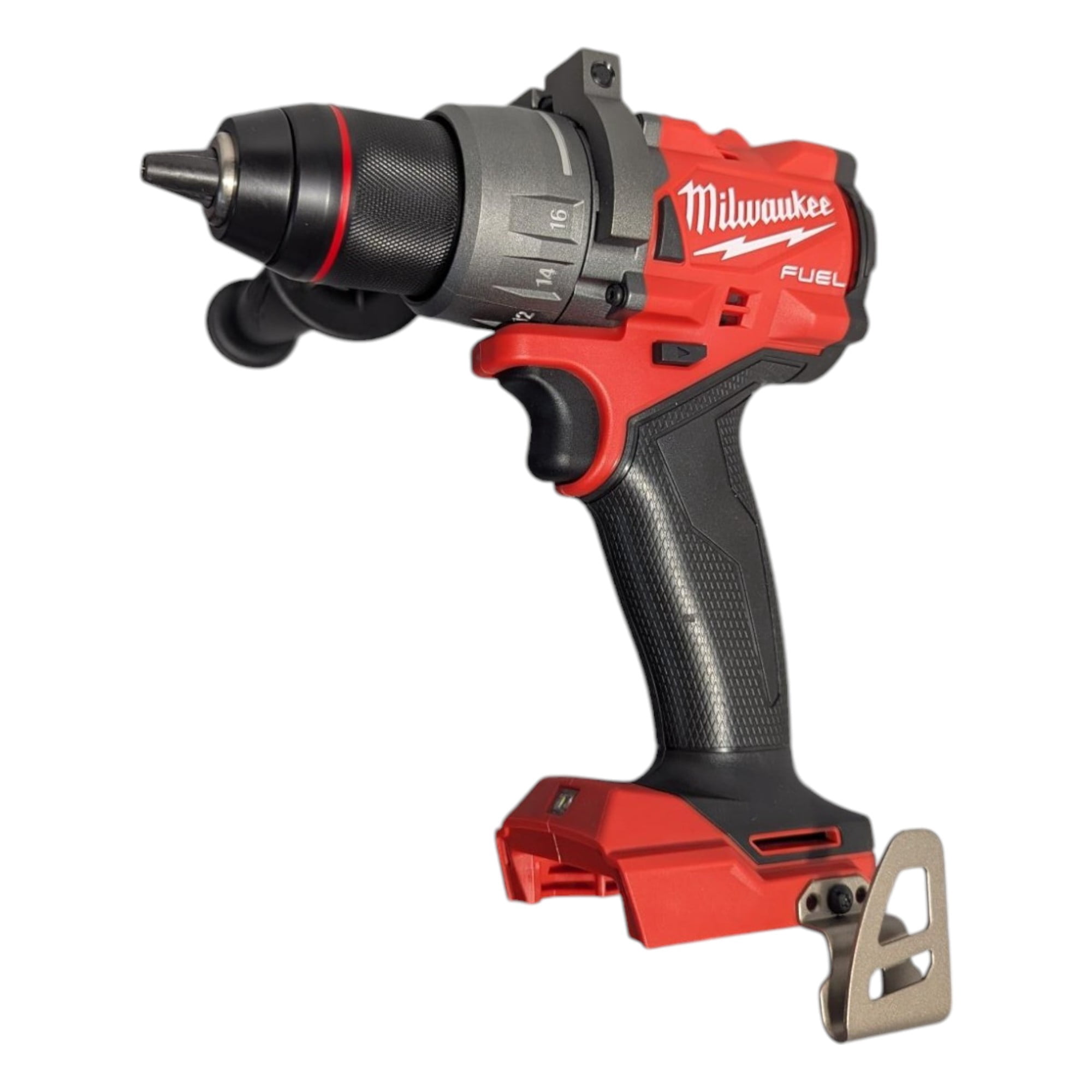
Hammer drill winner: DeWalt DCD1007. Milwaukee is easier to handle, but DeWalt earns the category win for tested heavy-load performance.
Impact Driver: DeWalt DCF860 vs Milwaukee M18 FUEL 2953
The result reverses in the impact-driver matchup.
DeWalt DCF860
DeWalt rates the DCF860 for up to 2,500 in-lb of maximum torque and 3,800 RPM.
It uses three speed settings, a variable trigger, and nine built-in LEDs.
On paper, that published torque number is higher than Milwaukee’s 2953.
But application testing shows why specification sheets should not decide the comparison by themselves.
DeWalt DCF860 Pros
✅ High published 2,500 in-lb torque rating
✅ 3-speed control
✅ Nine LEDs and work-light mode
✅ Strong high-load capability
DeWalt DCF860 Cons
❌ Longer and heavier than Milwaukee 2953
❌ Lost the direct speed comparison despite the higher published torque figure
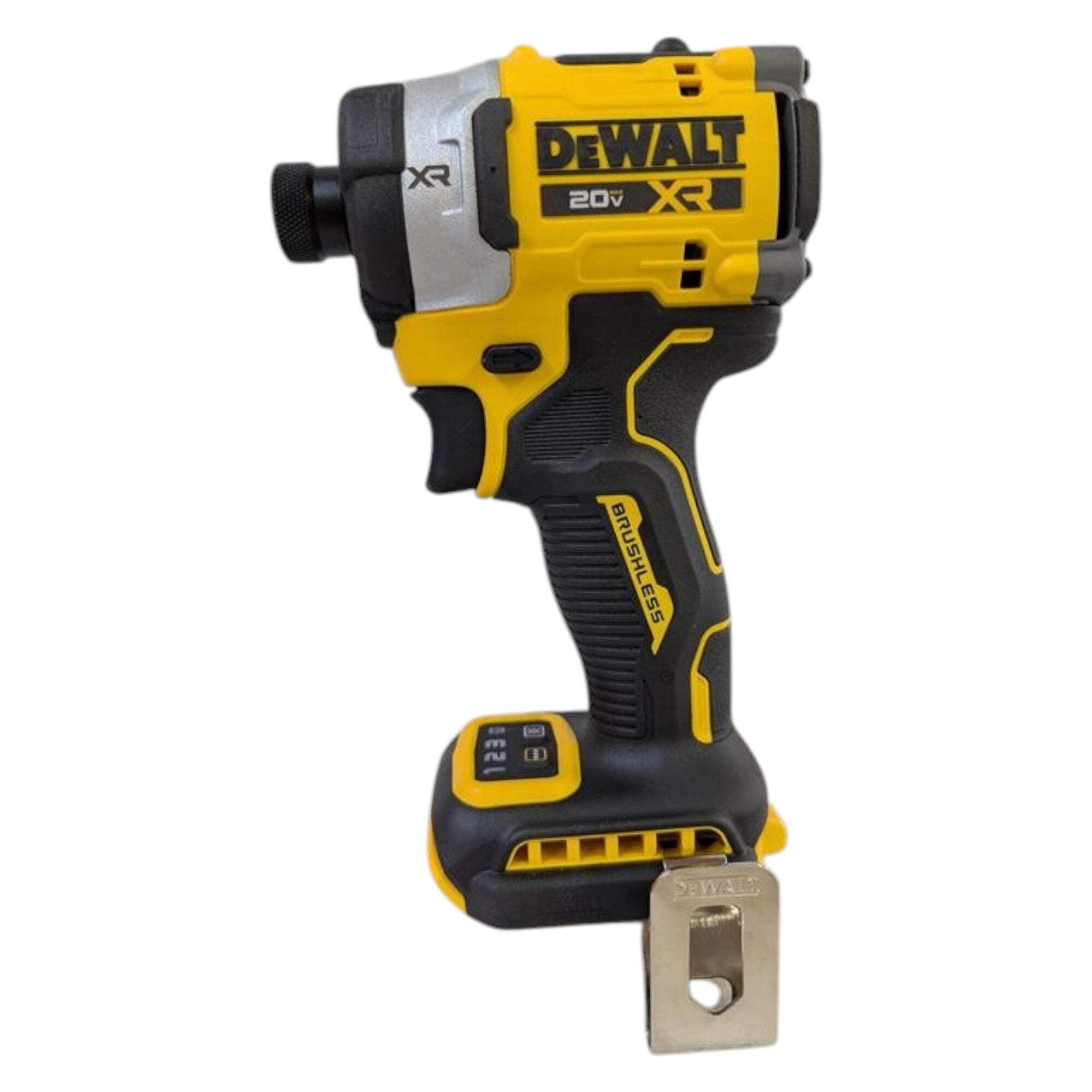
Milwaukee M18 FUEL 2953
Milwaukee rates the 2953 at 2,000 in-lb and up to 3,900 RPM.
Its head measures about 4.47 inches, while bare weight is about 2.2 pounds.
The driver also provides four-mode control, including a self-tapping screw mode.
In the direct Pro Tool Reviews comparison, Milwaukee completed the structural-screw, bolt-break, and lag-bolt tests faster than the DCF860.
That makes it a useful example of why real application speed matters more than simply choosing the largest torque number.
Milwaukee 2953 Pros
✅ Very compact 4.47-inch head
✅ 2.2-lb bare-tool weight
✅ Up to 3,900 RPM
✅ Won the reviewed direct speed tests
Milwaukee 2953 Cons
❌ Lower published torque figure than DeWalt
❌ Extreme heavy-load performance can vary by application and battery

Impact driver winner: Milwaukee 2953. It is shorter, lighter, and faster in the direct head-to-head testing we reviewed.
Circular Saw: DeWalt DCS590 vs Milwaukee M18 FUEL 2834
Both saws are professional 7-1/4-inch sidewinders, but their strengths are different.
DeWalt DCS590
The DCS590 runs up to 5,500 RPM and cuts up to 2-9/16 inches at 90 degrees.
It includes a 57-degree bevel capacity, electronic brake, LED, rafter hook, and optional dust-port compatibility.
DeWalt also makes the tool compatible with its Tool Connect chip-ready asset-management system.
In the direct comparison we reviewed, DeWalt scored better for size, weight, ergonomics, and price.
DeWalt DCS590 Pros
✅ Lighter handling in direct comparison
✅ Strong ergonomics
✅ 57-degree bevel capacity
✅ Competitive kit value
DeWalt DCS590 Cons
❌ Lower no-load RPM than Milwaukee 2834
❌ Milwaukee performed better in the reviewed cutting tests

Milwaukee M18 FUEL 2834
The 2834 runs at up to 6,000 RPM and has a maximum 2-5/8-inch cutting depth at 90 degrees.
Milwaukee uses magnesium guards and shoe construction, an electric brake, dust port, LED, and rafter hook.
Its performance is the main reason it wins here.
In the direct comparison against DCS590, Milwaukee took the cutting-power advantage and handled the compound-cut test better.
It also finished first overall in Pro Tool Reviews’ broader 2026 cordless circular-saw comparison.
Milwaukee 2834 Pros
✅ Up to 6,000 RPM
✅ 2-5/8-inch maximum cut depth
✅ Excellent guard action and shoe movement
✅ Outstanding independent 2026 test performance
Milwaukee 2834 Cons
❌ Heavier than DeWalt in the direct comparison
❌ DeWalt may feel better for users who prioritize handling over maximum cut speed

Circular saw winner: Milwaukee 2834. DeWalt wins on handling and value in the direct comparison, but Milwaukee takes the overall performance edge.
Which Brand Has the Better Batteries?
Both companies now offer several battery tiers rather than one standard pack.
DeWalt POWERSTACK
DeWalt POWERSTACK batteries use pouch-cell technology to provide high output in compact battery formats.
They can be especially useful where reducing tool bulk matters.
DeWalt POWERPACK
The newer XR POWERPACK line uses tabless cylindrical-cell technology.
DeWalt positions these packs for improved power delivery and lifespan compared with older packs of similar capacity.
DeWalt FLEXVOLT
FLEXVOLT remains DeWalt’s most distinctive battery idea because the pack changes voltage between compatible tool classes.
Milwaukee REDLITHIUM FORGE
Milwaukee FORGE is the premium M18 battery tier.
The XC8.0 is designed to provide high output in a smaller format, while compatible supercharging hardware can dramatically reduce charging downtime.
Battery Verdict: Tie
Milwaukee has an excellent high-output architecture while keeping everything inside M18.
DeWalt offers more battery architecture variety and gets the edge for users who specifically want FLEXVOLT.
There is no universal winner.
Which Brand Has the Better Warranty?
Milwaukee gets the advantage here, but the exact model always needs to be checked.
Most DeWalt power tools covered by the company’s standard package receive a three-year limited warranty, one year of free service, and a 90-day money-back guarantee.
Milwaukee states that many of its electric power tools carry a five-year limited warranty, although there are product-specific exceptions.
Warranty reminder: Check the exact tool and battery before buying. Battery warranties, specialty equipment, heated gear, outdoor equipment, and other categories can use different coverage periods.
Which Brand Has Better Compact Tools?
Milwaukee wins.
M12 is one of the broadest compact professional tool ecosystems available.
It covers obvious products such as drills and impact drivers, but also extends deeply into ratchets, rivet tools, plumbing equipment, inspection tools, specialty cutting tools, and trade-focused accessories.
DeWalt 12V MAX XTREME is useful, particularly for drilling, fastening, cutting, and compact mechanical tools.
It simply does not offer the same current breadth as M12.
Which Brand Is Better for Mechanics?
Winner: Milwaukee for overall compact ecosystem depth.
M12 is particularly strong for ratchets and tight-engine-bay tools, while M18 adds impact wrenches, grinders, lighting, and larger shop tools.
That does not mean DeWalt lacks strong automotive products.
DeWalt’s current impact-wrench lineup is highly competitive, and some individual DeWalt models have outperformed Milwaukee equivalents in independent testing.
If you already own DeWalt 20V batteries, there is little reason to switch brands just to gain one impact wrench.
Which Brand Is Better for Carpenters?
Winner: Tie, with different strengths.
Milwaukee’s M18 circular saw is exceptional, and its main platform covers nailers, routers, saws, vacuums, lights, and layout tools.
DeWalt remains especially strong in saws and woodworking-oriented tools, while FLEXVOLT gives demanding cutting tools access to a higher-voltage platform.
A framing carpenter who values high-output saws may prefer DeWalt FLEXVOLT.
A carpenter who wants to keep most handheld cordless tools on one M18 battery interface may prefer Milwaukee.
Which Brand Is Better for Plumbers and Electricians?
Winner: Milwaukee.
This is where M12 and Milwaukee’s trade specialization matter most.
Compact ratchets, inspection tools, press tools, cable equipment, specialty cutting tools, lighting, and other trade-specific products make it easier to build a focused kit around one manufacturer.
DeWalt still offers strong electrical and plumbing tools, but Milwaukee’s depth gives it the overall edge.
Which Brand Is Better for DIY?
Winner: Whichever platform matches your future tool list and best current starter-kit value.
A homeowner does not need to optimize around the same factors as a professional contractor.
For basic drilling, fastening, sawing, and occasional outdoor work, both brands offer more performance than most DIY projects require.
Do not pay extra for ecosystem depth you will never use.
Instead, list the five or six tools you expect to buy over the next several years. Then compare which battery family covers them most sensibly.
Should You Switch From DeWalt to Milwaukee?
Usually, no.
If you already own several good DeWalt batteries, chargers, and tools, moving to Milwaukee means duplicating chargers and buying expensive new packs.
The same is true in reverse.
A small performance advantage in one impact driver rarely justifies replacing an otherwise healthy cordless fleet.
Consider Switching Only If:
- the other brand has several tools your current platform lacks;
- your current batteries are already aging and need replacement;
- your trade has shifted toward a different tool category;
- your employer standardizes another platform;
- you are rebuilding your tool collection anyway.
Do Not Switch Just Because:
- one benchmark favored the other brand;
- one promotional kit is temporarily cheaper;
- another tool has a larger torque number;
- you prefer the color of the tool.
Frequently Asked Questions
Is DeWalt or Milwaukee better?
Milwaukee is our narrow overall winner for professionals starting from scratch because of M18/M12 ecosystem depth, strong trade-specific tools, and generally longer tool warranties. DeWalt remains better in some tool categories and offers a distinctive FLEXVOLT high-voltage system.
Is DeWalt 20V more powerful than Milwaukee 18V?
Not simply because of the voltage label. DeWalt states that 20V MAX is 20 volts at maximum initial charge and 18 volts nominally, so it belongs to the same nominal voltage class as Milwaukee M18.
Which brand has more cordless tools?
DeWalt currently advertises 300+ products in 20V MAX, while Milwaukee cites more than 275 M18 solutions. Milwaukee also has more than 150 M12 solutions, giving it a particularly strong compact-tool ecosystem.
Which drill is better, DeWalt or Milwaukee?
For the flagship hammer drills compared here, DeWalt DCD1007 gets the edge for heavy-load performance. Milwaukee 2904 is the more compact and lighter option.
Which impact driver is better?
Milwaukee 2953 wins our matchup because it is compact and performed faster in the direct application tests we reviewed, even though DeWalt DCF860 publishes a higher maximum torque figure.
Can DeWalt FLEXVOLT batteries run 20V tools?
Yes. FLEXVOLT batteries automatically change voltage for compatible DeWalt 20V MAX and 60V MAX tools. A normal 20V MAX battery cannot power a 60V FLEXVOLT tool.
Can every Milwaukee M18 battery work in every M18 tool?
Milwaukee maintains battery compatibility across M18. However, high-demand tools can perform better with suitable high-output or FORGE batteries than with older low-capacity packs.
Should I switch brands if I already own several batteries?
Usually not. Batteries and chargers are a major part of cordless-tool cost. Switching makes more sense only when the other brand offers several tools you genuinely need or when your existing battery fleet is already due for replacement.
Final Verdict: DeWalt or Milwaukee?
Milwaukee wins overall by a narrow margin.
The combination of M18, the deep M12 compact system, strong trade-specific tools, competitive flagship performance, and generally longer tool warranties makes Milwaukee the strongest platform for many professionals starting fresh.
That does not make DeWalt the weaker choice across the board.
DeWalt wins the hammer-drill matchup in this guide, offers an enormous 20V MAX platform, and provides a unique expansion path through FLEXVOLT for high-demand 60V tools.
Our impact-driver and circular-saw matchups favor Milwaukee, but DeWalt remains highly competitive in both categories. Individual performance varies by tool.
The most important rule is simple: choose the ecosystem, not just the first tool.
If you already own either platform, staying with it is usually the better financial decision unless the competing brand solves several problems your current system cannot.
Quick decision: Choose Milwaukee for the strongest all-around pro ecosystem and compact-tool depth. Choose DeWalt if FLEXVOLT, heavy drilling, or your existing 20V battery investment matters more. Existing owners of either platform should usually stay where they are.
For more tools and equipment comparisons, browse Discompare’s Home & Garden tools categories.
Sources
- DeWalt — 20V MAX, 12V MAX, FLEXVOLT and current battery-system documentation
- Milwaukee Tool — M18, M12 and REDLITHIUM FORGE system documentation
- DeWalt and Milwaukee — Current U.S. warranty policies
- Pro Tool Reviews — DeWalt vs Milwaukee Hammer Drill Head-to-Head
- Pro Tool Reviews — Current DeWalt vs Milwaukee Impact Driver and Circular Saw Comparisons
How we research: Discompare reviews current manufacturer specifications, battery compatibility, official warranty terms, current product availability, and independent application testing where relevant. We do not conduct original hands-on testing unless explicitly stated. Published torque, wattage, runtime, and speed figures may use different manufacturer test methods and should not be treated as directly comparable without context. Tool performance also changes with battery pack, accessory, material, temperature, and workload. Prices and availability can change. Discompare may earn a commission from eligible retailer or price-comparison links.
Product Groups: DEWALT DCD1007 20V MAX XR Hammer Drill, Milwaukee M18 FUEL 2904 Hammer Drill, DEWALT DCF860 20V MAX XR Impact Driver, Milwaukee M18 FUEL 2953 Impact Driver, DEWALT DCS590 20V MAX XR 7-1/4 Circular Saw, Milwaukee M18 FUEL 2834 7-1/4 Circular Saw