The best portable espresso makers are not necessarily the smallest or lightest devices. A brewer that weighs only a few hundred grams may still require you to carry an espresso grinder, stove, kettle, fuel and cleaning gear, while a heavier self-heating machine can combine several of those functions into one travel-ready device.
That makes portable espresso a workflow decision as much as a product decision. Electric models such as the OutIn Nano and Wacaco Pixapresso can heat their own water and automate pumping, making them practical for hotels, road trips and offices. Manual brewers such as the Wacaco Picopresso, Nanopresso and Leverpresso models eliminate battery dependence, but they usually assume you already have access to hot water and, in some cases, an espresso-capable grinder.
We compared seven travel-focused espresso makers across espresso capability, packed weight, heating requirements, grinder dependency, battery use, cleanup, grounds and capsule compatibility, and the amount of additional gear each system requires. The goal is not simply to identify the smallest brewer, but to help you choose the portable setup that makes sense for the way you actually travel.
Quick Answer: Best Portable Espresso Makers
Best Overall: OutIn Nano combines self-heating, electric pumping, ground-coffee support and capsule compatibility in a travel-friendly device that does not require a separate kettle.
Best Manual: Wacaco Picopresso gives experienced users a compact 18g, naked-basket workflow with much more manual control than convenience-first travel machines.
Best Feature-Rich Electric: Wacaco Pixapresso adds self-heating, adjustable temperature, pre-infusion controls and both grounds and capsule support.
Best for Beginners: Wacaco Nanopresso uses a pressurized basket that is more forgiving of grind and preparation than enthusiast-oriented manual brewers.
Best Ultralight: Cafflano Kompresso is dramatically lighter than most competitors and makes sense when you already carry a stove or other hot-water system.
Best Portable Espresso Makers at a Glance
| Product | Best For | Weight | Heats Water | Ground Coffee | Capsules |
|---|---|---|---|---|---|
| OutIn Nano | Best Overall | 670g | Yes | Yes | Yes |
| Wacaco Picopresso | Best Manual | 350g | No | Yes | No |
| Wacaco Pixapresso | Feature-Rich Electric | 755g | Yes | Yes | Yes |
| Wacaco Nanopresso | Beginners | 336g | No | Yes | Optional adapter |
| Leverpresso Pro | Espresso Enthusiasts | 995g | No | Yes | No |
| Cafflano Kompresso | Ultralight | About 180–200g* | No | Yes | No |
| Leverpresso V4 | Value Manual Lever | 560g | No | Yes | No |
*Current Kompresso documentation is less consistent than the official specification support available for the other products, so its weight is intentionally shown as an approximate range.
Total Travel Burden: What Else Do You Need to Carry?
A brewer’s listed weight can be misleading if you ignore everything required to use it. A manual espresso maker may weigh half as much as an electric model but still require a grinder, stove, fuel and kettle.
| Product | Need External Hot Water? | Need Grinder? | Battery / Power | Overall Travel Burden |
|---|---|---|---|---|
| OutIn Nano | No | Optional with capsules | Rechargeable | Low |
| Picopresso | Yes | Strongly recommended | None | Medium |
| Pixapresso | No | Optional with capsules | Rechargeable | Low/Medium |
| Nanopresso | Yes | Less critical with pressurized basket | None | Low/Medium |
| Leverpresso Pro | Yes | Yes | None | High |
| Kompresso | Yes | Yes for best results | None | Very Low only if hot-water gear is already packed |
| Leverpresso V4 | Yes | Depends on basket | None | Medium/High |
Key takeaway: A 200g manual brewer is not automatically the lightest complete travel setup. If you must add a grinder, stove, fuel and kettle, a heavier self-heating machine may require less total gear.
Which Portable Espresso Setup Fits Your Trip?
No Kettle or Stove
OutIn Nano is the easiest fit because heating and pumping are built into the device.
More Electric Control
Wacaco Pixapresso adds temperature selection, pre-infusion controls and multiple drink modes.
Serious Manual Espresso
Wacaco Picopresso is better suited to users comfortable with espresso-fine grinding, dosing and manual extraction.
Beginner-Friendly Manual
Wacaco Nanopresso uses a more forgiving pressurized basket and works better with less exact grinding.
Ultralight Backpacking
Cafflano Kompresso makes the most sense if you already have hot water and want the brewer itself to add minimal weight.
Enthusiast Lever Control
Leverpresso Pro is for travelers who care more about pressure control and espresso technique than minimal packed weight.
Do You Have Hot Water and an Espresso Grinder?
Two questions eliminate much of the confusion in this category:
No hot water → Choose self-heating → Hot water already available → Manual options become lighter
If you have neither hot water nor a grinder, an electric model using capsules is the simplest solution. OutIn Nano and Pixapresso both remove the need to heat water separately, while capsule compatibility can eliminate grinder and loose-grounds cleanup.
If hot water and an espresso grinder are already part of your travel setup, Picopresso and Leverpresso become much more attractive. Their lower reliance on batteries can be useful for longer off-grid trips.
If you have hot water but no precision grinder, Nanopresso is more forgiving because of its pressurized basket. Kompresso can be extremely light, but it makes the most sense when you already accept the additional grinder and hot-water workflow.
Electric vs Manual Portable Espresso Makers
Electric Self-Heating Models
OutIn Nano and Pixapresso use rechargeable batteries to heat water and operate an internal pump. Their biggest advantage is independence from an external kettle or stove.
That can be especially useful in hotels, offices, cars and road-trip environments where boiling water is inconvenient or unavailable. Electric models can also support capsules, making the overall setup cleaner and easier.
The trade-off is battery dependence. Heating water requires much more energy than pumping already-hot water, so the number of cold-water extractions per charge is limited.
Manual Models
Manual models eliminate batteries entirely. Picopresso, Nanopresso, Kompresso and Leverpresso rely on the user to create pressure mechanically.
This can make them lighter, simpler and more reliable for extended off-grid use, but only if you already have a practical way to heat water. More espresso-focused manual systems also depend more heavily on grind precision and preparation technique.



OutIn Nano — Best Overall Portable Espresso Maker
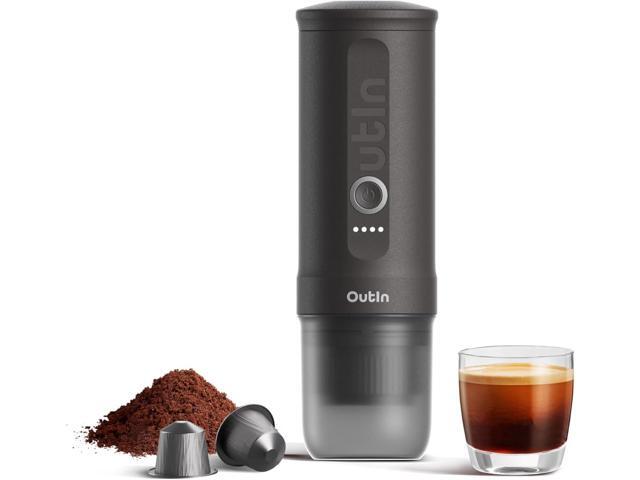
OutIn Nano earns the best-overall position because it solves the biggest logistical problem in portable espresso: hot water. The machine combines a rechargeable heater and electric pump, so you can add room-temperature water and prepare espresso without carrying a separate kettle or stove.
It weighs 670g and supports both ground coffee and compatible capsules. That dual workflow is particularly useful for travel. Freshly ground coffee gives you more control over beans and dose, while capsules remove the need to carry a grinder and make cleanup significantly easier in hotels and cars.
OutIn rates the internal pump up to 20 bar and lists a maximum heating temperature around 92°C. The maximum pump rating should not be interpreted as an espresso-quality score; extraction quality depends on the actual brewing conditions, coffee and preparation rather than the largest pressure number printed on the specification sheet.
OutIn also publishes battery-life figures indicating up to several cold-water brews per charge and dramatically more extractions when preheated water is used. Those numbers are manufacturer test claims and can vary with water temperature, volume, ambient conditions and battery state.
Add water → Add grounds or capsule → Press → Heat → Extract
Best For
Choose OutIn Nano for hotels, road trips, offices, RVs and camping situations where you do not want to depend on a separate hot-water source.
Pros
✅ Self-heating
✅ Ground coffee and capsule compatibility
✅ Electric pumping reduces manual effort
✅ Useful for hotel and car travel
✅ Can use preheated water to conserve battery
Cons
❌ Heavier than most manual brewers
❌ Cold-water brewing consumes significant battery power
❌ Less manual pressure control than lever systems
Alternative: Choose Wacaco Pixapresso if you want self-heating but value adjustable temperature, pre-infusion and more configurable brewing controls.
Wacaco Picopresso — Best Manual Portable Espresso Maker
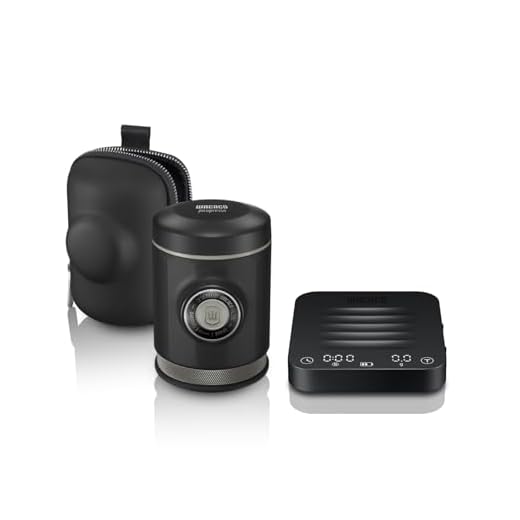
Wacaco Picopresso is aimed at users who want a compact brewer without giving up the process of dialing in espresso. At 350g and roughly 106mm tall, it packs into a very small footprint while still using a 52mm basket designed for up to 18g of coffee.
Unlike more forgiving pressurized travel machines, Picopresso uses a naked portafilter-style workflow. That means grind size, dose distribution and preparation matter much more. Wacaco recommends an ultra-fine grind, so this is not the ideal portable machine if you plan to use ordinary pre-ground coffee.
For experienced users, that extra preparation is exactly the attraction. Picopresso gives you more control over the coffee puck and manual extraction than capsule-oriented electric systems.
The limitation is total travel gear. Picopresso cannot heat water and performs best with a capable espresso grinder. The brewer itself may weigh only 350g, but the complete kit can become substantially heavier once a grinder and hot-water system are added.
Best For
Choose Picopresso if you already understand espresso dialing and want a compact manual setup that prioritizes coffee preparation and control over one-button convenience.
Pros
✅ Very compact 350g body
✅ 52mm basket with up to 18g capacity
✅ Naked-basket espresso workflow
✅ No battery dependence
✅ Strong manual control for its size
Cons
❌ Does not heat water
❌ Needs an espresso-capable grind for best results
❌ More technique-sensitive than pressurized brewers
❌ Grounds cleanup can be inconvenient away from a sink

If you want to use freshly ground coffee with Picopresso, see our Best Home Espresso Grinders guide for espresso-capable grinder options.
Alternative: Nanopresso is the more forgiving manual choice if you prefer simpler preparation over maximum puck-control flexibility.
Wacaco Pixapresso — Best Feature-Rich Electric Portable Espresso Maker
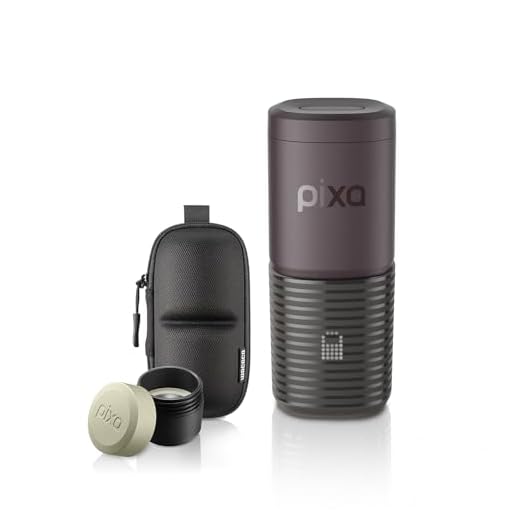
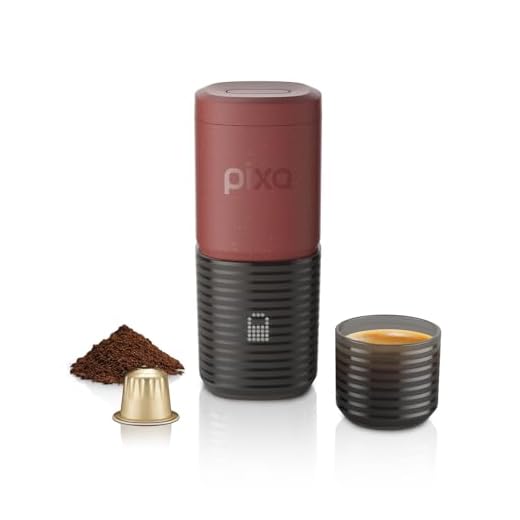
Pixapresso takes the self-heating concept further than a basic one-button electric travel machine. At 755g, it is heavier than OutIn Nano, but the additional weight brings a broader set of controls.
Wacaco offers three temperature presets—88°C, 92°C and 96°C—along with pre-infusion controls, adjustable ground-coffee dosing and several beverage volumes. It can use both ground coffee and compatible Nespresso Original-style capsules.
This makes Pixapresso a better fit for travelers who still want to adjust brewing behavior instead of accepting a fixed electric workflow. Capsule mode remains useful when convenience is the priority, while fresh grounds offer more control.
The downside is complexity. More controls, a larger water tank and additional accessories make Pixapresso a more substantial travel system than OutIn. Its rechargeable battery also means cold-water brewing remains dependent on available charge.
Choose dose → Choose temperature → Set pre-infusion → Extract
Best For
Choose Pixapresso if you want the independence of self-heating with more control over temperature, dose and pre-infusion than simpler electric travel machines provide.
Pros
✅ Self-heating
✅ Ground coffee and capsule support
✅ Three temperature settings
✅ Pre-infusion control
✅ Multiple beverage-volume options
Cons
❌ Heavier than OutIn Nano
❌ More complicated than a simple one-button electric brewer
❌ Cold-water brewing remains battery-limited
Alternative: OutIn Nano is better if simplicity and lower total setup friction matter more than configurable brewing controls.
Wacaco Nanopresso — Best Portable Espresso Maker for Beginners
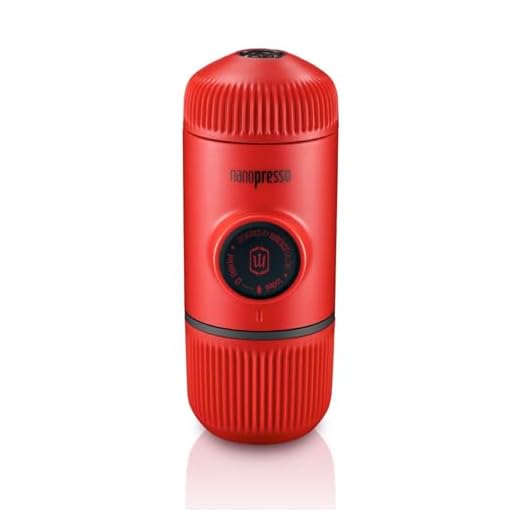
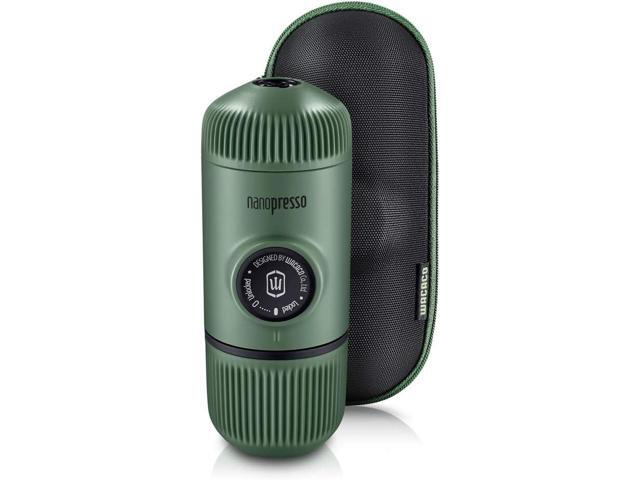
Nanopresso is one of the easiest manual entry points into portable espresso because it uses a pressurized portafilter. That makes it more forgiving of grind size and preparation than the naked-basket Picopresso.
The standard Nanopresso weighs 336g, holds up to 80ml of water and uses an 8g standard coffee basket. It does not heat water, so you still need a kettle, stove or other hot-water source.
Wacaco offers accessories that can expand the system with larger coffee capacity and compatible capsule workflows, but those capabilities should not be confused with the standard out-of-box configuration.
Important: Standard Nanopresso uses an 8g coffee basket. Larger 16g and capsule-oriented workflows depend on optional accessories and should not be treated as standard equipment.
The trade-off for easier preparation is less control. Experienced users chasing a more conventional non-pressurized espresso workflow will likely prefer Picopresso or a lever system.
Best For
Choose Nanopresso if you want a lightweight, battery-free travel brewer that is more forgiving of pre-ground coffee and beginner preparation than enthusiast-focused manual systems.
Pros
✅ Lightweight at 336g
✅ Pressurized basket is more forgiving
✅ No batteries
✅ Integrated cup
✅ Optional accessory ecosystem
Cons
❌ Requires external hot water
❌ Standard basket is only 8g
❌ Capsule and larger-dose workflows require accessories
❌ Less manual espresso control than Picopresso
Alternative: Picopresso is the better choice once grind precision and manual espresso control become more important than forgiving preparation.
Leverpresso Pro — Best for Portable Espresso Enthusiasts
Leverpresso Pro is much closer to a compact manual espresso machine than a simple travel gadget. It uses a 51mm basket, supports approximately 15–18g doses and includes a pressure gauge so the user can monitor lever pressure during extraction.
That pressure feedback is the main reason to choose it. Instead of pushing a small hand pump until coffee exits, you can actively manage the extraction profile through the dual-lever system.
The trade-off is portability. At about 995g before adding a grinder, scale or hot-water equipment, Leverpresso Pro is not an ultralight backpacking option. It is better suited to RVs, basecamps, car travel or hotels where you have enough space for a more complete manual setup.
Temperature management also matters. The unit does not heat its own water, and preheating helps reduce heat loss before extraction.
Availability can vary, and official direct listings have shown limited availability during our research. That makes current retailer stock worth checking rather than assuming the product is always immediately available.
Best For
Choose Leverpresso Pro if you already understand espresso technique and want pressure feedback and lever control in a travel-capable format.
Pros
✅ Integrated pressure gauge
✅ 51mm basket
✅ 15–18g espresso dose range
✅ Manual pressure control
✅ No battery dependency
Cons
❌ Nearly 1kg before accessories
❌ Requires hot water and benefits from preheating
❌ Requires a capable grinder for best results
❌ Availability may be inconsistent
Alternative: Picopresso is dramatically lighter if you want serious manual espresso without carrying a nearly one-kilogram lever machine.
Cafflano Kompresso — Best Ultralight Portable Espresso Maker
Cafflano Kompresso stands out for one reason before almost anything else: weight. Current references generally place the brewer around 180–200g depending on configuration and listing, making it much lighter than the electric machines and even substantially lighter than Picopresso or Nanopresso.
It uses manual hydraulic compression to create espresso-oriented pressure and requires externally heated water. That makes it particularly interesting for hikers and campers who already carry a stove and water-heating system.
The device’s extremely low weight should not be confused with low total system weight. If Kompresso forces you to add a grinder and hot-water equipment that you otherwise would not carry, its real travel advantage becomes smaller.
Important: Current manufacturer specification support for Kompresso is less complete than for the other products in this guide, so its weight is intentionally presented as an approximate range rather than an exact current manufacturer figure.
Best For
Choose Kompresso for minimalist hiking or camping when hot-water gear is already part of your pack and every additional gram matters.
Pros
✅ Extremely light
✅ No batteries
✅ Compact manual hydraulic design
✅ Strong fit for minimalist camping setups
Cons
❌ Requires hot water
❌ Proper grind is important
❌ Manual technique and force required
❌ Current specification documentation is less consistent

Alternative: Picopresso adds weight but offers a more polished espresso-preparation ecosystem and an 18g basket.
Leverpresso V4 — Best Value Manual Lever Espresso Maker
Leverpresso V4 brings the lever concept into a lighter and more accessible format than Leverpresso Pro. The brewer weighs around 560g, uses a 51mm basket and supports up to roughly 120ml of water.
One of its most useful features is basket flexibility. Depending on configuration, users can choose a pressurized basket for a more forgiving workflow or a non-pressurized basket for greater control over grind and extraction.
That makes V4 more adaptable than many fixed-workflow manual travel brewers. A beginner can start with the forgiving basket and later move toward a more conventional espresso workflow.
It still requires externally heated water, and non-pressurized use benefits from an espresso-capable grinder. Like the Pro, availability can vary across direct and third-party channels.
Best For
Choose Leverpresso V4 if you want manual lever control and basket flexibility without the weight and premium positioning of Leverpresso Pro.
Pros
✅ 51mm basket platform
✅ Pressurized or non-pressurized workflows
✅ Lighter than Leverpresso Pro
✅ No battery required
Cons
❌ Requires externally heated water
❌ Non-pressurized use demands better grinding
❌ Retailer availability can vary
Alternative: Nanopresso is easier for beginners, while Leverpresso Pro adds a pressure gauge for more enthusiast-oriented control.
Best Portable Espresso Maker for Camping
The best portable espresso maker for camping depends on whether hot water is already part of your camp setup.
No Stove or Kettle: OutIn Nano
If you are not carrying a stove or reliable hot-water source, OutIn Nano is the easiest option because it heats its own water.
Stove Already Packed: Picopresso
If you already boil water for meals, Picopresso becomes much more attractive because its biggest missing component—heat—is already solved.
Ultralight Backpacking: Cafflano Kompresso
Kompresso is the weight-focused choice when a stove and grinder are already part of your packing system.
Beginner Camping Setup: Nanopresso
Nanopresso is more forgiving if you want manual brewing without dialing a naked espresso basket.
Basecamp or RV: Leverpresso Pro
If you have table space, hot water and a capable grinder, Leverpresso Pro delivers far more hands-on control than ultralight camping brewers.
Best Portable Espresso Maker for Hotel Travel
Hotel travel strongly favors self-heating electric models because you cannot always rely on having a clean, convenient kettle.
OutIn Nano is the simpler choice. Add water and either grounds or a capsule, then let the machine handle heating and pumping.
Pixapresso is better for travelers who want temperature and pre-infusion control and do not mind carrying a slightly heavier device.
Capsules are particularly useful in hotel rooms because they reduce loose grounds, eliminate the grinder and make cleanup easier.
Best Portable Espresso Maker for Car and RV Travel
Road travel gives electric systems an advantage because charging options are easier to access than during backpacking.
OutIn Nano is especially useful because it supports travel-oriented charging workflows and does not depend on a kettle. Pixapresso is another strong electric option if configurable brewing matters more.
Manual lever systems make sense in an RV when you already have a kitchen, water heating and enough storage for a grinder and accessories.
Best Portable Espresso Maker for Backpacking
Backpacking changes the equation because every component counts.
If your stove, pot and grinder are already being carried, Cafflano Kompresso adds very little brewer weight. Picopresso weighs more but offers a more developed espresso preparation workflow.
Electric machines are heavier, but they can make sense on short trips if they replace hot-water equipment you otherwise would not carry.
There is no universal backpacking winner because the correct comparison is the weight of the complete coffee system, not just the brewer.
Ground Coffee vs Capsules for Travel
Fresh Grounds
✓ More bean choice
✓ More control over grind and dose
✓ Better fit for enthusiast manual brewers
✗ Requires grinder, dosing and more cleanup
Capsules
✓ No grinder required
✓ Cleaner hotel and car workflow
✓ Faster preparation
✗ Recurring cost, waste and ecosystem limitations
Capsule compatibility is useful in portable espresso, but it is only one feature. If capsules themselves are your primary buying criterion, a dedicated pod-machine guide is the more relevant category.
Do You Need a Grinder With a Portable Espresso Maker?
It depends on the brewing system.
For non-pressurized or more espresso-focused manual devices such as Picopresso and Leverpresso Pro, a capable grinder is strongly recommended. Grind size has a major influence on shot flow and pressure.
Nanopresso is more forgiving because of its pressurized basket. Electric machines using capsules can eliminate the grinder completely.
If you plan to build a fresh-ground portable setup, our Best Home Espresso Grinders guide explains the differences between beginner, single-dose, manual and enthusiast espresso grinders.
Does 18 or 20 Bar Mean Better Espresso?
No. Maximum pump pressure is not a quality ranking.
Several portable machines advertise maximum pump ratings of 18 or 20 bar. That number describes what the mechanism can generate under particular conditions, not the pressure that should necessarily be maintained through the entire extraction.
Espresso preparation depends on the interaction between grind size, coffee resistance, dose, basket and pressure. A machine rated to 20 bar is not automatically better than one rated to 18 bar, and a manual brewer that gives the user meaningful pressure control can be more useful than simply having the largest maximum figure.
Important: Treat maximum pump pressure as an engineering specification, not a shortcut for ranking espresso quality.
Portable Espresso Maker vs Travel Coffee Maker
A portable espresso maker is designed around pressure-based extraction and a small concentrated beverage. A broader best travel coffee maker search includes many products that make excellent coffee without trying to reproduce espresso-style extraction.
An AeroPress, for example, is lightweight, durable and highly practical for travel, but it is better categorized as a portable coffee brewer than a conventional espresso machine. A moka pot also makes concentrated coffee, but it uses a different brewing process.
If espresso itself is the goal, choose a pressure-oriented device such as the products in this guide. If your priority is simply easy, good coffee while traveling, a simpler travel brewer may require less equipment.
If convenience matters more than true espresso, our Best Coffee Makers for Busy Mornings guide focuses on low-effort brewing rather than manual espresso preparation.
How Many Shots Can You Realistically Make?
Portable espresso makers are usually optimized for one or two users rather than serving a group.
Electric From Cold Water
Heating water consumes significant battery energy. Manufacturers typically rate only a limited number of cold-water brews per full charge.
Electric With Preheated Water
If you provide hot water, the electric machine mainly powers the pump, so many more extractions can be possible.
Manual
Manual brewers have no battery limit, but each additional shot still requires:
- removing the used puck;
- cleaning or rinsing the basket;
- grinding and dosing again;
- refilling hot water;
- potentially reheating the brewer.
For several people, a portable espresso setup can quickly become less convenient than a larger camp or countertop coffee system.
Which Portable Espresso Makers Are Easiest to Clean?
Cleanup matters more away from home because a sink may not be available.
Capsule workflows are usually the cleanest because there is no loose puck to knock out and less coffee residue to manage.
Nanopresso is relatively approachable because its components are designed to separate for cleaning.
Picopresso creates a more conventional coffee puck and therefore demands more grounds handling after each shot.
Leverpresso systems involve more parts and preparation but can still be easy to maintain when you have access to water at a hotel, RV or campsite.
For remote trips, bring a small cloth, brush and sealable waste bag rather than assuming you will always have a sink nearby.
Manual vs Electric Reliability
Manual brewers have fewer electronic components and no rechargeable battery to age. That makes them attractive for extended off-grid use.
Electric models contain heaters, pumps, controls and batteries, which introduce more potential failure points. In return, they eliminate several external components and reduce technique.
The better choice depends on where failure would be more inconvenient. For a long wilderness trip, mechanical simplicity may win. For hotel and road travel, the convenience of integrated heating may be much more valuable.
How Much Should You Spend on a Portable Espresso Maker?
Portable espresso spans everything from lightweight manual tools to advanced rechargeable machines. Rather than choosing by price alone, pay for the workflow that removes the biggest inconvenience in your travel setup.
Affordable Manual Options
Manual systems avoid the cost of batteries, heating elements and electric pumps. Nanopresso, Kompresso and Leverpresso V4 can make sense when you already have hot water available.
Midrange Travel Systems
Picopresso is attractive when espresso control matters, while OutIn makes more sense if self-heating and simpler travel logistics are priorities.
Premium and Feature-Rich
Pixapresso adds configurable electric features, while Leverpresso Pro spends its complexity on pressure feedback and enthusiast manual control rather than automation.
The right upgrade is the feature you will actually use: self-heating, lower weight, capsule compatibility, pressure control or better manual espresso preparation.
How We Chose the Best Portable Espresso Makers
We evaluated these products using criteria that reflect how they are actually used away from home:
- Espresso capability: Is the product meaningfully designed around espresso-style pressure extraction?
- Device weight: How much does the brewer itself add to the pack?
- Total system burden: Do you also need a grinder, kettle, stove, battery or additional accessories?
- Hot-water independence: Can the machine heat its own water?
- Grinder dependency: How sensitive is the workflow to espresso-level grind precision?
- Battery requirements: How dependent is the machine on available charge?
- Grounds and capsule flexibility: Can the brewer support different travel workflows?
- Setup complexity: How many preparation steps are required?
- Cleanup: How practical is the brewer away from a full kitchen sink?
- Multiple-shot practicality: How much work is involved in preparing the next cup?
- Portability: Does the complete system make sense for hotel, car, camping or backpacking use?
- Value: Does the product solve a meaningful travel problem at its market position?
We do not claim independent laboratory pressure, temperature or battery testing for every machine in this guide. Specific heating, pressure and battery-life figures published by manufacturers are treated as manufacturer specifications rather than Discompare measurements.
Portable Espresso vs a Full Home Espresso Setup
A portable brewer is built around mobility and compromise. A full home espresso setup gives you larger baskets, greater thermal mass, easier back-to-back drinks and a wider grinder ecosystem.
If you are choosing a permanent countertop machine rather than a travel brewer, our Easiest Espresso Machines for Beginners guide is a better starting point.
For an integrated home-machine comparison, see our Jura ENA 8 vs Breville Barista Pro: Espresso Showdown.
Portable Espresso Makers FAQ
What is the best portable espresso maker?
OutIn Nano is our best overall choice because it combines self-heating, electric pumping, ground-coffee support and capsule compatibility while keeping total travel setup relatively simple. Picopresso is the stronger choice for manual espresso enthusiasts.
Can a portable espresso maker make real espresso?
Pressure-oriented portable machines can produce espresso-style extraction, but results depend on the grinder, basket, coffee, water temperature and preparation. Not every portable coffee brewer should be categorized as an espresso maker.
Which portable espresso maker heats its own water?
OutIn Nano and Wacaco Pixapresso are self-heating electric options. Manual machines such as Picopresso, Nanopresso, Kompresso and Leverpresso require an external source of hot water.
Do you need a grinder for a portable espresso maker?
An espresso-capable grinder is strongly recommended for non-pressurized systems such as Picopresso and Leverpresso Pro. Pressurized baskets are more forgiving, while capsule-compatible electric machines can eliminate the grinder completely.
What is the best portable espresso maker for camping?
OutIn Nano is easiest when you do not already have a stove or kettle. Picopresso is a stronger manual choice when hot water is already available, while Kompresso is particularly attractive for ultralight setups.
Are manual or electric portable espresso makers better?
Manual machines are generally lighter and battery-independent, while electric models reduce pumping effort and may heat their own water. The better choice depends on whether you already carry hot-water equipment.
Can you use coffee capsules in a portable espresso maker?
Some models support capsules. OutIn Nano and Pixapresso can use compatible capsules, while Nanopresso can support capsule workflows through optional accessories. Picopresso and the Leverpresso models are primarily ground-coffee systems.
Is an AeroPress a portable espresso maker?
AeroPress is an excellent portable coffee maker, but it is better categorized as a travel coffee brewer than a conventional espresso machine because it uses a different pressure and extraction approach.
Final Verdict
OutIn Nano is our best overall portable espresso maker because its integrated heating and electric pumping reduce the amount of additional travel equipment you need to carry. It is particularly practical for hotels, road trips, offices and camping situations without an established hot-water setup.
Wacaco Picopresso is the stronger choice if manual espresso quality and puck preparation matter more than convenience. Wacaco Pixapresso gives electric users more control through temperature selection, pre-infusion and configurable brewing.
Wacaco Nanopresso remains the easier manual choice for beginners, while Leverpresso Pro is better suited to enthusiasts who want pressure feedback and do not mind carrying a heavier setup. Cafflano Kompresso is the standout for ultralight travel when hot water is already solved, and Leverpresso V4 offers a flexible entry into manual lever espresso.
✓ Best Overall: OutIn Nano
✓ Best Manual: Wacaco Picopresso
✓ Best Feature-Rich Electric: Wacaco Pixapresso
✓ Best for Beginners: Wacaco Nanopresso
✓ Best Ultralight: Cafflano Kompresso
The most useful way to choose among portable espresso makers is to stop looking at brewer weight in isolation. Start with the equipment you already carry, then decide whether heating, grinding, batteries or manual pressure should be built into the brewer or handled elsewhere in your travel system.
Sources
- OutIn — Nano official product specifications, charging information and manufacturer battery-life guidance.
- Wacaco — Picopresso official specifications, basket capacity and operating guidance.
- Wacaco — Pixapresso official specifications, temperature controls, battery data and capsule compatibility.
- Wacaco — Nanopresso official specifications and accessory documentation.
- HUGH / Leverpresso — Leverpresso Pro and V4 official specifications, basket information and usage documentation.
- Cafflano — Kompresso user documentation and pressure guidance.
- Coffee Chronicler — portable espresso testing and market comparisons used for competitive and workflow context.
- Home Coffee Expert — portable espresso comparisons and workflow observations used for competitive context.
- My Free Range Family — outdoor and camping-oriented portable espresso usage observations.
Product Groups: OutIn Nano, Wacaco Picopresso, Wacaco Pixapresso, Wacaco Nanopresso, Leverpresso Pro, Cafflano Kompresso, Leverpresso V4