
Winter Wellness: Products to Stay Healthy
The most useful winter wellness products solve specific problems: dry indoor air, airborne particles, respiratory exposure in crowded spaces, fever monitoring, and reduced winter daylight. Our top picks are the Levoit Classic 300S humidifier, Coway Airmega Mighty2 air purifier, 3M Aura 9205+ N95 respirator, Braun ThermoScan 7+ Connect thermometer, and Carex Day-Light Classic Plus light therapy lamp.
No product can guarantee that you stay healthy through winter. Vaccination, handwashing, cleaner air, staying away from others when sick, and additional precautions such as a well-fitting mask when appropriate remain more important than buying another wellness gadget. These products are useful because they support those routines or address a defined seasonal problem—not because they “boost” the immune system.
Early fall is a good time to prepare before dry indoor heating and respiratory-virus season become more noticeable. Buy based on the problem you actually need to solve, and avoid paying extra for supplements, essential oils, or gadgets built around health claims that are much stronger than the evidence.
Quick Answer: Best Winter Wellness Products
Best for Dry Winter Air: Levoit Classic 300S Ultrasonic Smart Humidifier — a 6-liter smart humidifier with automatic humidity control and a top-fill design.
Best for Cleaner Indoor Air: Coway Airmega Mighty2 — strong smoke, dust, and pollen CADR with HEPA, activated carbon, and a washable pre-filter.
Best for Crowded Indoor Settings: 3M Aura Particulate Respirator 9205+ N95 — an active NIOSH-approved N95 with a three-panel design and adjustable nose clip.
Best for Family Fever Tracking: Braun ThermoScan 7+ Connect — quick ear measurements, age-based fever guidance, positioning feedback, and optional app logging.
Best for Winter Light Therapy: Carex Day-Light Classic Plus — a large 10,000-lux light box suited to an evidence-based winter-pattern SAD light-therapy routine.
Before You Buy Anything: What Actually Helps During Winter Illness Season?
Products should supplement proven prevention habits rather than replace them. CDC guidance for the 2026–2027 flu season emphasizes annual flu vaccination, while everyday preventive measures include hand hygiene, cleaner indoor air, avoiding close contact when sick, and taking additional precautions when respiratory illnesses are circulating.
Masking is one of those additional strategies. CDC notes that better-fitting, more protective masks and respirators generally provide more protection than loose-fitting alternatives, particularly when they cover the nose and mouth without large gaps.
An air purifier can reduce airborne particles. A humidifier can correct excessively dry air. A thermometer can help you monitor a fever. None of those functions is equivalent to preventing or treating an infection.
Health note: This guide discusses household products and general public-health guidance, not individualized medical care. Seek appropriate medical advice for persistent or severe symptoms, medication or supplement decisions, and treatment of conditions such as seasonal affective disorder.
How We Chose These Winter Wellness Products
We selected products around five distinct winter needs rather than filling the list with supplements or similar gadgets. We prioritized authoritative public-health and safety guidance first, current manufacturer specifications second, and recent independent testing where useful.
Each product also had to have a clearly defined function. We looked at humidity control and maintenance for the humidifier, CADR for the air purifier, NIOSH approval and fit for the respirator, measurement usability for the thermometer, and light output plus treatment context for the therapy lamp.
Discompare did not conduct laboratory or clinical testing of these products, and none is ranked because of an unsupported disease-prevention or immune-boosting claim.
Winter Wellness Products Compared
| Product | Best For | What It Actually Does | Key Specification | Main Limitation |
|---|---|---|---|---|
| Levoit Classic 300S | Dry indoor air | Adds moisture to dry room air | 6L tank; Auto humidity control | Requires regular cleaning |
| Coway Airmega Mighty2 | Cleaner indoor air | Filters airborne particles | 240 smoke / 242 dust / 249 pollen CADR | Does not prevent infection by itself |
| 3M Aura 9205+ N95 | Crowded indoor settings | Filters certain inhaled airborne particles when properly fitted | NIOSH-approved N95 | Protection depends heavily on fit |
| Braun ThermoScan 7+ Connect | Fever tracking | Measures ear temperature and logs readings | 2-second measurement | Monitors temperature; does not diagnose illness |
| Carex Day-Light Classic Plus | Winter-pattern SAD light therapy | Provides bright-light exposure | 10,000 lux at 12–14 inches | Needs correct timing and health context |
Compare Current Winter Wellness Product Prices
Prices for humidifiers, purifiers, thermometers, respirators, and light boxes vary by retailer, pack size, and seasonal promotion. Use current offers rather than treating a temporary sale as an evergreen price.
The more important comparison is whether you actually need the product category. A discounted humidifier is still unnecessary if indoor humidity is already appropriate, and an expensive light box is not a substitute for evaluating persistent winter depression symptoms.


1. Levoit Classic 300S Ultrasonic Smart Humidifier — Best for Dry Winter Air
Best For: Bedrooms and living spaces that become uncomfortably dry when indoor heating runs during winter.
The Levoit Classic 300S is our top winter wellness product because dry heated air is a common seasonal comfort problem and humidity can be measured rather than guessed. Its 6-liter tank, top-fill design, built-in humidity sensing, and Auto Mode make it easier to maintain a target instead of simply releasing mist continuously.
Levoit rates the Classic 300S for rooms from roughly 215 to 505 sq. ft. and advertises up to 60 hours of operation under its specified conditions. Auto Mode is designed to maintain approximately 40–50% relative humidity or a custom target chosen through the VeSync app.
That upper limit matters. EPA recommends keeping indoor relative humidity at or below 50% because excessive moisture can encourage biological growth such as mold and increase other indoor-air problems. A humidifier should correct dry air—not turn a room damp.
Water quality and cleaning also matter with ultrasonic humidifiers. Minerals in tap water can contribute to scale and airborne mineral residue often seen as white dust. EPA suggests distilled water as one way to reduce mineral exposure, particularly in areas with hard water.
Good Housekeeping’s current testing names the Classic 300S its best overall humidifier, while independent testing has also supported its quiet operation and strong output. The tradeoff is maintenance: a humidifier only helps if the tank, base, and other water-contact surfaces are kept clean.
Pros
✅ 6-liter tank reduces frequent refilling
✅ Auto Mode can maintain a selected humidity target
✅ Top-fill design simplifies refilling
✅ VeSync supports schedules and remote controls
✅ Strong current independent testing support
Cons
❌ Water-contact surfaces require regular cleaning
❌ Hard tap water can contribute to mineral buildup and white dust
❌ Excessive humidification can encourage mold and dust-mite problems
Who should skip it: If your home already stays around an appropriate relative-humidity level or develops window condensation, adding more moisture may make indoor conditions worse rather than better.
Alternative: If dry air is not the problem and airborne particles are, choose an air purifier such as the Coway Mighty2 instead.
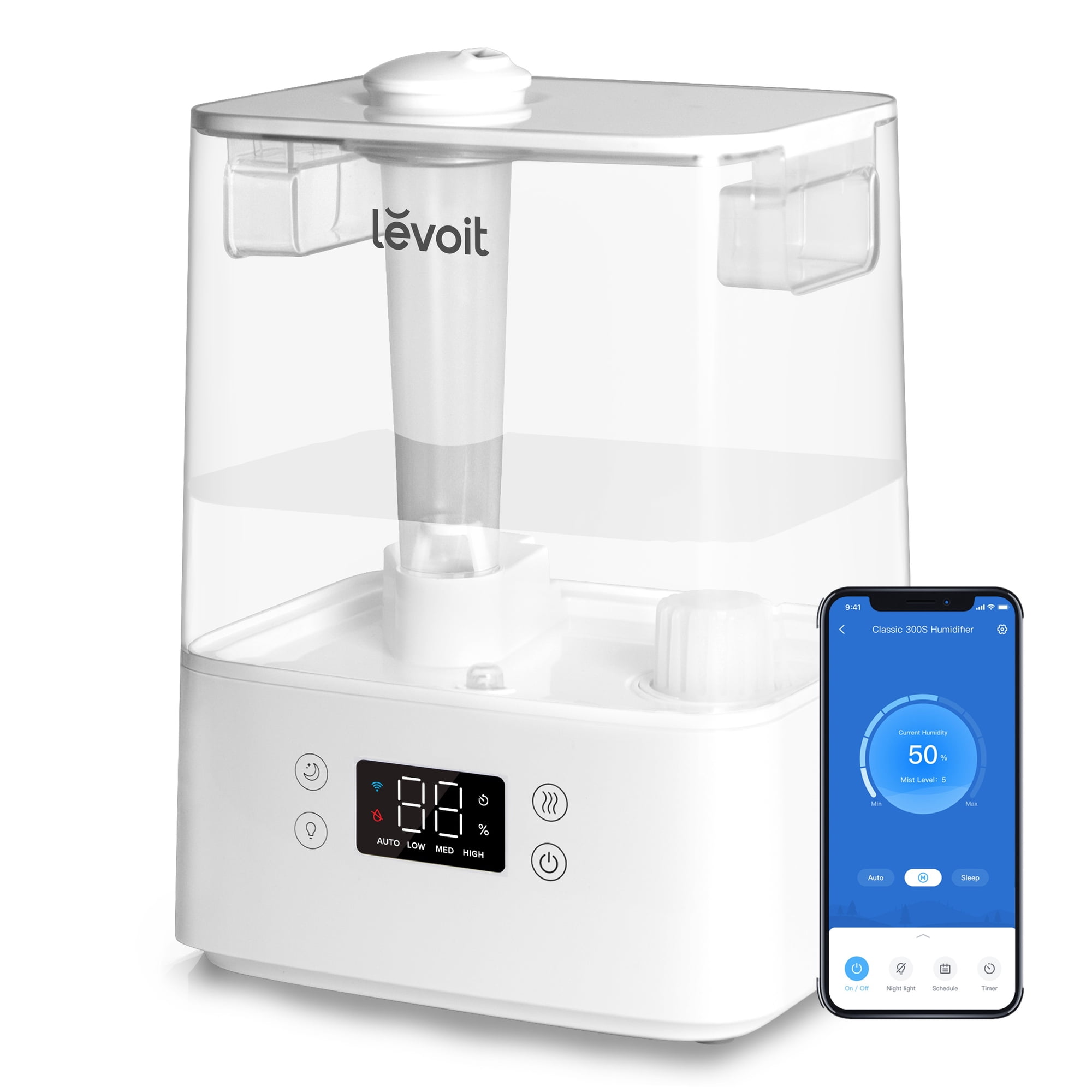
Levoit Classic 300S Smart 6L Humidifier — Bring restful, perfectly humidified air to your home with smart control, aromatherapy, and whisper‑quiet ultrasonic mist. Enjoy up to 60 hours of continuous comfort and full remote control through the VeSync app, including customizable schedules. Upgrade your air and simplify your routine—order your Levoit Classic 300S today and start breathing better tonight.
2. Coway Airmega Mighty2 — Best for Cleaner Indoor Air
Best For: Homes that want to reduce airborne pollen, dust, smoke particles, pet dander, and other particulate pollution during months when windows stay closed more often.
The Coway Airmega Mighty2 is a better winter wellness purchase than vague “air-cleaning” gadgets because its output can be evaluated with CADR. Coway publishes CADRs of 240 for smoke, 242 for dust, and 249 for pollen, backed by a washable pre-filter and a Max2 filter combining activated carbon with HEPA media.
The purifier also uses a MegaScan laser sensor for PM1, PM2.5, and PM10 readings and can automatically adjust fan speed. Coway rates filter life at approximately one year under typical conditions and lists an operating-noise range of 19–50 dB.
Do not choose it based on the advertised 1,800-sq.-ft. figure alone. That number represents one air change per hour. Its CADR places it more realistically in small-to-medium-room territory when you want the room’s air filtered several times per hour.
Cleaner indoor air is part of broader respiratory-risk reduction, but the distinction is important: an air purifier reduces certain airborne particles; it does not guarantee that household members will avoid colds, influenza, or other respiratory infections.
WIRED’s 2026 review gave the redesigned Mighty2 strong marks for filtration, compact size, low noise, and longer filter life. Its most obvious omissions are Wi-Fi and a remote control.
For a deeper comparison of particle filtration and room sizing, our best air purifiers for allergy sufferers guide looks specifically at CADR, filtration, noise, and realistic coverage.
Pros
✅ Balanced smoke, dust, and pollen CADR
✅ HEPA and activated-carbon filtration
✅ Washable pre-filter simplifies routine maintenance
✅ PM1, PM2.5, and PM10 particle sensing
✅ Quiet enough for many bedrooms and workspaces
Cons
❌ No Wi-Fi app or remote control
❌ Large advertised coverage figure is based on only one air change per hour
❌ Filtration reduces airborne particles but does not eliminate infection risk
Who should skip it: Buyers primarily trying to solve dry-air discomfort need a humidifier, not an air purifier. They perform different jobs.
Alternative: Levoit Classic 300S if indoor relative humidity is too low rather than particle pollution being the main concern.

COWAY Airmega Mighty2 HEPA Air Purifier — Purify spaces up to 900 ft² in 30 minutes with IEST‑certified HEPA filtration that removes 99.97% of particles down to 0.3 μm. Enjoy real‑time air quality sensing, whisper‑quiet Sleep Mode, and energy‑efficient Smart Mode for cleaner, healthier air around the clock. Order yours today and breathe easier with confidence—backed by an industry‑leading 3‑year warranty.
3. 3M Aura Particulate Respirator 9205+ N95 — Best for Crowded Indoor Settings
Best For: People who want an additional layer of respiratory protection in crowded indoor spaces, during periods of increased respiratory-virus activity, or around people at higher risk of severe illness.
The 3M Aura 9205+ is not a wellness gadget—it is a NIOSH-approved filtering facepiece respirator. NIOSH’s current certified-equipment database lists approval TC-84A-8590 for the Model 9205+ and shows that approval as active rather than obsolete.
N95 approval means the respirator is designed to filter at least 95% of certain non-oil-based airborne particles under the applicable test conditions. Actual protection on a person also depends on fit. Air that leaks around the nose, cheeks, or chin bypasses the filter material.
The Aura’s three-panel flat-fold design, adjustable nose clip, soft nose foam, and dual headbands are intended to help it conform to different face shapes. The individual packaging also makes spare respirators easier to keep clean in a bag or drawer before use.
CDC describes masks as an additional respiratory-virus prevention strategy and notes that better-fitting respirators such as NIOSH-approved N95s generally provide more wearer protection than looser mask designs. That does not make an N95 necessary in every situation; it is a tool whose value changes with exposure, community illness levels, personal risk, and whether you can wear it correctly and consistently.
Pros
✅ Current NIOSH-approved N95 respirator
✅ Three-panel design accommodates facial movement
✅ Adjustable nose clip and nose foam support a closer seal
✅ Individually packaged and easy to store
✅ No exhalation valve on the 9205+ model
Cons
❌ One respirator design will not seal equally well on every face
❌ Headbands and tight fit can become uncomfortable during long wear
❌ Protection drops when significant gaps allow air around the respirator
Who should skip it: If the Aura does not fit your face without significant gaps, choose another legitimate respirator shape or size rather than forcing a poor seal.
Alternative: Another genuine NIOSH-approved N95 that fits your face better. Fit is more important than loyalty to one respirator model.
4. Braun ThermoScan 7+ Connect Ear Thermometer — Best for Family Fever Tracking
Best For: Families that want fast temperature measurements, age-based fever guidance, and an easy way to log readings during an illness.
A reliable thermometer is useful during winter because it answers a narrow but important question: what is the person’s measured temperature, and how is it changing over time? It does not tell you which infection caused a fever or whether a specific treatment is needed.
The Braun ThermoScan 7+ Connect uses an ear measurement and provides a reading in about two seconds. Age Smart technology changes the display guidance according to the selected age group, while the color-coded screen helps users interpret the measurement within that system.
The pre-warmed tip is designed to reduce the cooling effect that can influence an ear reading, and Braun’s ExactTemp system uses a light and beep to confirm positioning. Bluetooth synchronization with the Braun Family Care app can record readings for different family members and create a temperature timeline.
Technique still matters. Braun recommends using a clean genuine lens filter, measuring consistently in the same ear, and ensuring proper positioning. Earwax, recent exposure to extreme room temperatures, a hearing aid, and poor probe placement can affect readings.
TechGearLab’s March 2026 comparison ranked the ThermoScan 7+ Connect third among ten tested thermometers, with particularly strong marks for ease of use and speed. The main drawback is cost: simpler digital thermometers can measure temperature for much less if you do not need connectivity or age-based guidance.
Pros
✅ Readings in about two seconds
✅ Age-based fever guidance
✅ ExactTemp positioning feedback
✅ Pre-warmed tip
✅ App can track readings for multiple family members
Cons
❌ More expensive than basic digital thermometers
❌ Correct ear positioning affects measurement quality
❌ Temperature monitoring cannot diagnose the cause of an illness
Who should skip it: If all you need is an occasional temperature reading, a simpler thermometer may offer better value.
Alternative: A reputable basic digital thermometer is sufficient for many households that do not need Bluetooth tracking or age-adjusted display guidance.
5. Carex Day-Light Classic Plus Light Therapy Lamp — Best for Winter Light Therapy
Best For: People considering bright-light therapy for winter-pattern seasonal affective disorder after discussing whether the approach is appropriate for them.
The Day-Light Classic Plus earns a place in this winter wellness guide because bright-light therapy has a much clearer evidence base for winter-pattern SAD than the vague “mood boosting” claims attached to many seasonal wellness products.
NIMH describes light therapy as a mainstay treatment for winter-pattern SAD and outlines a common routine using a 10,000-lux light box for about 30–45 minutes, usually first thing in the morning from fall through spring. Treatment should still be discussed with a healthcare provider, particularly when symptoms are significant.
The Carex Day-Light Classic Plus delivers 10,000 lux at approximately 12–14 inches and uses a large 16-by-13-inch screen. The lamp height and angle are adjustable, the screen is designed to block ultraviolet light, and Carex backs the product with a five-year warranty.
Its large illuminated surface makes positioning less restrictive than with a tiny light panel, but it also makes the lamp much bulkier than compact travel models.
Light therapy is not a generic treatment for every kind of low mood or depression. NIMH advises discussing benefits and risks with a healthcare provider, and extra caution can be necessary for people with certain eye conditions or who use medications that increase light sensitivity.
Pros
✅ Delivers 10,000 lux at the specified working distance
✅ Large 16-by-13-inch illuminated area
✅ Adjustable height and angle
✅ UV-blocking screen
✅ Five-year manufacturer warranty
Cons
❌ Large footprint compared with compact light boxes
❌ Correct timing, distance, and routine matter
❌ Light therapy is not appropriate as unsupervised treatment for every type of depression
Who should skip it: Do not buy a light box simply because winter makes you occasionally tired. Persistent seasonal mood symptoms deserve appropriate assessment, and some eye conditions or medications require extra caution with bright-light therapy.
Alternative: A smaller 10,000-lux light box may be more practical where desk space or portability matters, provided it delivers the required intensity at a realistic sitting distance.
Bring daylight home with the Carex Day‑Light Classic Plus 10,000 LUX Lamp — glare‑free, Mayo Clinic‑inspired LED therapy that delivers clinical‑strength light at a comfortable 12" distance. Boost mood, improve sleep, and fight jet lag with full‑spectrum BrightZone technology and a 5‑year warranty for peace of mind. Ready to feel brighter? Order your Carex Day‑Light Classic Plus today and start your personalized light therapy routine.
Winter Wellness Claims We Would Not Spend Money On
The phrase “immune booster” is usually too vague to be a useful buying criterion. Adequate nutrition matters for normal immune function, and correcting a genuine nutrient deficiency can matter medically. That is different from assuming that extra vitamins, essential oils, or supplement blends will stop winter infections in an otherwise well-nourished person.
Do Vitamin Supplements Boost Immunity?
Vitamins and minerals such as vitamins C and D and zinc are necessary for normal immune function. More is not automatically better, however, and supplement needs vary with diet, health status, medications, age, and documented deficiencies.
That is why we did not rank a generic “immune support” supplement as one of the best winter wellness products. A bottle containing many nutrients does not provide the same kind of predictable function as a humidifier controlling humidity or an N95 filtering airborne particles.
What Does Vitamin C Actually Do for Colds?
NIH’s Office of Dietary Supplements reports that regular vitamin C supplementation does not appear to reduce the risk of getting a cold in the general population. Regular use may modestly shorten cold duration or reduce symptom severity, while starting vitamin C only after symptoms appear has not shown consistent benefit.
That evidence does not justify selling vitamin C as a product that will keep most people from becoming sick during winter.
What About Vitamin D?
Vitamin D is essential for normal health and immune function, and people with low vitamin D status may have different health considerations than people whose levels are already adequate. Research on supplements for preventing respiratory infections has produced mixed results, with some analyses finding small benefits and others finding no meaningful reduction.
Vitamin D therefore belongs in a nutrition or clinician-guided deficiency discussion rather than as a universal winter infection-prevention product.
Can Zinc Prevent Winter Colds?
Oral zinc is better studied as an early cold-treatment option than as a general prevention product. NCCIH notes that oral zinc may reduce the length and severity of a cold when used early, but it can cause side effects and interact with medicines.
Intranasal zinc products should be avoided because they have been linked to irreversible loss of smell. That is another reason not to add a generic zinc product to a seasonal shopping list without appropriate context.
Do Essential Oils Prevent Colds?
No strong evidence shows that oil of oregano or eucalyptus essential oil prevents or treats the common cold. An essential-oil diffuser may provide a scent you enjoy, but fragrance preference is not the same as infection prevention.
Essential oils should therefore be treated as optional aroma products rather than as a winter health intervention.
How to Use a Humidifier Safely in Winter
Measure humidity rather than running a humidifier continuously. EPA recommends keeping indoor relative humidity at no more than 50%. If windows, walls, or nearby surfaces begin collecting condensation, reduce humidifier output or stop using it until the excess moisture clears.
Emptying and cleaning the tank matters because standing water and mineral deposits can support unwanted microbial growth. Follow the exact manufacturer’s cleaning schedule rather than waiting until visible residue becomes severe.
For an ultrasonic humidifier, distilled or low-mineral water can reduce scale and mineral particles dispersed into the air. If white dust appears around the room, that is a sign to reassess the water source and cleaning routine.
During winter, humidity and temperature are separate parts of indoor comfort. Our best heating devices for winter guide compares ceramic heaters, radiators, smart wall heaters, and other supplemental heating options.
Air Purifier vs Humidifier: Which Do You Need?
An air purifier removes particles from the air; a humidifier adds moisture. They solve different problems and should not be treated as substitutes.
| Problem | Better Tool | Why |
|---|---|---|
| Very dry indoor air | Humidifier | Raises relative humidity |
| Pollen, dust, smoke particles, pet dander | Air purifier | Moves room air through particle filtration |
| Both dry air and particle pollution | Potentially both | Use each device for its separate function and monitor humidity |
A purifier does not add moisture, and a humidifier does not meaningfully replace HEPA particle filtration. In some winter homes both devices are useful, but only when each addresses a measured or identifiable problem.
When Does Wearing an N95 Make Sense?
An N95 is most useful when additional respiratory protection is appropriate and the respirator fits you well. CDC identifies crowded settings, periods when respiratory illness is increasing, recent exposure, recovery from illness, and situations involving people at higher risk of severe illness as times when additional masking can be particularly helpful.
The respirator should cover both the nose and mouth and sit against the face without obvious gaps. Facial hair, face shape, strap positioning, and nose-clip adjustment can all affect the seal.
A legitimate NIOSH approval is also preferable to assuming that any product labeled “N95-style” provides N95 protection. Check the model and approval information rather than buying solely from marketplace imagery.
Why a Thermometer Belongs in a Winter Wellness Kit
A thermometer helps you monitor an illness rather than guessing whether someone has a fever. That can make it easier to record changes over time and provide concrete information when communicating with a healthcare professional.
The reading still needs context. Fever definitions and clinical significance can vary by age, measurement method, and individual circumstances. A normal reading does not rule out illness, and a fever reading does not identify the cause.
For that reason, the ThermoScan’s app and color guidance are convenience features rather than a replacement for medical judgment.
Winter Light and Seasonal Mood
Bright-light therapy has a legitimate role in winter-pattern SAD, but it should not be reduced to a generic “feel happier” product claim. NIMH describes a common treatment protocol using approximately 10,000 lux for 30–45 minutes in the morning from fall through spring.
The exact distance required to receive 10,000 lux depends on the lamp. With the Carex Day-Light Classic Plus, the manufacturer specifies approximately 12–14 inches, so sitting much farther away changes the amount of light reaching you.
If winter repeatedly brings significant depression, loss of interest, sleep changes, or other concerning symptoms, the right next step is professional assessment rather than simply purchasing a brighter lamp.
What About Tea, Hydration, and Comfort Products?
Warm drinks can be useful for comfort and hydration, but ordinary tea should not be marketed as a way to prevent respiratory infections. Tea can be part of a pleasant winter routine, and different caffeinated or caffeine-free options may fit different preferences.
The same distinction applies to blankets, heating products, and other seasonal comforts: making winter more comfortable is worthwhile without inventing a medical claim.
For a broader seasonal setup beyond health-related products, our upcoming winter essentials for a cozy home guide covers warmth, household comfort, and practical cold-weather items.
Best Winter Wellness Product by Need
| Winter Need | Best Pick | Key Reason |
|---|---|---|
| Dry heated air | Levoit Classic 300S | Automatic humidity control and large 6L tank |
| Airborne particles indoors | Coway Airmega Mighty2 | Strong CADR and HEPA/carbon filtration |
| Additional protection in crowded spaces | 3M Aura 9205+ N95 | Current NIOSH-approved N95 |
| Tracking fever at home | Braun ThermoScan 7+ Connect | Fast measurements with optional app history |
| Winter-pattern light therapy | Carex Day-Light Classic Plus | 10,000-lux large-format light box |
Keeping frequently used household products organized also makes seasonal routines easier, particularly when thermometers, masks, filters, and cleaning supplies need to be easy to find. Our upcoming home organization tools and supplies guide covers storage and decluttering separately.
Frequently Asked Questions
What are the most useful winter wellness products?
The most useful products address a defined need: a humidifier for overly dry air, an air purifier for airborne particles, a well-fitting respirator for additional protection in appropriate settings, a thermometer for fever monitoring, and a properly specified light box for winter-pattern light therapy.
Do humidifiers help during winter?
A humidifier can reduce discomfort caused by excessively dry indoor air. It should be used only when more moisture is needed, kept clean, and adjusted so indoor relative humidity does not exceed about 50%.
Can an air purifier prevent colds or flu?
No air purifier guarantees prevention of respiratory infection. A properly sized purifier can reduce certain airborne particles and contribute to cleaner indoor air, which is one layer of a broader prevention strategy.
When is wearing an N95 useful?
CDC identifies masking as an additional prevention strategy that can be particularly useful in crowded spaces, when respiratory illness is increasing, after exposure, during recovery, or around people at higher risk. A respirator needs a good facial seal to provide its intended protection.
Do vitamins prevent winter colds?
Not reliably for the general population. Adequate vitamin intake is important for normal health, but regular vitamin C does not appear to prevent most colds, and evidence for vitamin D supplementation reducing respiratory infections is mixed. Supplement decisions should reflect individual nutritional and medical needs.
Do essential oils boost immunity?
There is no strong evidence that oregano oil or eucalyptus essential oil prevents or treats the common cold. Essential oils can be used for fragrance when appropriate, but that is different from improving immunity or preventing infection.
Is a 10,000-lux light therapy lamp worth it?
Bright-light therapy is an established treatment option for winter-pattern seasonal affective disorder. NIMH describes a common routine using 10,000 lux for about 30–45 minutes in the morning, but treatment choice and potential risks should be discussed with a healthcare provider.
When should I use a thermometer during an illness?
A thermometer is useful when you need an objective temperature reading or want to track changes over time. The reading should be interpreted alongside symptoms, age, measurement method, and appropriate medical guidance rather than used as a diagnosis by itself.
Final Verdict: Which Winter Wellness Products Are Worth Buying?
The best winter wellness products are the ones that solve a real, identifiable seasonal problem without making exaggerated health promises. For dry heated rooms, the Levoit Classic 300S is our top choice. For reducing airborne particles, the Coway Airmega Mighty2 provides measurable filtration performance.
The 3M Aura 9205+ N95 serves a different purpose: additional respiratory protection when masking is appropriate and the respirator fits well. Braun’s ThermoScan 7+ Connect makes sense for families that value fast fever tracking, while the Carex Day-Light Classic Plus is the specialist option for people considering evidence-based light therapy for winter-pattern SAD.
What we would not prioritize is an expensive collection of generic “immune boosters.” Vitamins, zinc, essential oils, and other products each have their own evidence and limitations, but none should be treated as a shortcut around vaccination, cleaner air, hygiene, appropriate masking, nutrition, sleep, or medical care when needed.
Bottom line: Choose the Levoit 300S for dry air, Coway Mighty2 for particle filtration, 3M Aura 9205+ when you need a well-fitting N95, Braun ThermoScan 7+ for temperature tracking, and Carex Day-Light Classic Plus when winter-pattern light therapy is appropriate. Buy for the function—not an “immune boosting” promise.
Sources
- Centers for Disease Control and Prevention — Healthy Habits to Prevent Flu
- U.S. Environmental Protection Agency — Use and Care of Home Humidifiers
- National Institute for Occupational Safety and Health — Certified Equipment List: 3M Model 9205+ N95
- National Institute of Mental Health — Seasonal Affective Disorder: Light Therapy Guidance
- National Institutes of Health Office of Dietary Supplements — Dietary Supplements for Immune Function and Infectious Diseases
Product Groups: Levoit Classic 300S Ultrasonic Smart Humidifier, Coway Airmega Mighty2, 3M Aura Particulate Respirator 9205+ N95, Braun ThermoScan 7+ Connect Ear Thermometer, Carex Day-Light Classic Plus Light Therapy Lamp