Best Robot Lawn Mowers 2026: Smart Gardening Tech
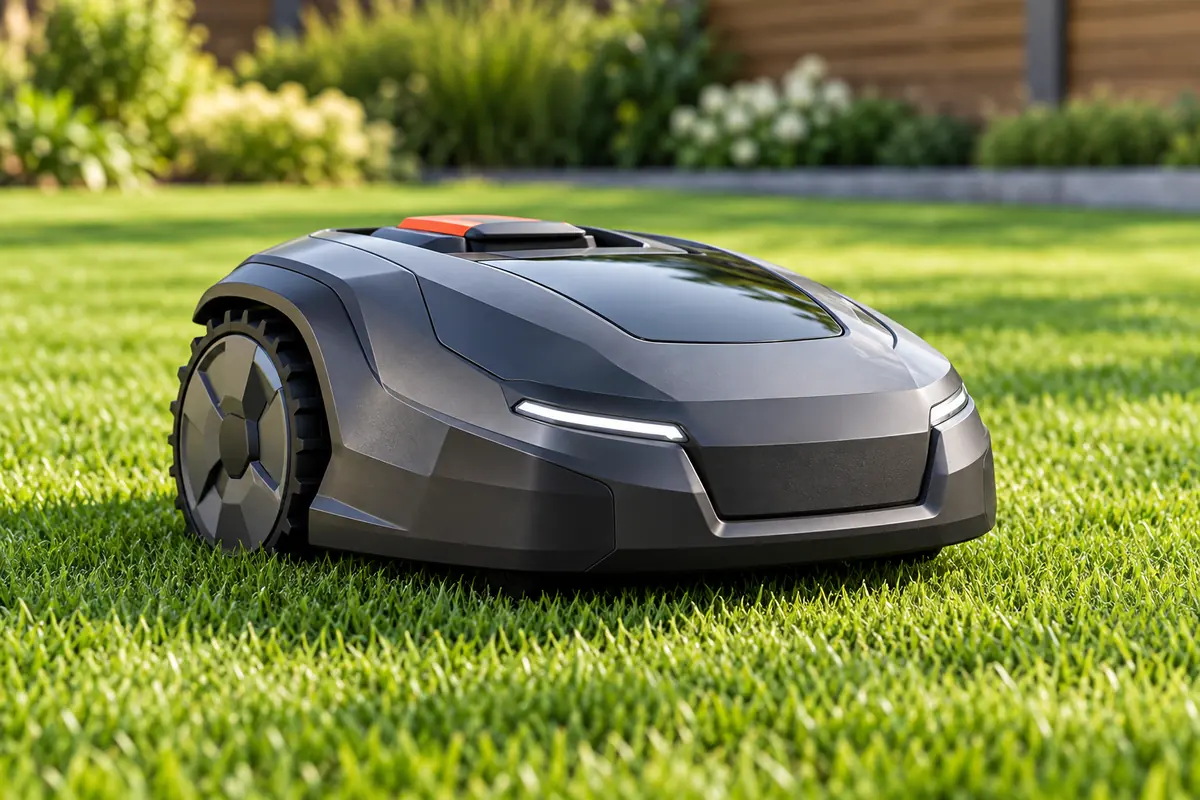
The best robot lawn mowers can take over much of the repetitive work involved in maintaining a lawn, but choosing one is less about buying the most advanced machine and more about matching its navigation system, traction, cutting range, and coverage to your yard.
For complex or hilly properties, the MAMMOTION LUBA 3 AWD 3000 stands out with all-wheel drive and a multi-sensor navigation system. The Husqvarna Automower 410 iQ is a strong premium option for typical U.S. lawns, while the eufy E15 focuses on simple camera-based setup for smaller, flatter yards. The WORX Landroid Vision Cloud WR310 offers a lower-cost route into modern wire-free mowing.
Modern robot mowers have moved beyond the buried perimeter wires used by many older systems. Current models increasingly rely on RTK positioning, LiDAR, cameras, cloud-based positioning, or combinations of these technologies to create virtual boundaries and systematic mowing paths.
They are not completely maintenance-free, though. You may still need to trim certain edges, clear problematic obstacles, clean the mower, replace blades, adjust virtual boundaries, and intervene when wet grass or difficult terrain reduces traction.
If you’re preparing the rest of your yard as well, our Best Garden Tools for Early Spring guide covers pruning, planting, cleanup, and soil-preparation tools.
Quick Answer: Best Robot Lawn Mowers
Best for Complex and Hilly Lawns: MAMMOTION LUBA 3 AWD 3000 — all-wheel drive, LiDAR, Network RTK, and camera vision make it the strongest option here for demanding terrain.
Best Premium Pick for Typical U.S. Lawns: Husqvarna Automower 410 iQ — useful 1–4 inch cutting height, virtual boundaries, app control, and a mature robotic-mower ecosystem.
Best for Easy Setup: eufy Robot Lawn Mower E15 — camera-based automatic mapping without a buried wire or separate RTK antenna, designed for smaller lawns.
Best Value Wire-Free Pick: WORX Landroid Vision Cloud WR310 — RTK Cloud, stereo cameras, V-SLAM, and automatic mapping at a lower price than the premium options.
How We Selected These Robot Lawn Mowers
We selected four models with clearly different roles rather than filling the guide with near-identical robotic mowers. The main criteria were lawn coverage, navigation technology, slope capability, cutting-height range, cutting width, setup requirements, current U.S. availability, and independent evidence about real-world performance.
We also considered how much infrastructure each mower needs. A robot that requires a buried boundary cable or dedicated positioning tower may still work very well, but a growing number of current buyers prefer systems that can create virtual boundaries through LiDAR, cameras, RTK, or cloud-based positioning.
Manufacturer slope ratings, coverage numbers, and runtime specifications should be treated as operating limits rather than guarantees. Wet grass, exposed roots, soft soil, tree cover, narrow passages, and the shape of your boundaries can all affect performance.
Discompare did not perform hands-on testing of these robot lawn mowers. Manufacturer specifications are combined with published independent testing where available.
Robot Lawn Mowers Compared
| Model | Recommended Lawn Size | Navigation | Slope Rating | Cutting Range | Best For |
|---|---|---|---|---|---|
| MAMMOTION LUBA 3 AWD 3000 | Up to 0.75 acre | 360° LiDAR + Network RTK + dual cameras | Up to 80% / 38.6° | 1–2.7″ selected standard version | Complex terrain |
| Husqvarna Automower 410 iQ | Up to 0.5 acre systematic | EPOS virtual boundary + radar | Up to 45% inside installation | 1–4″ | Typical U.S. lawns |
| eufy E15 | Up to 0.2 acre | Camera-based V-FSD | Up to 18° | 1–3″ | Small flat lawns |
| WORX Landroid Vision Cloud WR310 | Up to 0.25 acre | RTK Cloud + stereo cameras + V-SLAM | Up to 30% / 17° | 1.57–3.54″ | Value-focused wire-free mowing |
Important: Lawn-size ratings assume suitable conditions. A complicated yard with multiple zones, narrow passages, steep grades, trees, raised roots, or soft soil can be more demanding than a larger open rectangle.
Compare Current Robot Lawn Mower Prices
Robot mower prices can change substantially with seasonal promotions, bundles, and manufacturer discounts. Compare current exact-model offers rather than relying on a temporary sale price.


The 4 Best Robot Lawn Mowers
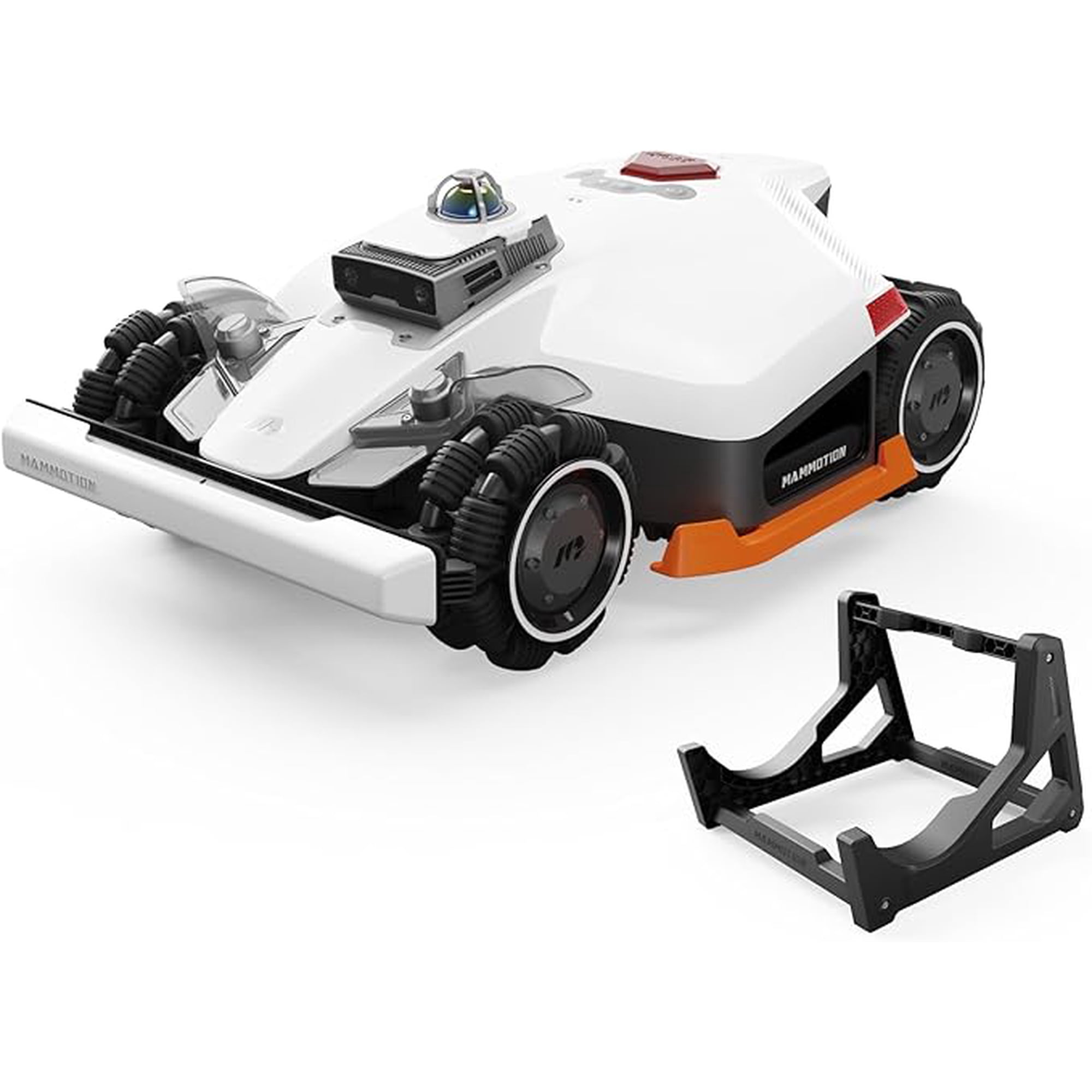
1. MAMMOTION LUBA 3 AWD 3000 — Best for Complex and Hilly Lawns
Best For: Uneven properties, steep slopes, multiple mowing zones, tree cover, and buyers who want a high-end navigation system.
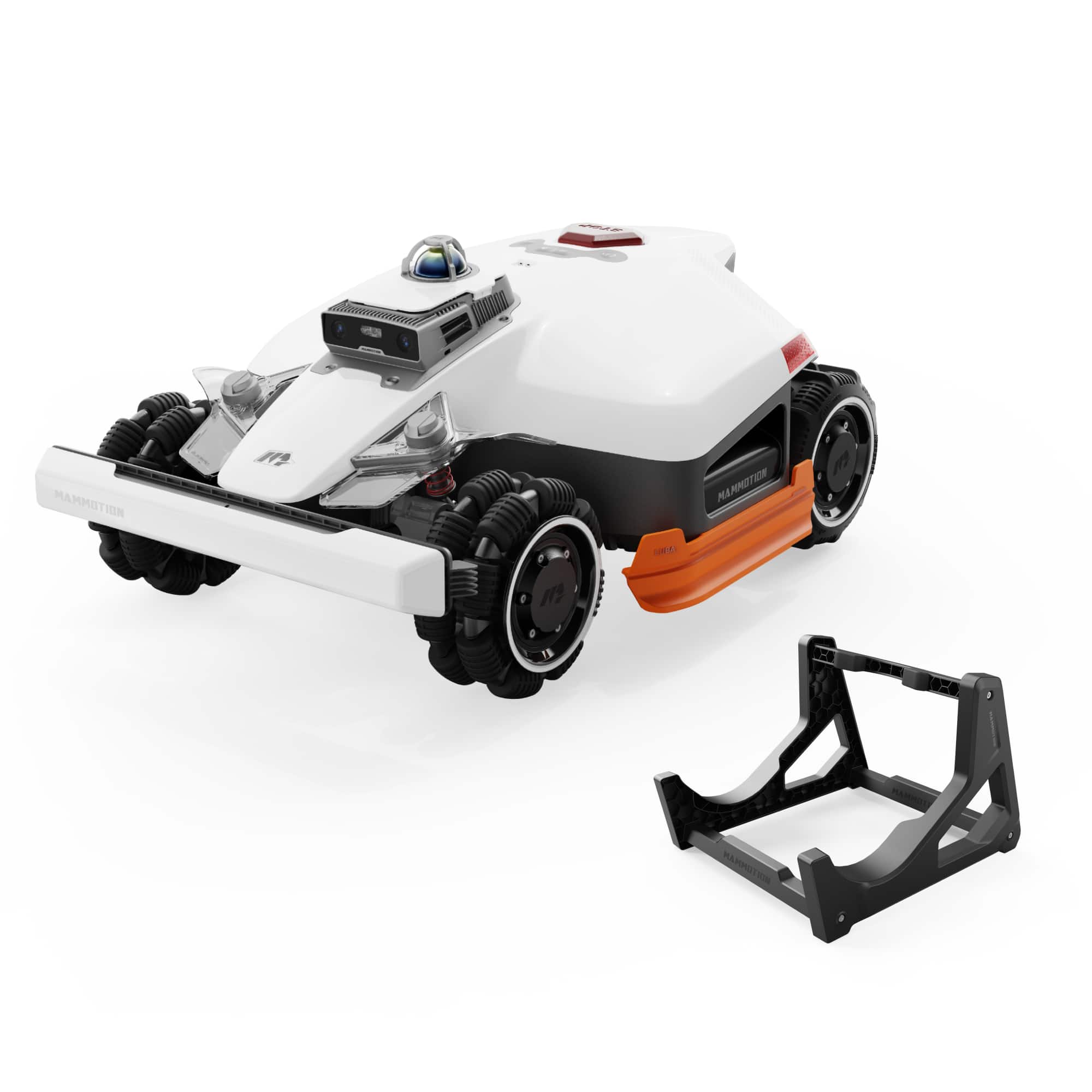
The MAMMOTION LUBA 3 AWD 3000 is the most terrain-focused model in this roundup. Its biggest advantage is the combination of all-wheel drive and a multi-sensor positioning system rather than dependence on one single navigation method.
MAMMOTION combines 360-degree LiDAR, Network RTK, and dual-camera AI vision in what it calls a Tri-Fusion positioning system. The 3000 version is rated for lawns up to 0.75 acre, and the company specifies slope handling up to 80%, equivalent to 38.6 degrees.
That makes it relevant for properties where a simple two-wheel robot may lose traction. The AWD system can also help with transitions between zones and uneven terrain.
The LUBA 3 uses a dual-disc cutting system with a wide mowing path, helping it cover more ground per pass than several smaller residential robots.
A major setup advantage is that the 3000 can use Mammotion’s Network RTK service rather than requiring a permanently installed physical RTK base station. LiDAR and cameras provide additional positioning and obstacle information.
Independent 2026 testing has supported its strengths on difficult ground, with reviewers praising navigation, hill performance, quiet operation, and coverage. The main concerns have been app complexity, occasional connectivity issues, and the learning curve associated with a highly configurable system.
Its aggressive drive system also deserves realistic expectations. Heavy AWD wheels that provide good traction on slopes can be less gentle on very soft or waterlogged turf.
Pros
✅ All-wheel drive for demanding terrain
✅ LiDAR, Network RTK, and dual-camera navigation
✅ Rated for lawns up to 0.75 acre
✅ Wide cutting system for faster coverage
Cons
❌ High purchase price
❌ More setup and app complexity than simpler systems
❌ Heavy AWD design can be aggressive on very soft turf
❌ More machine than many small flat lawns require
Who should skip it: Owners of small, flat, uncomplicated lawns are unlikely to benefit enough from the AWD hardware and advanced navigation to justify the added cost.
Alternative: Husqvarna Automower 410 iQ is a better fit for many conventional residential lawns where a broad cutting-height range and established support network matter more than extreme slope performance.
2. Husqvarna Automower 410 iQ — Best Premium Pick for Typical U.S. Lawns
Best For: Small-to-medium residential lawns, taller turf preferences, and buyers who want a mature robotic-mower ecosystem.
Husqvarna has been producing Automower systems for years, and the 410 iQ brings that established platform into the newer virtual-boundary generation.
The mower is rated for up to 0.5 acre when used with systematic mowing patterns. Husqvarna also lists an irregular-area capacity of 0.25 acre, which is an important reminder that yard complexity affects effective coverage.
Its biggest advantage for many U.S. homeowners is the 1-to-4-inch cutting-height range. That gives it more flexibility for grass types and mowing preferences than robots designed primarily around shorter European-style lawns.
Husqvarna specifies maximum slope performance of 45% inside the mowing area and 15% at the boundary. Its cutting system uses three pivoting razor blades and a 9.4-inch cutting width.
The 410 iQ supports virtual boundaries through Husqvarna EPOS and can also work with physical-wire installations. The system includes app-based scheduling, mowing-pattern selection, GPS theft tracking, PIN protection, lift and tilt sensors, and over-the-air firmware updates.
Obstacle detection uses radar rather than relying only on bump sensors. The app can also switch between systematic patterns including stripes and checkerboard-style mowing.
Husqvarna lists a typical mowing time of 84 minutes per charge. The mower then automatically returns to its station for charging before continuing its schedule.
The main downside is cost. You’re paying premium money for half-acre-class capacity, and the narrow cutting width means it may need more passes than a wide dual-disc machine such as the LUBA.
Pros
✅ Wide 1–4 inch cutting-height range
✅ Virtual boundaries and systematic patterns
✅ GPS theft tracking and app control
✅ Established Husqvarna support ecosystem
Cons
❌ Premium price for half-acre capacity
❌ Narrower 9.4-inch cutting width
❌ Boundary slope rating is lower than the internal-area rating
❌ Some difficult installations may still require additional planning or positioning hardware
Who should skip it: Buyers with extremely steep, muddy, or rough terrain may be better served by an AWD machine. Small simple yards may not justify this price tier.
Alternative: Consider Husqvarna’s larger iQ models when your lawn exceeds the 410 iQ’s intended capacity.
3. eufy Robot Lawn Mower E15 — Best for Easy Setup on Small Lawns
Best For: Small suburban lawns, flatter properties, and buyers who want to avoid boundary wires and dedicated RTK hardware.
The eufy E15 takes a deliberately simpler approach. Rather than asking the owner to bury wire or install an RTK reference station, it uses camera-based V-FSD navigation to map the yard and plan mowing routes.
eufy rates the E15 for up to 0.2 acre, with an 8-inch cutting width and adjustable cutting height from 1 to 3 inches. Maximum supported slope is 18 degrees.
The automatic mapping feature is the main attraction. For an appropriately shaped lawn, setup is closer to introducing the robot to the yard than engineering a permanent positioning system around the property.
Its smaller size and lower complexity also make it easier to understand than many flagship machines.
Independent testing has shown why yard compatibility matters, though. Reviewers have praised easy setup and generally even cutting but have also reported missed mapping areas, less convincing edge trimming, and traction problems on damp grass.
This means the E15 is most compelling on relatively flat, straightforward lawns. A property with steep grades, muddy sections, deep ruts, or very complex boundaries is not the ideal use case.
The mower is IPX6 rated and eufy lists operating noise around 56 dB, helping it work without the sound associated with a conventional gas mower.
Pros
✅ No buried perimeter wire
✅ No dedicated RTK antenna
✅ Automatic camera-based mapping
✅ Quiet operation and straightforward setup
Cons
❌ Limited 0.2-acre coverage
❌ Less suitable for steep terrain
❌ Damp grass can reduce traction
❌ Edge trimming may still require manual work
Who should skip it: Owners of large or steep lawns should choose a machine with greater coverage and stronger traction.
Alternative: The eufy E18 uses a similar navigation approach but is designed for a larger mowing area.
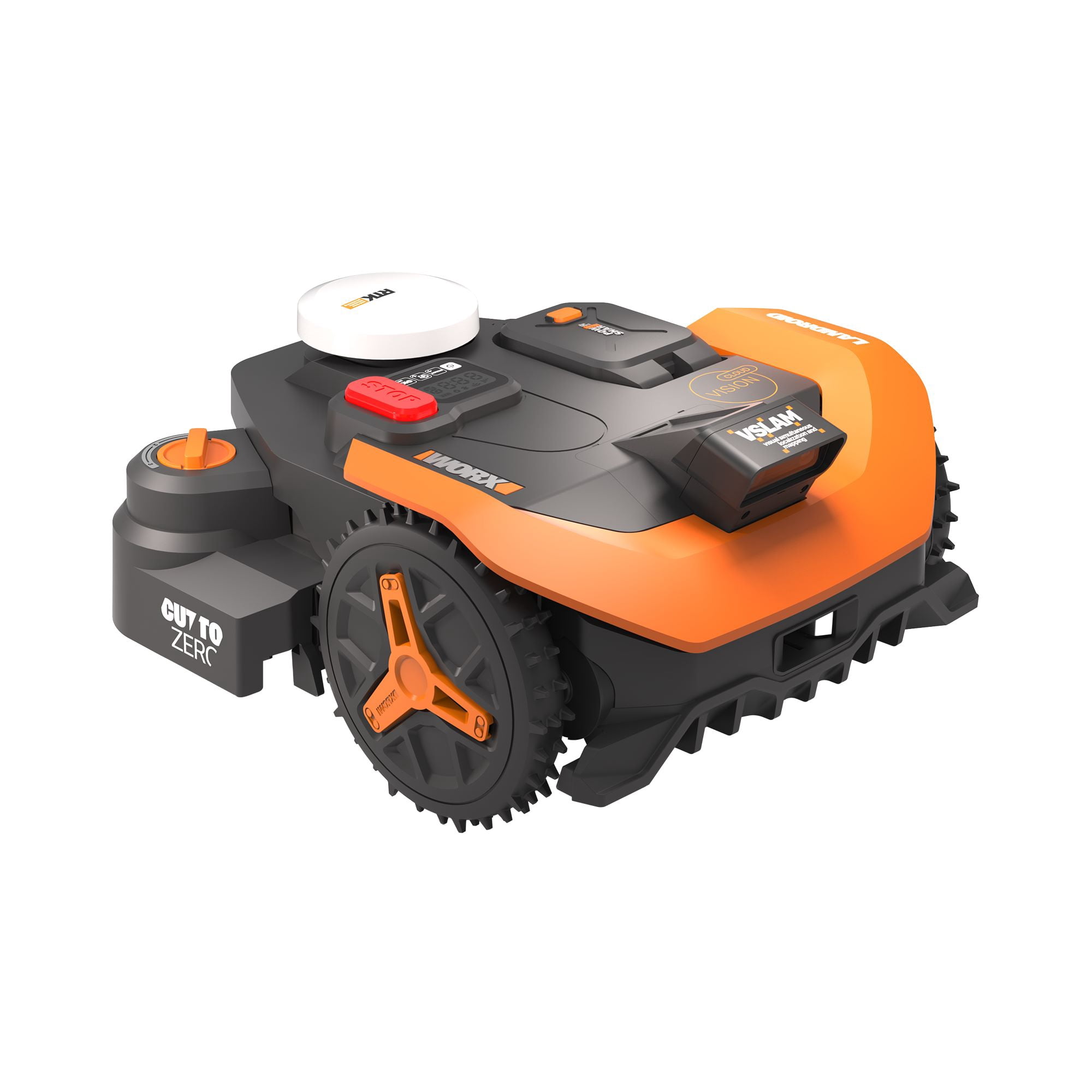
4. WORX Landroid Vision Cloud WR310 — Best Value Wire-Free Pick
Best For: Small lawns, moderate terrain, and buyers who want modern navigation without moving into a $2,000-plus flagship system.
The WR310 represents WORX’s newer Vision Cloud generation. It combines cloud-based RTK positioning, stereo cameras, and V-SLAM mapping without requiring a buried boundary wire or separate RTK tower.
WORX rates the WR310 for lawns up to 0.25 acre and slopes up to 30%, or about 17 degrees. Cutting height adjusts from approximately 1.57 to 3.54 inches, and the mower uses an 8.7-inch cutting width.
Another practical advantage is the removable 20V PowerShare battery. The battery ecosystem is shared with other compatible WORX cordless tools, which may appeal to households already invested in the platform.
WORX also emphasizes its Cut-to-Zero blade-offset design, intended to reduce the strip of uncut grass normally left around certain borders.
Independent reviewers have generally found the WR310 easy to install and competitively capable for its price. Its limitations become more noticeable on steep, uneven, or especially complex lawns, where higher-end AWD and multi-sensor systems have an advantage.
Cloud-based positioning is also worth understanding before purchasing. The system is designed to avoid the need for a local RTK tower, but reliable app connectivity and correct initial mapping still matter.
Pros
✅ No perimeter wire or separate RTK tower
✅ RTK Cloud, stereo cameras, and V-SLAM
✅ PowerShare removable battery platform
✅ Competitive price for modern navigation
Cons
❌ Limited to approximately 0.25 acre
❌ Not intended for extreme hills
❌ Navigation can still require map adjustments
❌ More complex terrain favors premium AWD alternatives
Who should skip it: Owners of large, steep, or highly uneven yards should prioritize greater traction and coverage.
Alternative: A larger Vision Cloud configuration may provide the same general navigation approach with additional lawn capacity.
How Robot Lawn Mower Navigation Works
Navigation technology is now one of the most important differences between robot lawn mowers.
Perimeter Wire
Traditional robot mowers use a low-voltage boundary wire installed around the edge of the mowing area. The mower detects the signal and stays inside the boundary.
This system can be reliable, but initial installation requires physical work. Moving flower beds, changing lawn shapes, or repairing damaged wire also adds maintenance.
RTK Positioning
RTK, or Real-Time Kinematic positioning, improves location accuracy beyond ordinary consumer GPS. Some systems require a physical reference station positioned with a clear view of the sky.
Newer platforms increasingly use Network RTK or cloud-based correction services, reducing or eliminating the need for a dedicated antenna on the property.
RTK works particularly well in open areas, but buildings, dense tree cover, and local conditions can affect satellite reception. Manufacturers increasingly combine it with cameras or LiDAR to improve reliability.
LiDAR
LiDAR measures the environment using laser-based distance sensing. A mower can use that information to understand nearby objects and terrain rather than depending exclusively on satellite positioning.
This can be useful near trees, buildings, or other areas where satellite reception is less consistent.
Camera and Vision Navigation
Camera-based systems analyze visual information to identify grass boundaries, objects, and routes. The advantage is simpler hardware installation because they may not need either a wire or external positioning tower.
The trade-off is that lighting, visual complexity, similar-looking surfaces, and changing yard conditions can make perception more challenging.
The strongest premium systems increasingly combine multiple methods rather than relying on one sensor alone.
Which Robot Lawn Mower Fits Your Yard?
| Your Yard | Suggested Model | Reason |
|---|---|---|
| Steep and uneven | MAMMOTION LUBA 3 AWD 3000 | AWD and high slope rating |
| Up to about half an acre, conventional turf | Husqvarna 410 iQ | 1–4″ cut range and mature ecosystem |
| Small, flat, simple lawn | eufy E15 | Simple camera-based mapping |
| Small lawn and lower budget | WORX WR310 | Modern navigation at a lower price |
| Very large lawn above these capacities | Larger model required | Choose capacity before brand preference |
Do Robot Lawn Mowers Replace Traditional Mowing?
They can replace most routine mowing for a compatible property, but they do not eliminate every lawn-care task.
Robot mowers work best by cutting frequently and removing very small amounts of grass at a time. The tiny clippings fall back into the lawn rather than being collected in a bag.
Because the robot repeatedly maintains the grass instead of waiting until it becomes tall, the lawn can remain visually consistent with less manual mowing.
You may still need a string trimmer or edger around walls, fences, raised beds, narrow borders, and other locations where the cutting disc cannot safely reach.
A conventional mower may also still be useful after prolonged downtime if the grass becomes significantly taller than the robot’s intended cutting range.
If you are comparing robotic mowing with traditional push or self-propelled equipment, preserve `{{URL_TOP_LAWN_MOWERS}}` for the planned conventional lawn-mower guide once its published URL is verified.
Safety and Obstacle Detection
Current robot mowers combine several safety systems, including lift sensors, tilt detection, object recognition, radar, cameras, bump sensing, or automatic blade shutdown.
These systems reduce risk, but they should not be treated as a reason to leave small children, pets, toys, hoses, tools, or other hazards unattended in the mowing area.
Before a scheduled session, remove objects that could become tangled, damaged, or difficult for the mower to classify.
Small debris deserves particular attention because a camera or radar system may not identify every object reliably under every condition.
Always follow the manufacturer’s guidance regarding operation around people and animals.
Are Robot Lawn Mowers Eco-Friendly?
Robot lawn mowers are battery-powered and do not produce exhaust at the point of use, but that alone does not mean every robotic mower has a lower overall environmental impact than every conventional alternative.
Manufacturing electronics, batteries, replacement parts, charging electricity, eventual battery replacement, and the lifespan of the mower all matter.
A better approach is to look at practical attributes rather than broad environmental labels: energy consumption, repairability, battery replacement options, blade life, noise, and how long you expect to keep the machine.
For other products where environmental claims need similar scrutiny, our Spring Cleaning: Eco-Friendly Products guide explains how we distinguish specific documented attributes from vague sustainability marketing.
Robot Lawn Mower Maintenance
Robot mowing reduces labor, but the machine still needs maintenance.
Replace or Rotate Cutting Blades
Small pivoting razor blades gradually wear as they contact grass, small debris, and occasional obstacles. Replace them according to the manufacturer’s instructions and actual condition.
Dull blades can tear grass rather than cutting it cleanly.
Clean the Underside
Grass clippings can accumulate around the deck, wheels, and cutting mechanism. Follow the manufacturer’s cleaning instructions and avoid directing water into components that are not rated for it.
Inspect Wheels and Sensors
Mud or grass on wheels can reduce traction. Dirty cameras, LiDAR covers, or other sensors can also interfere with navigation.
Maintain the Charging Area
Keep the path to the charging station clear and ensure the station remains level and correctly positioned.
Adjust Maps When the Yard Changes
New landscaping, garden beds, play equipment, or construction can change the mowing area. Update virtual boundaries and no-go zones rather than expecting an older map to remain correct indefinitely.
Frequently Asked Questions
Are robot lawn mowers worth buying?
They can be worthwhile when routine mowing consumes substantial time and your lawn is compatible with the mower’s coverage, slope, cutting-height, and navigation limits. Their value is lower when you have a very small lawn or terrain that frequently requires manual intervention.
Do modern robot lawn mowers need a perimeter wire?
Not necessarily. Many current models use virtual boundaries created through RTK, LiDAR, cameras, V-SLAM, cloud positioning, or combinations of these technologies. Some models still support physical boundary wires as an option.
Which robot mower is best for hills?
Among the models in this guide, the MAMMOTION LUBA 3 AWD 3000 has the highest published slope capability and uses all-wheel drive. Real traction still depends on moisture, soil firmness, roots, and the direction of travel.
Can a robot mower handle wet grass?
Some models are weather-resistant, but wet turf can reduce traction, increase clumping, and leave wheel marks. Independent testing has shown that some two-wheel machines may slip on damp grass. Follow the manufacturer’s operating guidance and postpone mowing when conditions are unsuitable.
Do robot lawn mowers collect grass clippings?
Most residential robot mowers do not collect clippings. They mow frequently and cut off very small pieces of grass that remain on the lawn as mulch.
Do I still need a string trimmer?
Often yes. Even models with edge-cutting features may leave grass along walls, fences, raised borders, or other places where the blade cannot safely reach. The amount of manual trimming depends on the yard layout and mower design.
How large a robot lawn mower should I buy?
Choose a mower with enough capacity for the actual mowable area and some practical headroom. Yard complexity matters as much as raw acreage, so a lawn with many zones, obstacles, slopes, or narrow passages may require a more capable model than an open lawn of similar size.
Final Verdict: Which Robot Lawn Mower Should You Buy?
The best robot lawn mower is determined more by the property than by the brand name.
Choose the MAMMOTION LUBA 3 AWD 3000 for complex terrain, steep slopes, or larger multi-zone lawns where AWD and redundant positioning systems provide a meaningful advantage.
Choose the Husqvarna Automower 410 iQ for a typical premium residential setup where a broad 1–4 inch cutting range, established support, virtual boundaries, and mature app features matter.
Choose the eufy E15 when your lawn is relatively small and flat and your main priority is avoiding perimeter-wire and RTK-station installation.
Choose the WORX WR310 when you want modern wire-free mapping at a lower price and your lawn is within its quarter-acre and moderate-slope limits.
Complex / Hilly Lawn: MAMMOTION LUBA 3 AWD 3000
Premium Typical Lawn: Husqvarna Automower 410 iQ
Easy Small-Lawn Setup: eufy Robot Lawn Mower E15
Value Wire-Free Pick: WORX Landroid Vision Cloud WR310
Before ordering, measure your mowable area, identify the steepest sections, check your preferred grass height, and examine any narrow passages or soft ground. A robot that suits the physical yard will provide more value than a more expensive model whose headline features do not match your property.
Sources
- MAMMOTION — LUBA 3 AWD Product Specifications and U.S. Product Documentation
- Husqvarna — Automower 410 iQ Product Specifications
- eufy — E15 Robot Lawn Mower Product Specifications
- WORX — Landroid Vision Cloud WR310 Product Specifications
- Tom’s Guide — Robot Lawn Mower Buying and Long-Term Testing Guidance
Product Groups: MAMMOTION LUBA 3 AWD 3000, Husqvarna Automower 410 iQ, eufy Robot Lawn Mower E15, WORX Landroid Vision Cloud WR310