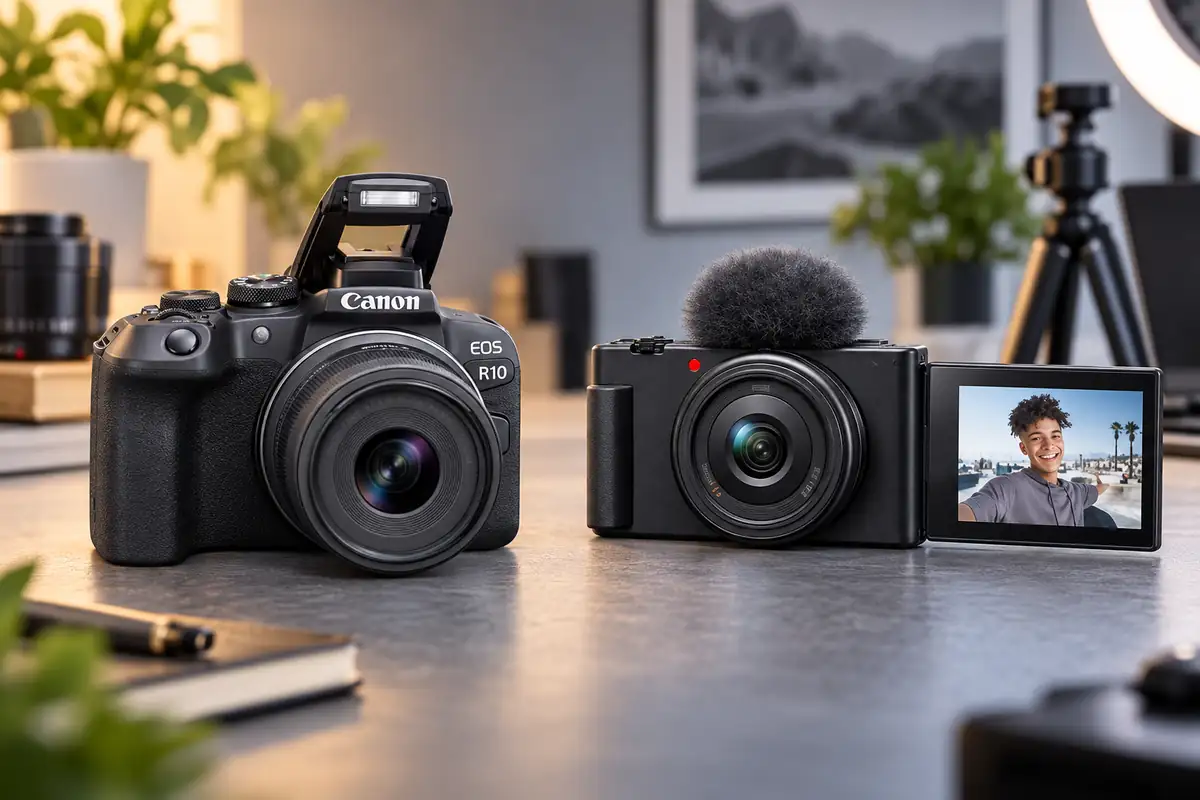
Canon EOS R10 vs Sony ZV-E10 | Which Is Better?
The Canon EOS R10 is the better camera overall if you want to learn photography while also shooting video. Its electronic viewfinder, stronger grip and controls, built-in flash, faster burst shooting and 4K/60 option make it much closer to a traditional all-purpose mirrorless camera. The Sony ZV-E10, however, is the better fit for budget-conscious vloggers thanks to its smaller body, creator-focused controls, directional microphone and headphone output.
There is an important 2026 buying caveat. Canon now marks the EOS R10 as discontinued and unavailable through its U.S. direct store, although new authorized-retailer inventory may still be available. Sony still maintains the original ZV-E10 in its U.S. product lineup, but the newer ZV-E10 II has replaced it as Sony’s more capable current-generation creator camera.
That means this comparison is no longer simply about specifications. If you find the R10 at a competitive price, it remains the stronger beginner photography camera. If you mainly vlog and can buy the original ZV-E10 cheaply, Sony’s older body can still offer excellent value. If video is your priority and the price difference is manageable, you should also compare the ZV-E10 II before buying.
Quick Winner: Canon EOS R10 vs Sony ZV-E10
Best Overall: Canon EOS R10 — the stronger all-purpose beginner camera for photography, family use, travel and occasional video.
Best for Photography: Canon EOS R10 — EVF, faster bursts, built-in flash and conventional camera controls make it easier to grow as a photographer.
Best for Vlogging: Sony ZV-E10 — lighter body, directional three-capsule microphone, headphone monitoring and creator-specific shooting modes.
Best for Portability: Sony ZV-E10 — approximately 343 g with battery and memory card compared with about 426 g for the Canon.
Best Buy Today: Canon if photography is the priority and remaining R10 stock is sensibly priced; Sony if the original ZV-E10 is substantially cheaper and your focus is vlogging.
Important 2026 Buying Context
Neither camera now represents a straightforward current-generation matchup. Canon’s U.S. store marks the EOS R10 body and kits as discontinued, although retailer inventory can remain available. Sony still lists the original ZV-E10, but the ZV-E10 II is the newer creator-focused model with a 26MP sensor, 4K/60 and more advanced video capabilities. The R10 and original ZV-E10 therefore make the most sense when their live prices compensate for their age or product status.
This does not make the comparison irrelevant. Both cameras remain attractive because they target buyers who want to move beyond smartphone photography without spending full-frame-camera money. They also approach that job very differently, which makes the decision relatively easy once you know whether photography or video matters more.
If you are still deciding what type of first camera you need, our digital cameras for beginners guide compares current mirrorless, full-frame step-up and point-and-shoot options beyond these two models.
Canon EOS R10 vs Sony ZV-E10: Specs at a Glance
| Feature | Canon EOS R10 | Sony ZV-E10 | Winner |
|---|---|---|---|
| Sensor | 24.2MP APS-C | 24.2MP APS-C | Tie |
| Viewfinder | 2.36M-dot OLED EVF | None | Canon |
| Maximum Burst | 15 fps mechanical / 23 fps electronic | Up to 11 fps | Canon |
| 4K Video | Full-width 4K/30; cropped 4K/60 | Full-width 4K/24; cropped 4K/30 | Canon |
| 10-bit Internal Option | HDR PQ | No | Canon |
| Built-In Audio | Standard built-in microphone | Directional three-capsule microphone + windscreen | Sony |
| Headphone Output | No | Yes | Sony |
| IBIS | No | No | Tie |
| Operating Weight | About 426 g | About 343 g | Sony |
| Lens Mount | Canon RF / RF-S | Sony E | Sony for APS-C lens breadth |
| Current Manufacturer Status | Canon U.S. direct: discontinued | Still listed; newer ZV-E10 II available | Depends on price and use |
Compare Current Canon EOS R10 and Sony ZV-E10 Prices
Current price matters more than launch MSRP in this comparison. The EOS R10 is now remaining-stock territory in the U.S., while the original ZV-E10 competes directly with discounts on its own successor. Make sure you are comparing body-only listings with body-only listings and kits with equivalent lens kits.

Capture fast action and stunning video with the Canon EOS R10 — now bundled with a battery and charger.
Powered by the R3-derived DIGIC X processor, the R10 delivers high-speed continuous shooting and 120p Full HD slow-motion for creative results.
Order yours today and start shooting immediately.
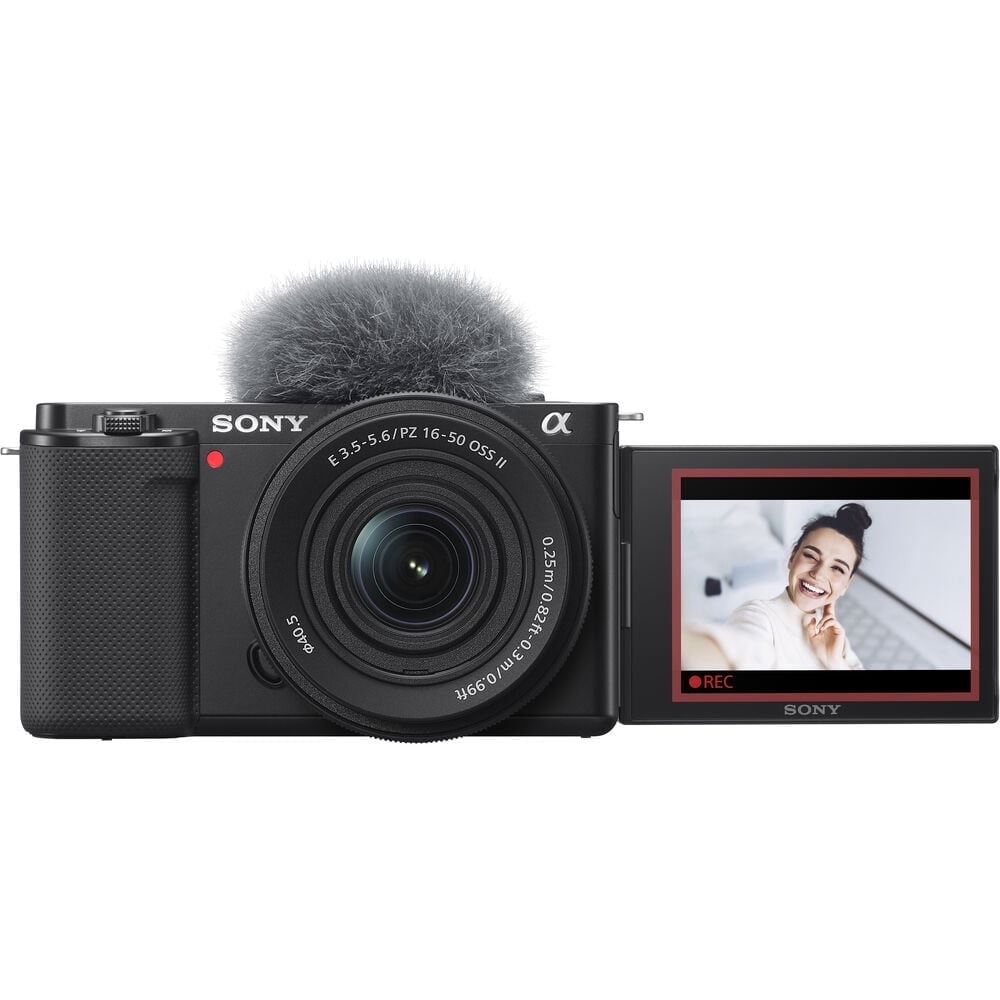
Capture cinematic-quality footage with the Sony ZV-E10 Mirrorless w/ 16-50mm Lens — APS-C sensor, lightweight mirrorless design, and vlogger-focused features make it perfect for creators. Don’t wait: grab yours now and start creating standout videos today.
Photography: Canon EOS R10 Wins
The Canon EOS R10 is the better photography camera because it gives a beginner the conventional tools expected from an interchangeable-lens camera instead of designing the body primarily around self-recorded video.
The electronic viewfinder is the biggest everyday difference. Looking through an EVF makes it easier to compose in bright sunlight, brace the camera against your face and follow moving subjects. Sony’s ZV-E10 relies entirely on its rear LCD, which works well for vlogging but feels less natural for traditional photography.
Canon also gives you a more substantial grip, direct controls and a built-in pop-up flash. Those features matter when you move beyond automatic shooting and begin adjusting shutter speed, aperture, ISO and autofocus while keeping your eye on the scene.
The R10’s 24.2MP APS-C sensor delivers plenty of resolution for family photography, travel, portraits and large everyday prints. The Sony also has a 24.2MP APS-C sensor, so sensor resolution alone should not decide this comparison.
Canon’s advantage is instead the complete shooting experience. DPReview describes the R10 as beginner-friendly while retaining meaningful manual capability, which makes it much easier to recommend to someone who wants photography to become a hobby rather than simply needing a camera for videos.
Autofocus: Both Are Strong
Autofocus should not be the deciding factor for most buyers because both cameras perform well for their intended audiences.
Canon uses Dual Pixel CMOS AF and offers subject-tracking features inherited from higher-tier EOS R cameras. Its autofocus works particularly well with the R10’s fast burst shooting, making the camera useful for family action, pets and casual sports.
The Sony uses a Fast Hybrid AF system with 425 phase-detection points and supports eye autofocus for people and animals. Its creator modes build on that system effectively: Product Showcase can move focus from your face to an object presented toward the camera, which is useful for reviews, tutorials and unboxings.
For still photography, Canon’s viewfinder, burst speed and traditional controls give the whole autofocus experience an edge. For self-recorded video, Sony’s creator-focused behavior makes autofocus very easy to use without another person operating the camera.
Sports and Moving Subjects: Canon EOS R10 Wins
The EOS R10 is substantially better for sports and action. It can shoot at up to 15 frames per second using its mechanical shutter and up to 23 fps electronically, compared with up to 11 fps from the ZV-E10.
The viewfinder is just as important as the frame-rate specification. Following a child, pet, athlete or moving vehicle is easier when you can hold the camera to your eye instead of keeping a rear screen visible at arm’s length.
The R10 is not a professional sports camera. Its RAW buffer can fill quickly during long bursts, and electronic-shutter shooting can introduce rolling-shutter distortion with fast movement. But between these two cameras, Canon is clearly the stronger action tool.
Vlogging: Sony ZV-E10 Wins
The Sony ZV-E10 is the better vlogging camera because its body, controls and audio system were designed specifically around filming yourself.
The fully articulating screen faces forward, and Sony adds one-touch tools such as Background Defocus and Product Showcase. These features reduce the number of settings a solo creator needs to adjust while recording.
Audio is an even larger advantage. The original ZV-E10 includes a built-in directional three-capsule microphone and comes with a windscreen. It also provides both a 3.5mm microphone input and headphone output, which means you can add an external microphone and monitor audio during recording.
The Canon EOS R10 has a microphone input but lacks a headphone jack. It can still produce good creator video, particularly with an external microphone, but Sony’s built-in workflow is more complete for someone sitting in front of the camera.
The ZV-E10 is also easier to carry. Sony lists an operating weight of approximately 343 g with battery and memory card, versus about 426 g for the R10. That difference becomes more noticeable on a small tripod, handheld grip or travel setup.
Creators considering a more capable Sony body should also compare the current models in our best Sony mirrorless cameras guide. The newer ZV-E10 II is especially relevant if you need 4K/60 and more advanced video recording.
Video Quality: Canon Wins on Specs, but Both Have Caveats
The Canon EOS R10 has the stronger video specification sheet. It records oversampled full-width 4K at up to 30p and offers 4K/60, although the 60p mode uses a substantial 1.56x crop.
The ZV-E10 produces detailed oversampled 4K at 24p. Moving to 4K/30 introduces approximately a 1.23x crop, and there is no 4K/60 mode on the original model.
Sony’s largest video weakness is rolling shutter. DPReview measured sensor readout at about 33 ms in 4K/24 and 27 ms at 4K/30. Fast pans or rapidly moving subjects can therefore appear skewed or develop a distracting jello-like effect.
The Canon is not free from rolling shutter either, particularly in its full-width high-quality 4K mode. Its cropped 4K/60 setting also makes wide-angle filming harder and can reduce image quality in lower light.
Neither camera is ideal for fast handheld movement. For talking-head videos, product content and more static scenes, the Sony remains very usable. For someone who wants a broader hybrid video specification alongside photography, Canon has the advantage.
Stabilization: Neither Camera Has IBIS
This category is a tie because neither the EOS R10 nor ZV-E10 has sensor-shift in-body image stabilization.
Both systems can use lenses with optical stabilization, and both brands provide additional digital video-stabilization options. Digital stabilization typically crops the image, so it is not a complete substitute for moving-sensor IBIS.
This matters most for handheld video and low-light photography with unstabilized lenses. A tripod, stabilized lens or gimbal can solve many of these situations, but buyers who specifically want IBIS should consider a different body rather than expecting either camera to provide it.
Design, Viewfinder and Controls: Canon Wins
The EOS R10 feels more like a conventional photography camera. Its grip, EVF, built-in flash and direct controls make it easier to operate while concentrating on the subject rather than the rear screen.
The ZV-E10 deliberately takes the opposite approach. Removing the viewfinder reduces size and weight, while the fully articulating LCD and large video controls favor someone filming themselves. That is an advantage for creators but a compromise for photographers.
If you expect to take still photos most of the time, Canon’s design is significantly better. If the camera will usually sit on a desk tripod, handheld creator grip or small travel tripod facing you, Sony’s simpler layout makes more sense.
Portability: Sony ZV-E10 Wins
The Sony ZV-E10 is about 83 g lighter with battery and memory card, and its body is substantially flatter because there is no viewfinder hump.
That makes it easier to fit into a small day bag or use on a compact creator grip. The difference becomes even larger when paired with a small Sony power-zoom kit lens.
The R10 is still a lightweight mirrorless camera and remains easy to travel with, but its stronger grip and EVF create a more conventional camera shape.
If rugged first-person travel footage matters more than interchangeable lenses, neither may be the best format. Our most popular action cameras for travelers covers smaller waterproof cameras designed for mounting, sports and rough environments.
Audio and Streaming: Sony Wins
The ZV-E10 wins for audio and streaming because Sony built these functions into the camera’s core creator identity.
The directional microphone and included windscreen are useful when recording without an external microphone, while the separate mic input and headphone output provide a better path toward more serious audio.
The ZV-E10 can also function as a USB webcam, making it practical for livestreaming, calls and desktop content creation without requiring the same type of dedicated capture workflow that older cameras often needed.
The R10 can support external microphones and is capable of streaming workflows, but its overall hardware design is less specifically optimized around solo content creation.
Lenses and Upgrade Path: Sony Has the Broader APS-C Ecosystem
Sony has the advantage if affordable native APS-C lens selection is a major priority. The E-mount ecosystem has existed for many years and includes extensive Sony and third-party options from manufacturers covering everything from compact primes to wide-angle creator lenses and telephoto zooms.
Canon’s R10 uses the RF mount and accepts both RF-S APS-C and full-frame RF lenses. It can also use older EF and EF-S DSLR lenses through Canon’s EF-EOS R mount adapter.
That gives Canon a substantial total lens ecosystem, but the number of compact native RF-S choices specifically designed around APS-C has historically been more limited than Sony’s mature APS-C E-mount range.
The upgrade paths are also different. An R10 owner can eventually move into a full-frame Canon RF body while retaining compatible full-frame RF lenses. A ZV-E10 user can similarly move into Sony’s larger APS-C or full-frame Alpha bodies, though APS-C lenses used on full-frame cameras normally trigger a cropped capture area.
Price and Value: Sony Can Win, but Check the Newer Models
The original ZV-E10 becomes particularly attractive when its live price is far below remaining new R10 stock. Its sensor, autofocus, microphone system and E-mount lens compatibility remain useful even though the body is no longer Sony’s newest creator camera.
The problem is that old-model value disappears quickly when the ZV-E10 II falls into a nearby price range. The newer Sony adds a 26MP sensor, 4K/60 and significantly more advanced video capability. A small price gap can therefore make buying the original ZV-E10 harder to justify.
The R10 has the opposite issue. Canon-direct discontinuation means retailer pricing can become inconsistent as stock declines. It remains an excellent camera, but scarcity should not turn it into a premium-priced collectible. If a newer current beginner camera costs the same or less, compare the alternatives before buying.
Who Should Buy the Canon EOS R10?
Buy the Canon EOS R10 if photography is at least as important as video. It is the stronger choice for learning photography, family events, pets, travel, casual sports and anyone who wants a viewfinder and conventional camera controls.
Its faster bursts make it much more useful for movement, while the built-in flash can be handy for casual indoor photography. The R10 also provides more advanced video options than the original ZV-E10, including cropped 4K/60.
The biggest reason not to buy it is current product status. Treat it as a remaining-stock value purchase rather than assuming it deserves any price simply because it is becoming harder to find.
Who Should Buy the Sony ZV-E10?
Buy the Sony ZV-E10 if you primarily create YouTube videos, tutorials, product reviews, livestreams or talking-head content and can find the original model at an attractive price.
The microphone system, headphone jack, creator modes, articulating screen and low weight give it a much more convenient solo-video workflow than the R10.
Photography is possible and image quality is good, but the absence of a viewfinder, mechanical photography-focused ergonomics and sensor stabilization makes the camera less compelling if still images are your primary reason for buying a dedicated camera.
Better Alternatives in 2026
Sony ZV-E10 II
The ZV-E10 II is the first alternative video buyers should check. It moves to a 26MP APS-C sensor and adds 4K/60 plus more advanced recording options. If the original ZV-E10 is only slightly cheaper, the newer camera is usually easier to justify for a video-first buyer.
Nikon Z50II
The Nikon Z50II is one of the strongest current alternatives for beginners who want a conventional photo/video hybrid. It has an EVF, modern subject-recognition autofocus and a current manufacturer position rather than relying on remaining discontinued inventory.
Our beginner camera comparison covers the Z50II and other current starter models in more detail.
A Smartphone May Still Be Enough
If your priority is family snapshots, travel, social-media content and easy editing rather than interchangeable lenses, a dedicated camera may add more complexity than benefit. Our best smartphones for photography explains where modern phones are competitive and where a mirrorless camera still provides meaningful advantages.
Canon EOS R10 vs Sony ZV-E10: Best Choice by Use Case
| Use Case | Winner | Why |
|---|---|---|
| Beginner photography | Canon EOS R10 | EVF, better grip, built-in flash and conventional controls |
| Family, pets and casual sports | Canon EOS R10 | Up to 15 fps mechanical / 23 fps electronic bursts |
| Photography + video hybrid | Canon EOS R10 | More balanced camera design and 4K/60 option |
| Vlogging | Sony ZV-E10 | Directional mic, headphone monitoring and creator modes |
| Travel portability | Sony ZV-E10 | Smaller, lighter body |
| Budget creator setup | Sony ZV-E10 | Strong creator features if the older body is heavily discounted |
| Best if both cost about the same | Canon EOS R10 | More complete all-purpose camera unless video-first use dominates |
Frequently Asked Questions
Is the Canon EOS R10 better than the Sony ZV-E10?
Yes for most photographers. The EOS R10 has an electronic viewfinder, faster burst shooting, stronger traditional controls, a built-in flash and a 4K/60 option. The ZV-E10 is the better specialist choice for affordable vlogging.
Which camera is better for beginners?
The Canon EOS R10 is better for a beginner who wants to learn photography and video together. The Sony ZV-E10 is easier to recommend when the beginner specifically wants to create vlogs, product videos or livestreams.
Which is better for photography, Canon R10 or Sony ZV-E10?
Canon R10. Both have 24.2MP APS-C sensors, but the Canon adds an EVF, faster continuous shooting, better photography ergonomics and a built-in flash.
Which is better for vlogging?
Sony ZV-E10. Its directional three-capsule microphone, headphone jack, Product Showcase mode, Background Defocus control, articulating screen and lower weight make it better suited to solo creators.
Does the Canon EOS R10 or Sony ZV-E10 have IBIS?
Neither camera has sensor-shift in-body image stabilization. Both can benefit from stabilized lenses and digital video stabilization, but digital stabilization typically introduces an additional crop.
Is the Canon EOS R10 discontinued?
Canon’s U.S. direct store currently marks the EOS R10 body and relevant kits as discontinued and no longer available. New inventory may still remain at authorized retailers, so availability should be checked before purchase.
Is the original Sony ZV-E10 still worth buying?
It can be worth buying when heavily discounted. The original ZV-E10 still offers good 4K/24 quality, strong autofocus and useful creator features, but buyers should compare the ZV-E10 II before purchasing because the newer model adds 4K/60 and substantially more advanced video capabilities.
Which camera has the better lens selection?
Sony has the advantage for native APS-C lens breadth because the E-mount ecosystem includes many Sony and third-party options. Canon R10 can use RF-S and full-frame RF lenses and can also adapt many EF and EF-S DSLR lenses with the appropriate Canon adapter.
Final Verdict: Canon EOS R10 or Sony ZV-E10?
The Canon EOS R10 wins this comparison overall. If your goal is to learn photography, photograph family and travel, capture pets or sports and still have capable video available, its EVF, burst performance, controls and broader hybrid design make it the better camera.
The Sony ZV-E10 remains the better choice for budget vlogging. Its directional microphone, headphone output, creator modes, low weight and mature E-mount ecosystem make it easy to build a compact YouTube or streaming setup.
Current product status should influence the final purchase. Do not overpay for remaining R10 inventory simply because Canon has discontinued direct sales. Likewise, do not buy the original ZV-E10 without checking how much more the ZV-E10 II costs at the same retailer.
Bottom line: Buy the Canon EOS R10 if photography and all-purpose camera use come first. Buy the Sony ZV-E10 if vlogging, portability and creator-focused audio matter most and the older Sony is meaningfully cheaper than its successor.
Sources
- Canon — EOS R10 official product page and specifications — current U.S. product status
- Sony — Alpha ZV-E10 official product page and specifications — current U.S. listing
- DPReview — Canon EOS R10 In-Depth Review
- DPReview — Sony ZV-E10 Review
- RTINGS — Canon EOS R10 and Sony entry-camera testing context — September 2026
Product Groups: Canon EOS R10, Sony ZV-E10