LG vs Samsung Soundbars 2026
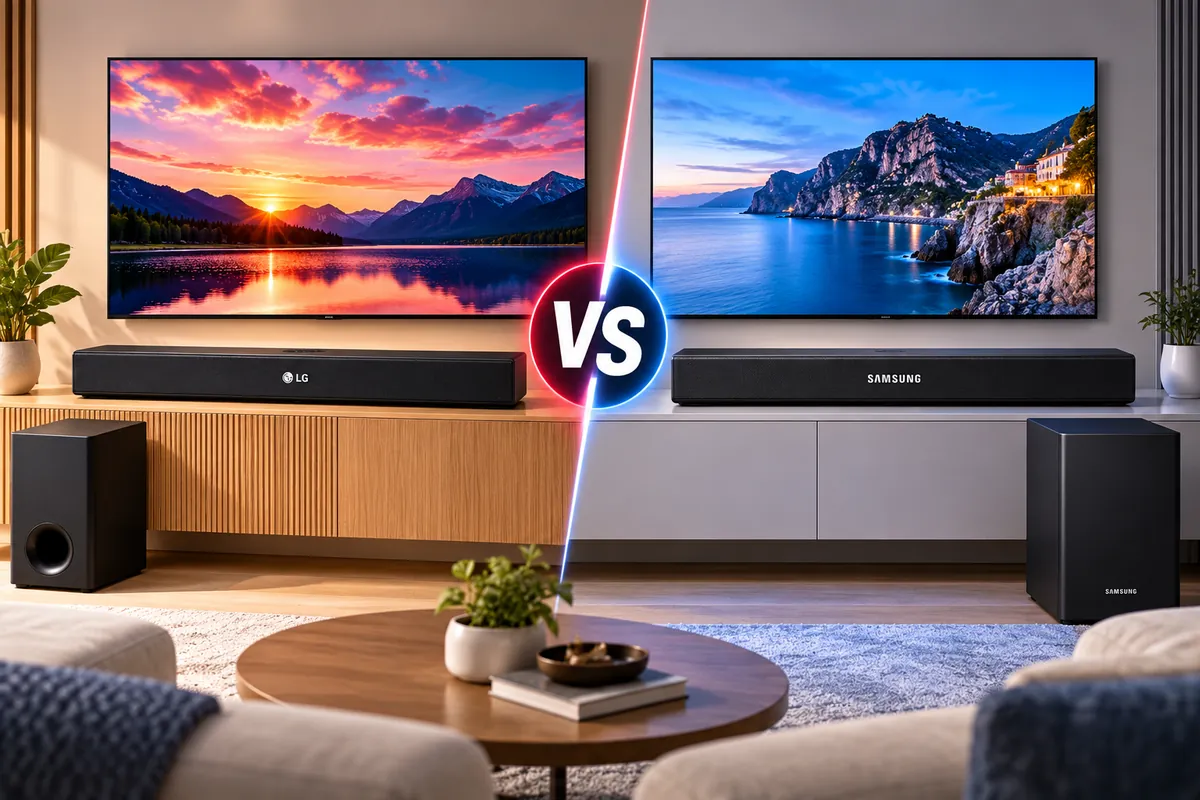
Samsung makes more sense for most buyers who want a complete home-theater soundbar system, while LG is the stronger choice for flexible speaker placement and modular upgrades. In this LG vs Samsung soundbars comparison, the Samsung HW-Q990H is our preferred premium all-in-one purchase because it includes a subwoofer, rear speakers, and 4K/120Hz HDMI passthrough. However, LG’s Sound Suite offers greater freedom to build and arrange a surround system around your room.
The latest 2026 models make this comparison especially interesting. Samsung offers the 11.1.4-channel HW-Q990H and the compact HW-QS90H, which uses built-in woofers instead of a separate subwoofer. LG takes a different approach with its Sound Suite H7, which can operate alone or connect to additional wireless speakers and subwoofers.
Choosing between them involves more than Dolby Atmos channel counts. Sound quality, dialogue clarity, bass, TV compatibility, gaming connections, and total system cost all matter. Also, LG added DTS:X support to the H7 in October 2026, addressing a limitation noted in earlier reviews.
Below, we compare current LG and Samsung soundbars at three levels: standalone models, complete home-theater packages, and expanded surround systems. The goal is to help you choose the right audio setup rather than declare a winner based on brand reputation.
Quick Answer: LG vs Samsung Soundbars
Which Soundbar Brand Should You Choose?
Best Complete Home Theater — Samsung: The HW-Q990H includes its subwoofer and two rear speakers in one 11.1.4-channel package, with strong movie performance and gaming connectivity.
Best Modular System — LG: Sound Suite lets you begin with the H7 soundbar and expand using M5 or M7 speakers and W7 subwoofers.
Best Standalone Convenience — Samsung: The HW-QS90H delivers 7.1.2-channel sound with four integrated woofers and no separate subwoofer to place.
Best Speaker Placement Flexibility — LG: Dolby Atmos FlexConnect adjusts sound according to compatible speaker positions, making unconventional room layouts easier to accommodate.
Best Premium Package Value — Samsung: The Q990H’s $1,999.99 launch price is lower than the regular reference prices of LG’s comparable complete surround bundles.
How We Compared LG and Samsung Soundbars
We compared current U.S. manufacturer specifications, original prices, included components, audio formats, HDMI connectivity, room-calibration features, and expansion options. We also reviewed independent testing from RTINGS to evaluate dialogue, music, surround sound, bass, and gaming performance.
Rather than compare a standalone LG soundbar with a complete Samsung package, we separated products by their intended use. This makes the differences easier to understand and the pricing more meaningful.
Our findings reflect published specifications and independent test evidence, not hands-on testing conducted by Discompare. Product prices and bundle offers may change, and some features depend on firmware or TV compatibility. Discompare may earn commissions through participating shopping and price-comparison partners.
LG vs Samsung Soundbars: Specifications Compared
The most important difference between the two brands is how their current systems are packaged. Samsung offers several complete configurations, while LG lets buyers combine separate Sound Suite components.
| Soundbar / System | Best For | Configuration | Included Components | HDMI Video Passthrough | Reference Price |
|---|---|---|---|---|---|
| LG Sound Suite H7 | Modular starting point | Standalone soundbar | H7 soundbar | No | $999.99 |
| Samsung HW-QS90H | All-in-one convenience | 7.1.2 | Soundbar with integrated woofers | Yes; not 4K/120Hz | $999.99 |
| LG Immersive Suite 5 Pro | Flexible surround | 7.1.4 in independent testing | H7, two M5 speakers, W7 subwoofer | No | $2,099.96 |
| Samsung HW-Q990H | Complete premium theater | 11.1.4 | Soundbar, subwoofer, two rear speakers | Up to 4K/120Hz | $1,999.99 |
| LG Immersive Quad Suite 7 Pro | Maximum LG immersion | 9.1.6 in independent testing | H7, four M7 speakers, W7 subwoofer | No | $3,199.94 |
About channel counts: LG advertises larger spatial-audio channel configurations for some Sound Suite bundles than the classifications used in independent testing. The table uses RTINGS’ tested configuration numbers for the LG surround systems. These differences mean channel counts should not be treated as a direct measure of audio quality.
LG and Samsung Soundbar Prices: What Do You Actually Get?
Samsung offers better package simplicity at the premium level, while LG makes it easier to spread upgrades over time. The total cost depends on whether you need only a soundbar or a full surround system.
Samsung: Complete Packages From the Start
The Samsung HW-Q990H launched in the United States at $1,999.99. That price includes the main soundbar, wireless subwoofer, and two rear satellite speakers.
Therefore, buyers receive a complete surround setup without immediately purchasing a separate subwoofer or rear-speaker package.
The HW-QS90H launched at $999.99 and takes a different approach. It includes four woofers inside the soundbar, removing the need for a separate bass speaker in the standard package.
Samsung also offers the HW-Q800H, a 5.1.2-channel model with an external subwoofer and a $1,099.99 launch price. That is another option for buyers who want stronger bass but do not need included rear speakers.
LG: Start Small and Expand Later
The LG Sound Suite H7 launched at $999.99. That price covers the soundbar only.
LG’s original U.S. component reference prices were $249.99 for each M5 speaker, $399.99 for each M7 speaker, and $599.99 for the W7 subwoofer.
As a result, a complete system costs considerably more than the H7 alone.
| LG Configuration | Included Components | Regular Reference Price |
|---|---|---|
| Sound Suite H7 | H7 only | $999.99 |
| Immersive Suite 5 Pro | H7 + 2 M5 + W7 | $2,099.96 |
| Immersive Quad Suite 7 Pro | H7 + 4 M7 + W7 | $3,199.94 |
LG periodically offers bundle discounts, so actual selling prices may be lower. Still, these reference prices illustrate the difference between a standalone soundbar and a complete home-theater system.
Price winner: Samsung for buyers who want a ready-to-use premium surround package. LG remains attractive for people who prefer a gradual upgrade path.
LG vs Samsung Soundbars: Sound Quality
Both brands offer capable audio, but their strongest products emphasize different qualities. Samsung’s Q990H is especially balanced as a complete system. LG’s larger Sound Suite configurations stand out for flexible speaker placement, expansive surround effects, and stereo width.
Dolby Atmos and Surround Sound
Samsung HW-Q990H uses an 11.1.4-channel arrangement with physical rear speakers and dedicated height drivers. Independent RTINGS testing found impressive surround performance, balanced tuning, and smooth directional effects across Dolby Atmos content.
The system supports convincing movement around the listening position without requiring buyers to assemble separate components.
LG’s Immersive Quad Suite 7 Pro uses four satellite speakers rather than Samsung’s two included rear speakers.
RTINGS found that this LG configuration creates a wider stereo soundstage and stronger surround presentation than the standard Q990H package.
That advantage becomes relevant in larger rooms or layouts where wider speaker placement can improve immersion.
However, LG’s most expansive configuration costs substantially more at regular reference pricing.
Surround winner: LG Quad Suite 7 Pro for maximum speaker-placement flexibility and expansive surround sound. Samsung Q990H wins for a more affordable complete premium package.
Dialogue and TV Shows
Both LG and Samsung offer useful dialogue performance, particularly in their premium models.
The Samsung Q990H has a balanced default sound profile and Adaptive Sound processing. It also includes Sound Elevation, designed to make dialogue appear closer to the television image rather than coming from below it.
For viewers who struggle with quiet speech, Samsung provides additional sound customization and dialogue-related settings.
LG’s H7 uses dedicated center-channel drivers and processing intended to improve voice clarity. RTINGS found its dialogue performance strong, while its room correction and sound adjustments allow further tuning.
The Samsung QS90H also produces intelligible speech, but independent testing notes that voices can sound somewhat processed with certain room-correction settings.
Dialogue winner: No universal brand winner. Both offer capable dialogue enhancement. Samsung Q990H has a strong default balance, while LG H7 provides extensive adjustment options.
Music and Stereo Soundstage
Music listening places greater emphasis on stereo imaging, tonal balance, and how convincingly a system reproduces instruments and vocals.
The Samsung Q990H performs well with stereo material. Its balanced frequency response and broad range of sound settings make it suitable for different genres.
LG becomes particularly interesting when you expand Sound Suite with additional M7 speakers. RTINGS found that the Quad Suite’s four-speaker arrangement creates a notably wide stereo soundstage.
LG also supports music streaming through compatible services and platforms, including Apple AirPlay and Google Cast following its software updates.
Samsung offers a broad selection of wireless music and streaming features as well.
Music winner: LG’s expanded Quad Suite for a particularly wide stereo presentation. Samsung Q990H remains a strong all-purpose alternative.
Bass Performance and Maximum Volume
A dedicated subwoofer generally provides more low-frequency output than a compact bar relying only on built-in drivers.
Samsung Q990H includes a wireless subwoofer with dual active drivers. RTINGS found that it delivers substantial bass for movies and music, although some bass compression appears when approaching maximum volume.
LG Immersive Suite 5 Pro and Quad Suite 7 Pro both include the W7 subwoofer. Independent testing found powerful, controlled bass in those configurations.
Meanwhile, the standalone Samsung QS90H uses four integrated woofers. This saves floor space and still provides useful bass for an all-in-one soundbar.
However, its deepest low-frequency output remains more limited than systems with dedicated subwoofers.
Bass winner: Complete LG and Samsung surround packages are preferable for deep cinematic bass. The QS90H is the more convenient option when avoiding a separate subwoofer matters.
Standalone Showdown: LG Sound Suite H7 vs Samsung HW-QS90H
The LG H7 and Samsung QS90H are natural standalone competitors because both launched at $999.99 in the United States.
However, they serve different priorities. LG emphasizes expansion, while Samsung emphasizes convenient, self-contained performance.
LG Sound Suite H7 — Best for Modular Expansion
Best for: Buyers who want a premium standalone soundbar today but may add wireless surrounds and subwoofers later.
The H7 is the foundation of LG’s latest Sound Suite ecosystem. It uses an Alpha 11 AI Processor Gen 3 and a system of drivers and passive radiators designed for immersive audio without requiring a separate subwoofer immediately.
The soundbar provides Dolby Atmos, room calibration, a graphic equalizer, and detailed channel adjustments.
Its biggest advantage is flexibility. You can start with the H7 and gradually add compatible M5 or M7 wireless speakers and W7 subwoofers.
LG’s Dolby Atmos FlexConnect technology can optimize supported speaker arrangements according to their placement.
However, the H7 has no HDMI source input. It connects to the TV through HDMI ARC/eARC, so devices such as gaming consoles must normally connect directly to the television.
Independent testing also identifies some latency limitations. The H7 is suitable for casual gaming, but buyers prioritizing responsive competitive gaming should examine their complete connection path carefully.
Pros
✅ Flexible Dolby Atmos surround expansion.
✅ Room calibration and detailed sound adjustments.
✅ Strong dialogue capabilities.
✅ DTS:X support added in October 2026.
Cons
❌ No HDMI source input or video passthrough.
❌ Surround speakers and subwoofer cost extra.
❌ Some features depend on compatible devices and firmware.
Who should skip it? Buyers seeking a complete surround package immediately or those who need a soundbar to act as an HDMI hub.
Alternative: Samsung HW-QS90H is a straightforward all-in-one model with HDMI input. Samsung HW-Q990H provides a complete surround package.

Samsung HW-QS90H — Best All-in-One Soundbar
Best for: Apartment residents, smaller living rooms, and shoppers who want good TV sound without placing a separate subwoofer on the floor.
The Samsung HW-QS90H is a 7.1.2-channel soundbar with four built-in woofers and a design intended for both wall mounting and tabletop placement.
Samsung’s Convertible Fit system uses an internal orientation sensor to adjust sound distribution according to how the soundbar is installed.
Independent testing found strong everyday performance, useful dialogue enhancement, and extensive sound customization.
The QS90H also supports HDMI source input and major surround audio formats, including Dolby and DTS.
However, its HDMI passthrough does not support 4K/120Hz gaming signals. Modern console owners should connect the console directly to the TV when those video features are needed, then return audio through eARC.
Its integrated woofers provide useful bass, but not the deepest rumble associated with a powerful external subwoofer.
Pros
✅ 7.1.2-channel all-in-one design.
✅ Four integrated woofers save space.
✅ HDMI input and extensive sound adjustments.
✅ Strong dialogue and everyday TV performance.
Cons
❌ Limited deep bass compared with separate-subwoofer systems.
❌ No 4K/120Hz HDMI passthrough.
❌ Dialogue may sound processed with some settings.
Who should skip it? Home-theater enthusiasts who want substantial low-frequency output and physical rear speakers from the beginning.
Alternative: LG H7 offers greater modular flexibility. Samsung HW-Q800H includes a dedicated subwoofer at a somewhat higher launch price.
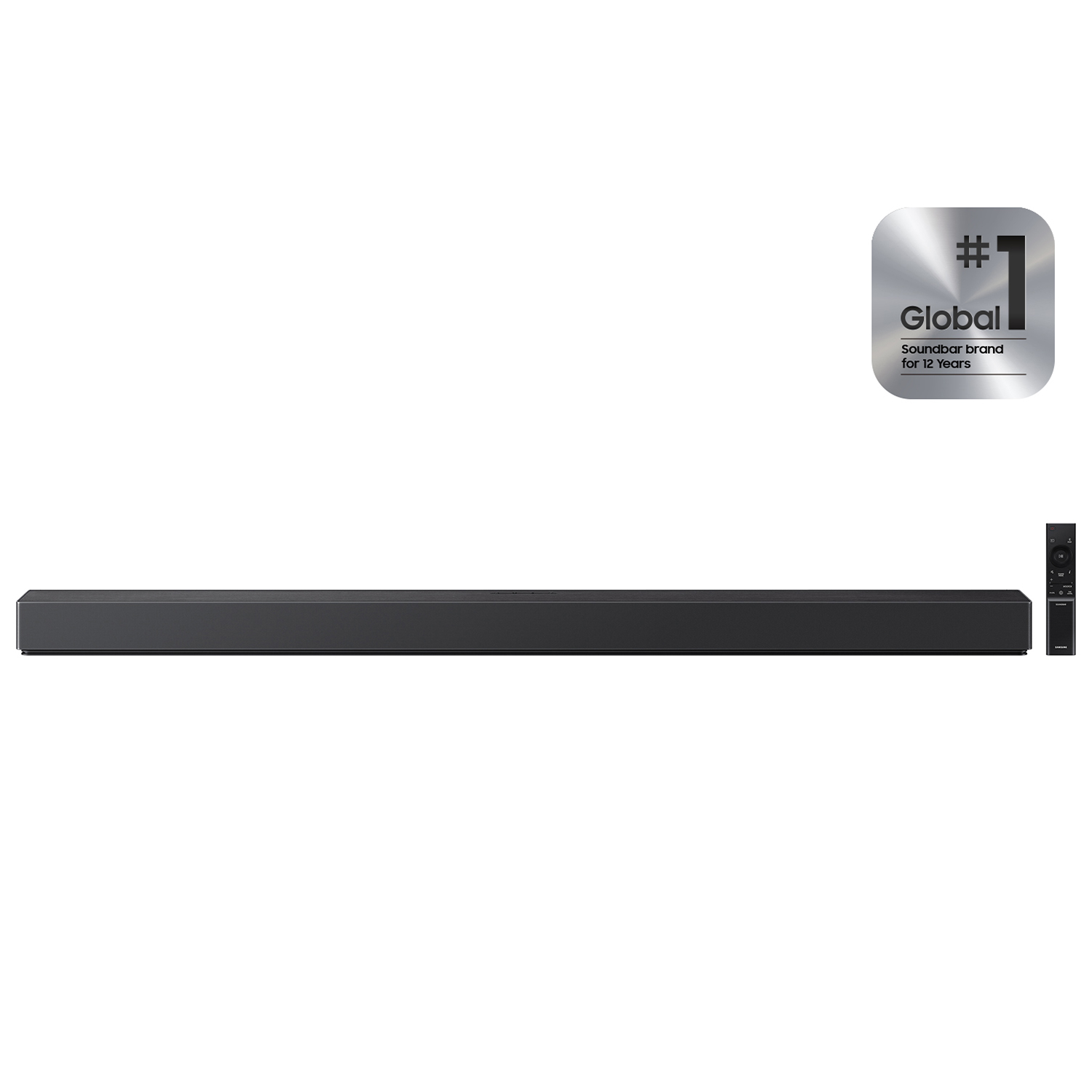
Standalone Winner: Which Should You Choose?
Choose Samsung QS90H if you want a self-contained soundbar with integrated bass and useful HDMI connectivity.
Choose LG H7 if you expect to add wireless speakers and subwoofers later. Its expansion options make it a stronger foundation for a personalized system.
Neither is automatically better for every room. The choice depends on whether immediate simplicity or future flexibility matters more.
For other compact alternatives, see our Bose vs Sonos soundbar comparison, which examines two different approaches to small-room Dolby Atmos audio.
Complete Home Theater: LG Immersive Suite 5 Pro vs Samsung Q990H
Samsung HW-Q990H is our preferred complete home-theater purchase because it includes everything needed for a premium surround setup at a competitive reference price.
The LG Immersive Suite 5 Pro is a compelling alternative when flexible wireless speaker placement matters more than HDMI source connectivity.
LG Immersive Suite 5 Pro — Best Flexible Surround Package
Best for: Buyers who want a complete LG Sound Suite with adaptable rear-speaker positioning.
Regular reference price: $2,099.96.
The LG Immersive Suite 5 Pro includes the H7 soundbar, two M5 wireless satellite speakers, and the W7 subwoofer.
RTINGS classifies the tested system as 7.1.4 and found its overall sound balanced, with effective surround presentation and substantial bass.
Its greatest advantage is Dolby Atmos FlexConnect. The technology helps adapt playback when speakers cannot be positioned in a conventional symmetrical layout.
This is particularly useful in living rooms with furniture, open floor plans, or limited placement options.
The system also supports LG’s Sound Follow feature with compatible devices. This adjusts the listening focus according to the user’s position.
However, the H7’s connectivity limitation remains. It does not provide HDMI input for direct video passthrough.
The LG package also costs slightly more than Samsung’s Q990H at regular reference prices, even though the two systems use different speaker configurations.
Pros
✅ Subwoofer and two wireless satellites included.
✅ Flexible speaker placement with Dolby Atmos FlexConnect.
✅ Balanced sound and capable surround performance.
Cons
❌ No HDMI source passthrough.
❌ Speaker placement and network configuration require planning.
Who should skip it? Gamers who want their soundbar to sit between a console and television, or buyers prioritizing the simplest ready-made premium package.
Alternative: Samsung HW-Q990H offers direct HDMI connectivity and an 11.1.4-channel system with the subwoofer and rear speakers included.

Samsung HW-Q990H — Best Complete Home-Theater Package
Best for: Movie enthusiasts, gamers, and buyers seeking a complete premium soundbar system with fewer additional purchases.
U.S. launch MSRP: $1,999.99.
The Samsung HW-Q990H provides 11.1.4-channel audio with a main soundbar, dedicated subwoofer, and two rear satellites.
Its complete hardware package is the main advantage. You do not need to choose separate speaker models or calculate the cost of a basic surround configuration.
Independent testing found balanced sound reproduction, a wide soundstage, and immersive Dolby Atmos playback. The subwoofer also provides substantial low-frequency impact.
Samsung includes SpaceFit Sound Pro room calibration, Adaptive Sound, Sound Elevation, and a seven-band graphic equalizer.
The Q990H supports major Dolby and DTS audio formats. It also includes HDMI source input with 4K/120Hz video passthrough, making it attractive for compatible gaming setups.
Its weaknesses are comparatively modest. Bass compression can appear near maximum volume, and room-correction settings may produce a sound profile that some listeners prefer to adjust manually.
It is also worth comparing prices with the previous HW-Q990F because the 2026 model focuses heavily on software and processing improvements rather than a completely redesigned speaker arrangement.
Pros
✅ Complete 11.1.4-channel surround package.
✅ Powerful bass and balanced sound.
✅ Dolby Atmos and DTS format support.
✅ HDMI input with 4K/120Hz passthrough.
Cons
❌ Some bass compression at very high volume.
❌ Rear speakers and subwoofer need room and power.
❌ A discounted Q990F may offer better value.
Who should skip it? Shoppers who do not have room for rear speakers or those seeking a minimalist single-bar installation.
Alternative: LG Immersive Suite 5 Pro is better suited to unconventional speaker placement. Samsung QS90H provides a more compact solution.
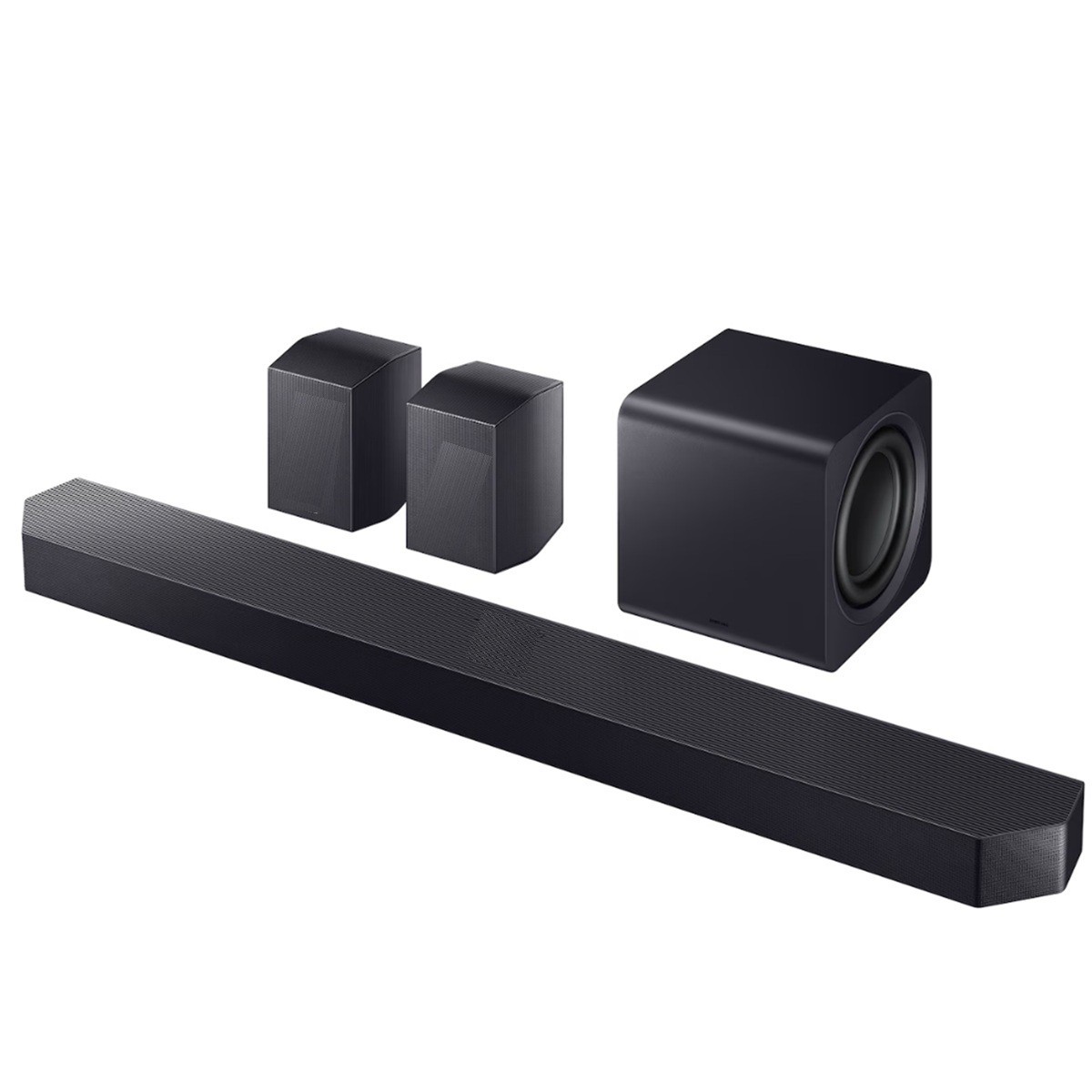
Complete-System Winner: Samsung Q990H
The Q990H is the better default purchase because it combines strong independent test performance, included surround hardware, and extensive connectivity.
LG’s Suite 5 Pro remains appealing when room layout makes conventional speaker positioning difficult.
For shoppers comparing these systems against other manufacturers, our best soundbars for home theaters guide includes additional premium and affordable alternatives.
Maximum Immersion: LG Quad Suite 7 Pro vs Samsung Q990H
LG’s Immersive Quad Suite 7 Pro has an advantage in surround coverage and speaker-placement flexibility, but Samsung’s Q990H remains the stronger overall package value.
This comparison is not price-matched. LG’s regular configuration price is significantly higher because it includes four M7 speakers rather than two rear satellites.
LG Immersive Quad Suite 7 Pro — Best for Expansive Surround Sound
Best for: Buyers who want a large, customizable Dolby Atmos speaker arrangement with four separate satellite speakers.
Regular reference price: $3,199.94.
The Quad Suite includes the LG Sound Suite H7 soundbar, four M7 wireless speakers, and one W7 subwoofer.
RTINGS classifies the tested system as 9.1.6. LG describes a larger spatial-audio configuration using its own processing terminology.
Independent testing found particularly strong surround presentation and a wide stereo soundstage. The four speakers provide more positioning flexibility than the two satellites included with Samsung’s standard Q990H package.
This matters when trying to create convincing audio across a larger listening area or when the room’s layout prevents conventional rear-speaker placement.
However, additional components introduce practical requirements. Each speaker still needs electrical power, and the system must be configured through LG’s supported wireless ecosystem.
The Quad Suite is also much more expensive than the Q990H at their regular reference prices.
Pros
✅ Four M7 speakers provide flexible surround coverage.
✅ Wide stereo soundstage in independent testing.
✅ Strong Dolby Atmos immersion.
✅ Modular LG Sound Suite ecosystem.
Cons
❌ Substantially higher total system cost.
❌ No HDMI source passthrough.
❌ Multiple wireless speakers still need electrical power.
Who should skip it? Buyers who want simple installation, limited speaker hardware, or the lowest cost for a premium home-theater package.
Alternative: Samsung HW-Q990H delivers excellent complete-system performance at a lower regular price. LG Immersive Suite 5 Pro offers a smaller modular setup.

Does LG Always Have More Surround Flexibility?
LG has an advantage in its current Sound Suite modular design, but Samsung also offers expansion options.
Samsung’s newer Music Studio speakers can work with compatible Samsung audio products and televisions in supported configurations.
However, compatibility depends on the exact components and software. The standard HW-Q990H package already includes rear speakers, while additional expansion requires a separate compatibility check.
LG’s approach is more explicitly designed around flexible speaker placement through Dolby Atmos FlexConnect.
Maximum-immersion winner: LG Quad Suite 7 Pro for flexible multi-speaker arrangements. Samsung Q990H wins when cost, connectivity, and package simplicity are considered together.
LG vs Samsung TV Integration: Which Ecosystem Works Better?
Both brands provide additional features when paired with compatible televisions from the same manufacturer. However, neither soundbar brand is restricted to its own televisions.
LG Dolby Atmos FlexConnect and WOW Orchestra
LG’s Dolby Atmos FlexConnect allows compatible wireless speakers to work together and adapt their output according to placement.
When using the H7 as the main device, the soundbar can connect to a television through HDMI ARC/eARC and manage compatible Sound Suite speakers wirelessly.
That means you can use the H7 with televisions from other brands, provided the required audio and connection features are supported.
Some compatible LG TVs can also manage FlexConnect speakers directly without an H7 soundbar.
WOW Orchestra is a separate LG feature that coordinates compatible LG television speakers with a supported soundbar.
However, LG’s documentation confirms that WOW Orchestra and Dolby Atmos FlexConnect mode cannot operate simultaneously in the relevant H7 setup.
Therefore, shoppers should not assume that every LG-branded audio feature can be combined at the same time.
Samsung Q-Symphony and Wireless Dolby Atmos
Samsung Q-Symphony allows supported Samsung televisions and compatible Samsung soundbars to work together for coordinated audio output.
The Q990H also supports Wireless Dolby Atmos with compatible Samsung TVs.
Samsung provides SpaceFit Sound Pro room calibration and several processing options intended to adjust output for the listening environment.
These features can make a Samsung TV and soundbar combination appealing, particularly when owners want a coordinated setup.
However, Q-Symphony should not be treated as a universal feature available with every television or every Samsung audio product.
Can You Use an LG Soundbar With a Samsung TV?
Yes. LG Sound Suite H7 can connect to a compatible Samsung television through HDMI ARC/eARC.
The reverse is also possible. Samsung soundbars can work with compatible LG televisions through standard HDMI audio connections.
However, exclusive ecosystem features may not function across brands. For example, Samsung Q-Symphony requires supported Samsung hardware, while LG WOW Orchestra depends on compatible LG products.
Before buying, check your television’s HDMI eARC support, audio-format passthrough capabilities, and the specific soundbar’s requirements.
The same principle applies to other manufacturers. Our guide to Sony 4K televisions for home theaters covers TV features that can influence a connected sound system.
Gaming and Connectivity: HDMI eARC, DTS:X, and 4K/120Hz
Samsung HW-Q990H is the most flexible gaming choice in this comparison because it supports HDMI source input and 4K/120Hz video passthrough.
LG H7 can still provide immersive game audio, but consoles should connect directly to the TV because the soundbar has no HDMI source input.
HDMI Passthrough vs. HDMI eARC
HDMI passthrough allows a game console or streaming device to connect to the soundbar before the video signal reaches the television.
HDMI eARC works differently. It allows a compatible TV to send audio back to the soundbar through an HDMI connection.
For a Samsung Q990H system, a supported console can connect through the soundbar using its passthrough capabilities.
For LG Sound Suite H7, the usual setup is console to TV, followed by TV audio output through eARC to the H7.
The LG approach can still support high-quality Dolby Atmos playback. However, the actual available formats and latency depend on the TV’s audio handling.
Similarly, Samsung QS90H has HDMI input but does not support 4K/120Hz passthrough. Gamers using current-generation consoles should take that limitation into account.
LG’s October 2026 DTS:X Update
Earlier reviews of LG Sound Suite identify missing DTS-format support as a disadvantage. However, LG announced DTS:X support for the H7 on October 14, 2026.
The update also expanded compatibility with Google Cast, supported Wi-Fi configurations, and systems using two W7 subwoofers.
This is a meaningful improvement for users who rely on compatible DTS:X audio sources.
Nevertheless, the H7 still does not have an HDMI source input. To receive DTS:X through its ARC/eARC connection, the television and source must support the required audio path.
Check the H7’s installed firmware and the TV’s DTS passthrough capabilities before assuming a particular Blu-ray player or media device will work.
LG also announced plans for a Media Connect Hub, but buyers should not count on that future accessory when evaluating hardware available today.
What About Streaming Sticks?
Streaming devices should generally connect to an available HDMI input on the television unless the soundbar specifically supports the required video and audio passthrough.
The TV can then send supported audio formats to the soundbar through HDMI eARC.
Our best streaming sticks comparison explains the differences between Roku and Amazon Fire TV devices, including their supported video and audio features.
Connectivity winner: Samsung Q990H for HDMI gaming and direct source connections. LG H7 remains a flexible audio solution when the television handles source switching and audio passthrough.
Expandability, Installation, and Everyday Ownership
LG has the more modular approach, while Samsung’s premium packages reduce the number of buying decisions required at the beginning.
LG’s Advantages for Flexible Rooms
LG Sound Suite lets buyers add compatible M5 or M7 speakers according to room size, budget, and placement preferences.
Dolby Atmos FlexConnect can optimize the supported arrangement without requiring every satellite to occupy a traditional fixed position.
That is useful when furniture placement or architectural features make symmetrical speaker positioning difficult.
However, the components still require power outlets and a suitable wireless environment. LG also provides network recommendations for improving connection stability.
The latest H7 updates allow additional configurations, including support for up to two W7 subwoofers. However, this does not mean every combination is necessary or worthwhile.
Samsung’s Advantages for Simple Installation
Samsung’s Q990H offers a defined system from the start. The included speakers and subwoofer are designed to function together.
That makes it easier for many buyers to plan a conventional home-theater arrangement without researching separate speaker packages.
Samsung’s app and sound modes also provide room tuning, channel adjustments, and everyday control.
However, the rear speakers still require power and suitable placement. Wireless audio does not mean wireless electricity.
Smart-Home and Multiroom Features
Both brands support selected wireless music and connected-home features. LG relies on Sound Suite and ThinQ integrations, while Samsung provides its own connected-audio ecosystem.
Actual availability depends on device compatibility, firmware, and supported services.
If you’re building a connected living room rather than buying audio equipment alone, our smart home devices for beginners guide explains how to evaluate broader ecosystem compatibility.
Ownership winner: LG for gradual expansion and unconventional layouts; Samsung for buyers who prefer a clearly defined premium system with fewer separate purchases.
Which Brand Should You Choose for Your Room?
The better soundbar depends on room size, TV connections, speaker placement, and how much equipment you want to manage.
| Your Situation | Recommended System | Why |
|---|---|---|
| Dedicated home theater | Samsung Q990H | Complete surround package and strong movie performance |
| Small living room or apartment | Samsung QS90H | Integrated bass without a separate subwoofer |
| Unconventional room layout | LG Immersive Suite 5 Pro | Flexible satellite placement |
| Maximum speaker coverage | LG Quad Suite 7 Pro | Four satellites and expansive soundstage |
| Standalone system with upgrades later | LG H7 | Expandable modular audio ecosystem |
| Gaming with 4K/120Hz passthrough | Samsung Q990H | HDMI source input and high-refresh video support |
| Premium surround value | Samsung Q990H | Included subwoofer and rears at a lower regular package price |
For smaller homes, the QS90H or standalone LG H7 may be sufficient. Larger rooms can benefit from dedicated subwoofers and satellites, but the number of speakers alone does not guarantee better sound.
Before buying, measure your available space and check your television’s HDMI eARC connection. Also consider electrical outlets for each separate speaker.
Frequently Asked Questions
Are LG or Samsung soundbars better?
Samsung is our preferred choice for a complete premium home-theater package, particularly the HW-Q990H. LG is more appealing for buyers who want flexible speaker placement and gradual expansion through Sound Suite. The better brand depends on your room, budget, and listening priorities.
Which LG or Samsung soundbar is best for Dolby Atmos?
Samsung HW-Q990H is a strong complete Dolby Atmos package with included rear speakers and subwoofer. LG Immersive Quad Suite 7 Pro delivers particularly expansive surround performance through four satellite speakers. The LG setup is more expensive but offers greater positioning flexibility.
Can I use an LG soundbar with a Samsung TV?
Yes. Compatible LG soundbars can connect to Samsung televisions through HDMI ARC/eARC. However, LG-specific features such as WOW Orchestra require supported LG equipment, while Samsung Q-Symphony requires compatible Samsung products. Check the exact models for advanced functionality.
Is Samsung HW-Q990H better than LG Sound Suite?
Samsung Q990H is better for buyers who want a complete premium system with convenient HDMI connectivity and strong value. LG Sound Suite provides more modular flexibility. Its largest configurations can create a wider surround presentation but cost substantially more at regular reference prices.
Does LG Sound Suite support DTS:X?
Yes. LG announced DTS:X support for the H7 in October 2026. However, the H7 does not have an HDMI source input, so playback depends on compatible firmware, source equipment, and the television’s ability to pass supported DTS audio through HDMI ARC/eARC.
Which brand is better for gaming?
Samsung HW-Q990H is the strongest choice in this comparison because it supports HDMI input and 4K/120Hz passthrough. LG H7 can deliver immersive game audio through eARC, but the console must connect directly to the TV. Samsung QS90H has HDMI input but does not pass through 4K/120Hz video.
Do wireless surround speakers need power cables?
Yes. Wireless audio connections remove the need for speaker wires carrying sound signals, but LG Sound Suite satellites and Samsung’s included rear speakers still need electrical power. Plan suitable outlets and safe cable placement before installing the system.
Is LG Sound Suite worth the extra money?
LG’s higher-priced configurations are worthwhile when modularity, flexible speaker placement, and larger surround arrangements matter. For buyers primarily seeking a complete home theater without additional purchases, Samsung Q990H offers better package value at its regular reference price.
Final Verdict: LG vs Samsung Soundbars — Which Brand Wins?
Samsung is the better overall choice for most buyers comparing complete premium soundbar systems. The HW-Q990H combines strong movie performance, balanced sound, physical rear speakers, a dedicated subwoofer, and excellent HDMI connectivity in a single package.
For buyers who prefer a soundbar without a separate subwoofer, the HW-QS90H is another compelling Samsung option. Its integrated woofers and all-in-one design suit smaller spaces, although the deepest bass remains limited compared with larger systems.
LG is the stronger alternative for flexibility. The H7 provides an expandable starting point, while the Immersive Suite 5 Pro adds adaptable surround sound. The Quad Suite 7 Pro goes further with four satellites and a particularly wide soundstage.
LG’s October 2026 DTS:X update also makes Sound Suite more versatile, although playback compatibility and HDMI limitations still matter.
Ultimately, the choice depends on your room and priorities. Samsung offers a simpler route to a complete premium system, while LG allows a more customized approach to immersive home audio.
Our Recommendation: Choose Samsung HW-Q990H for the best complete premium home-theater package and gaming connectivity. Choose LG Sound Suite if modular expansion and flexible surround-speaker positioning matter more. For standalone use, Samsung QS90H favors simplicity, while LG H7 favors future upgrades.
Sources
- Samsung Electronics America — Samsung Announces 2026 Home Audio Lineup
- LG Electronics USA — LG Announces U.S. Pricing and Availability for Sound Suite
- RTINGS — LG Immersive Quad Suite 7 Pro vs Samsung HW-Q990H
- LG Electronics USA — LG Advances Sound Suite with DTS:X Support and Expanded Capabilities
- RTINGS — LG Immersive Quad Suite 7 Pro Soundbar Review
Product Groups: LG Sound Suite H7 Soundbar 2026; Samsung HW-QS90H 7.1.2 Channel Soundbar; LG Sound Suite Immersive Suite 5 Pro H7 M5 W7; Samsung HW-Q990H 11.1.4 Channel Soundbar System; LG Sound Suite Immersive Quad Suite 7 Pro H7 M7 W7