
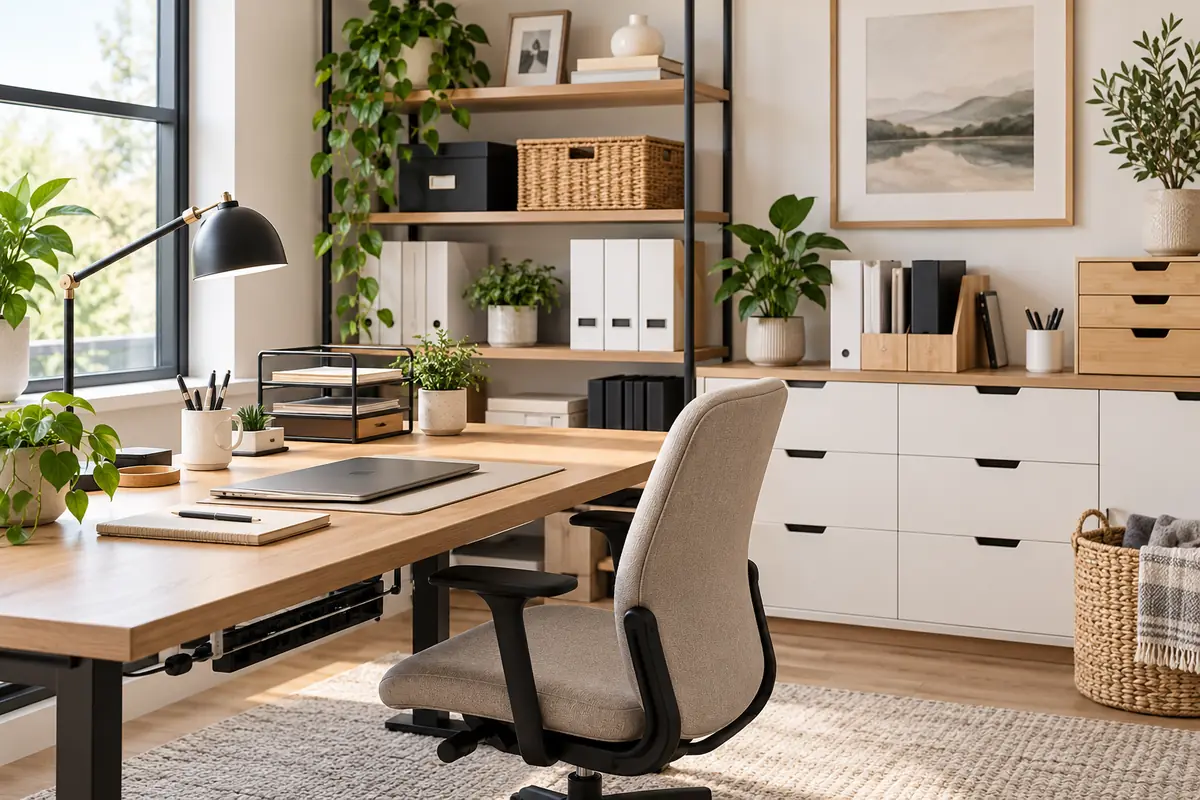
Office Storage Solutions: Organization Hacks
The best office storage solutions keep frequently used items within easy reach while moving paperwork, spare supplies and cables out of the primary work zone. For most home offices, the IKEA ALEX Drawer Unit/Drop File Storage is the best all-around starting point because it combines compact drawer storage with dedicated file space. IKEA KALLAX is better when you need vertical shelving, the UPLIFT Slim Desk Drawer uses otherwise wasted space beneath the desktop, Safco Onyx keeps active paperwork visible, and the VIVO Clamp-on Cable Management Tray gets power strips and excess cable off the floor.
The important part is not buying more organizers. It is deciding where each category belongs. Daily tools should be immediately accessible. Active paperwork should stay visible enough that you remember to act on it. Reference and archive materials can move farther from the desk. Cables and adapters belong in a dedicated tech zone rather than spreading across the desktop and floor.
This guide combines five practical products with office organization hacks you can use even if you buy none of them.
Quick Answer: Best Office Storage Solutions
Best Overall: IKEA ALEX Drawer Unit/Drop File Storage — a narrow drawer unit that combines everyday office-supply storage with dedicated drop-file space.
Best Vertical Storage: IKEA KALLAX Shelf Unit 30 1/8 x 57 5/8 — four large cubbies with optional inserts for books, binders, paper and boxed supplies.
Best Under-Desk Storage: UPLIFT Slim Desk Drawer — a low-profile locking steel drawer that keeps small tech and supplies beneath the work surface.
Best for Active Paperwork: Safco Onyx 2 Horizontal/6 Upright Sections — two letter-size trays plus six vertical sections for documents that are still in your workflow.
Best Cable Organization Solution: VIVO Clamp-on Cable Management Tray — an under-desk steel tray for power strips, adapters and excess cable without drilling into many compatible desktops.
The 5-Zone Office Storage System
A useful home office becomes easier to maintain when storage is assigned by frequency and workflow instead of by whichever drawer still has space.
| Zone | What Belongs There | Best Storage Style |
|---|---|---|
| 1. Daily Essentials | Pens, notebook, charging cable, headset, frequently used accessories | Top drawer or small under-desk drawer |
| 2. Active Paperwork | Documents waiting for action, signatures, review or filing | Visible trays and upright file sections |
| 3. Supply Storage | Staples, cables, notebooks, printer supplies and accessories | Drawer unit or labeled shelf containers |
| 4. Reference & Archive | Books, binders, older files and infrequently used documents | Shelving, closed cabinets or remote filing |
| 5. Cables & Power | Power strips, adapters, chargers and excess cord length | Under-desk cable tray with serviceable routing |
The goal is simple: items you touch constantly should require the fewest steps to retrieve and put away. Items you rarely use should not occupy prime desk real estate.
Office Storage Solutions Compared
| Product | Best For | Storage Zone | Approx. Footprint | Storage Type | Main Limitation |
|---|---|---|---|---|---|
| IKEA ALEX Drawer Unit/Drop File Storage | Best Overall | Supplies + files | 14 1/8 x 22 7/8 in. | Closed drawers | Limited total load and no lock |
| IKEA KALLAX | Vertical storage | Reference + supplies | 30 1/8 x 15 3/8 in. | Open cubbies / optional inserts | Must be securely anchored |
| UPLIFT Slim Desk Drawer | Under-desk storage | Daily essentials | 17.2 x 13.5 x 2 in. | Locking drawer | Only 1.5 in. internal height |
| Safco Onyx 3255 | Active paperwork | Current workflow | 13.25 x 11.5 in. | Open trays + upright sections | Consumes desktop space |
| VIVO Clamp-on Cable Tray | Cable organization | Cables + power | 17 x 6 x 5.8 in. | Open under-desk tray | Desk edge and thickness must be compatible |
Compare Current Office Storage Prices
Office storage products vary significantly in price by finish, retailer, configuration and shipping. IKEA units may also differ by color, while cable-management and under-desk accessories are frequently discounted.
Measure first and compare current offers second. A cheaper cabinet that blocks a door or an under-desk drawer that interferes with your knees is not good value.


1. IKEA ALEX Drawer Unit/Drop File Storage — Best Overall
Best For: Everyday supplies, notebooks, small accessories and office files that need to stay near the workstation without occupying the desktop.
The IKEA ALEX Drawer Unit/Drop File Storage is our best overall office storage solution because it combines several functions in a narrow footprint. The current U.S. model measures only 14 1/8 inches wide, 22 7/8 inches deep and 27 1/2 inches high, making it easy to place beside many standard home-office desks.
The combination of smaller drawers and dedicated drop-file storage creates a natural hierarchy. Small daily supplies can remain near the top while paperwork can move into the larger filing section instead of accumulating across the desk.
The back is finished, so the unit does not need to be hidden against a wall. That gives you more flexibility in offices where a desk floats in the room rather than sitting directly against the perimeter.
There are limits. IKEA lists a maximum total load of 26 pounds, with the larger drawer rated up to 13 pounds and smaller drawers lower. This is therefore a domestic office-storage unit, not a heavy commercial filing cabinet designed for very large paper archives.
There is also no built-in lock. Sensitive records may require a dedicated locking cabinet rather than relying on ALEX simply because the documents fit inside.
Pros
✅ Narrow 14 1/8-inch footprint
✅ Combines drawers with dedicated drop-file storage
✅ Finished back improves placement flexibility
✅ Good fit beside many standard desks
✅ Keeps paperwork and supplies off the work surface
Cons
❌ Not designed for very heavy file loads
❌ No integrated lock
❌ Requires floor space beside or near the desk
Who should skip it: If most of your storage is books, binders and boxed supplies rather than drawers and files, a vertical shelving unit will use the room more efficiently.
Alternative: IKEA KALLAX for larger reference materials and modular open or closed shelf storage.
IKEA ALEX Drawer Unit File Storage, White keeps your papers neatly sorted with a dedicated file drawer, secure drawer stops, and a finished back so it can go anywhere in the room. The included plastic bumpers hold the tabletop steady and the smooth surfaces wipe clean with a damp cloth. Ready to tidy your workspace? Add it to your cart and start organizing today.
2. IKEA KALLAX Shelf Unit 30 1/8 x 57 5/8 — Best Vertical Office Storage
Best For: Books, binders, boxed supplies, printer paper, reference materials and offices that need more storage without using a wide stretch of floor.
KALLAX is useful because it turns about 30 inches of floor width into almost 58 inches of vertical storage. The current four-cubby configuration measures 30 1/8 inches wide, 15 3/8 inches deep and 57 5/8 inches high.
Each shelf is rated for up to 29 pounds, which makes the unit practical for books, binders and office supplies as long as you remain within IKEA’s stated limits. The cubbies can remain open for fast access or accept compatible inserts and boxes when you want to conceal visual clutter.
This open-versus-closed flexibility is particularly useful in a mixed home office. Reference books can stay visible while extra cables, paper and supplies can disappear into labeled inserts.
KALLAX can also be oriented horizontally, although the vertical configuration is the reason we selected it here. In small offices, using height is usually a better way to add substantial storage without expanding the furniture footprint sideways.
Wall anchoring is not optional. IKEA explicitly warns that this KALLAX unit presents a tipping hazard and must be securely anchored using suitable hardware for the wall construction.
That warning matters even if the shelf feels stable while empty. Books and storage boxes change the center of gravity, and household furniture should not rely on its own weight as a substitute for the manufacturer’s anti-tip instructions.
Pros
✅ Uses vertical space efficiently
✅ 29-lb maximum load per shelf
✅ Compatible with open and closed storage inserts
✅ Useful for books, binders and supplies
✅ Can adapt as storage categories change
Cons
❌ Must be securely anchored to reduce tipping risk
❌ Open cubbies can look cluttered without containers
❌ Still occupies roughly 15 inches of room depth
Who should skip it: If you have almost no available floor area, prioritize wall-appropriate storage or under-desk organization instead.
Alternative: UPLIFT Slim Desk Drawer for small items when floor space is the limiting factor.
3. UPLIFT Slim Desk Drawer — Best Under-Desk Storage
Best For: Phones, tablets, notebooks, pens, wallets, small accessories and compact laptops that need to stay accessible without occupying the desktop.
The UPLIFT Slim Desk Drawer takes advantage of one of the most overlooked office-storage zones: the underside of the work surface. Its exterior dimensions are 17.2 inches wide, 13.5 inches deep and only 2 inches high when flush mounted.
Inside, usable space measures approximately 15.5 by 12.5 inches with 1.5 inches of height. That makes it wide enough for many small electronics, stationery and thin notebooks, but not deep enough vertically for bulky supplies.
The steel drawer includes a lock and a charging-cable pass-through, which is useful when you want to charge a phone or other small device without leaving it visible on the desk.
UPLIFT offers two mounting approaches. It can mount flush to the desktop for maximum leg clearance or use included brackets that create a small shelf above the drawer. On desktops 24 inches deep or less, UPLIFT specifies that the mounting brackets are required for proper installation.
Because the drawer mounts directly to the desktop, it moves with a height-adjustable desk. That keeps stored items at roughly the same relationship to the work surface when the desk moves between seated and standing positions.
Before installation, check knee and thigh clearance. Even a slim two-inch drawer becomes part of the underside geometry of the workstation, and it should not force you to lower your chair or sit farther from the desk.
For desk sizing and work-surface considerations, see our best home office desks guide.
Pros
✅ Uses space underneath the desktop
✅ Locking steel construction
✅ Charging-cable pass-through
✅ Moves with height-adjustable desks
✅ Backed by UPLIFT’s 15-year warranty
Cons
❌ Only 1.5 inches of internal height
❌ Installation requires compatible desktop thickness and depth
❌ Poor placement can reduce leg clearance
Who should skip it: If you need storage for thick notebooks, large accessories or bulk office supplies, use a full drawer unit instead.
Alternative: IKEA ALEX for larger-capacity drawer and file storage.

Keep your workspace tidy and secure with the UPLIFT Slim Under-Desk Storage Drawer.
With a 16" × 13" interior that holds pens, phones, tablets and laptops up to 15", plus a steel lock and included mounting hardware, it stays out of your way while protecting your valuables.
Order now to reclaim your desk space and keep essentials safely hidden and within reach.
4. Safco Onyx 2 Horizontal/6 Upright Sections — Best for Active Paperwork
Best For: Current projects, incoming documents, folders, notebooks and paperwork that still requires action.
Paper clutter becomes difficult to manage when active documents and archived documents are treated the same way. Safco’s Onyx 3255 gives current paperwork a visible home instead of sending everything into a drawer where unfinished tasks can disappear.
The organizer combines two horizontal letter-size trays with six vertical file sections. Each upright section is approximately two inches wide, which creates enough separation to divide documents by workflow rather than by broad subject alone.
For example, you might use vertical sections for “Action,” “Waiting,” “To File,” “Reference,” “Current Project” and “Receipts,” while the horizontal trays handle incoming papers or completed items waiting for processing.
The steel-mesh unit measures about 13.25 inches wide, 11.5 inches deep and 13 inches high. No assembly is required.
The main disadvantage is desktop consumption. On a deep 30-inch work surface, 11.5 inches of organizer depth may be acceptable against the rear corner. On a shallow desk, it can consume too much of the primary work zone.
This is why active-paper storage should remain intentionally small. If every document becomes “active,” the organizer simply turns into a vertical pile. Completed records should move into a filing or archive system instead.
Pros
✅ Two horizontal letter-size trays
✅ Six separate upright file sections
✅ Keeps current paperwork visible
✅ Durable steel-mesh construction
✅ No assembly required
Cons
❌ Uses about 11.5 inches of desk depth
❌ Open storage leaves papers visible
❌ Poor choice for long-term document archives
Who should skip it: If almost all of your work is digital and paper arrives only occasionally, a large desktop file organizer may create more clutter than it solves.
Alternative: Use a small inbox tray and move completed records into ALEX or another appropriate filing solution.
Declutter and upgrade your workspace with the Safco Onyx Black Metal Desk Organizer — sleek onyx finish and sturdy metal construction keep pens, notes and accessories neatly in place.
Lightweight and compact (Package weight: 2.615 kg; Model No. 3214BLKD), it fits easily on any desk without taking over your space.
Ready to streamline your desk? Add the Safco Onyx Black Metal Desk Organizer to your cart now and enjoy a cleaner, more productive workspace.
5. VIVO Clamp-on Cable Management Tray — Best Cable Organization Solution
Best For: Power strips, charging bricks, adapters and excess cable that would otherwise sit on the floor or hang visibly behind the desk.
Cable management is really a specialized type of storage. Power strips and extra cord length need a predictable place just like files and office supplies do.
The VIVO DESK-CM6L-B tray measures approximately 17 inches wide, 6 inches deep and 5.8 inches high, excluding the additional height created by its clamps. It is made from steel and supports up to 11 pounds.
Its clamp-on system fits compatible desktop edges approximately 0.2 to 2 inches thick. Padding helps protect the work surface, and the tray can hold cables as well as many power strips and small adapters.
The clamp design is useful when you prefer not to drill into the desk. It also makes removal easier if the workstation changes later.
Do not fill the tray by coiling every cable as tightly as possible. Leave enough service slack for a sit-stand desk to move through its full range, and keep connectors accessible enough that replacing a monitor or charger does not require dismantling the entire cable system.
The tray should also remain within the weight limit and should not interfere with a monitor arm, desk frame, wall or other clamp-mounted accessories sharing the same edge.
Pros
✅ Holds power strips, adapters and excess cable below the desk
✅ Clamp-on installation avoids drilling on compatible desks
✅ Fits desktop thicknesses from about 0.2 to 2 inches
✅ Steel construction
✅ 11-lb weight capacity
Cons
❌ Clamp occupies desk-edge space
❌ Not suitable for every desktop edge profile
❌ Can conflict with monitor-arm or desk-frame hardware
Who should skip it: Desks with thick aprons, beveled edges or incompatible rear framing may need a screw-mounted tray or another routing method.
Alternative: Use adhesive or screw-mounted raceways when clamp clearance is unavailable.

Tame desk clutter with the VIVO Clamp-On 31-inch Fabric Cable Tray — a durable, clamp-on Oxford fabric organizer that hides cables, holds up to 11 lbs, and installs with no drilling.
Adjustable height and quick-access sides make cable swaps effortless — order yours today to create a cleaner, safer, more organized workspace.
Declutter Before You Add Office Storage
Storage cannot compensate indefinitely for keeping things the office no longer needs. Before adding another cabinet, remove categories that do not belong in the workspace.
Start with obsolete paperwork, empty packaging, duplicate chargers, retired cables, dried-out pens and manuals that are already available digitally. Then relocate household items that migrated into the office simply because the room had an empty corner.
Only after that should you decide how much filing, shelf and drawer capacity remains necessary.
For a broader approach that extends beyond the workspace, our home organization tools guide covers storage bins, closet organization, vertical storage and labeling across the home.
Active Files vs Archive Files
Active files should be easy to see and retrieve. Archive files should not occupy the same premium space.
Active paperwork includes anything that still requires a decision, response, signature, payment, review or filing action. This is where a desktop organizer such as Safco Onyx makes sense.
Archive material includes completed records you may need later but rarely consult. Those documents belong in a filing cabinet, closed drawer or another storage area that does not compete with current work.
A useful workflow is:
- Inbox: new paper enters here.
- Action: something must be done.
- Waiting: you are waiting on someone else.
- To File: action is complete but record needs storage.
- Archive: completed record leaves the active workspace.
If the active system becomes full, the solution is usually to process it—not buy a larger active-paper organizer.
How to Organize Office Supplies
Store office supplies according to usage frequency rather than product type alone.
Daily-use items such as pens, notebook, charging cable and headset should stay in the easiest-access drawer or on a deliberately small portion of the desktop.
Weekly-use items such as spare batteries, labels, adapters and specialty stationery can move into a lower drawer.
Occasional supplies such as extra printer paper, bulk pens and replacement cables belong on shelves or in labeled containers away from the immediate work surface.
Backup inventory should remain especially controlled. Keeping twenty notebooks beside the desk because you may use them next year consumes space that could support current work.
Vertical Storage Hacks for Small Home Offices
Use height before adding another wide cabinet. A narrow tall shelf can provide far more storage than a short unit using a similar amount of floor width.
KALLAX is one example, but the general principle applies to appropriately installed wall shelves and tall cabinets as well.
Keep heavier items lower when practical and lighter supplies higher. Frequently used materials should stay between comfortable reaching heights, while rarely accessed reference material can occupy upper zones.
Do not place items so high that accessing them requires unstable furniture or awkward reaching. Follow mounting and anti-tip instructions for the specific shelving system.
Under-Desk Storage Without Ruining Legroom
The underside of a desk is valuable storage space only if your knees and thighs still have room to move.
A slim drawer such as the UPLIFT unit works because its flush-mounted profile is only about two inches high, but placement is still important. Centering a drawer exactly where your legs need to go can turn a clever organizer into an ergonomic problem.
Mount storage toward a side when the desk dimensions and hardware allow it, and sit at the workstation before permanently installing anything.
Your chair also needs to move close enough to the desk. Our upcoming guide to ergonomic office chairs explains why chair arms, seat height and desk clearance need to work together.
Cable Management Hack: Route, Secure and Label
A reliable cable system does not have to make every wire invisible. It should make the workstation easy to use and easy to service.
Start by removing cables that are no longer connected to anything. Then centralize power where appropriate, route long permanent cables beneath the desk and secure extra length without putting excessive stress on connectors.
For a height-adjustable desk, leave enough slack for the desktop to reach its highest position without pulling on wall outlets or connected equipment.
Label both ends of visually identical cables when that saves troubleshooting time. The back of a workstation with several displays, chargers and USB devices can otherwise become difficult to service later.
Where Should the Printer Go?
The printer does not automatically deserve desktop space. Placement should depend on how frequently you use it.
If you print multiple times every day, keeping the printer within easy reach may be worthwhile. If you print twice a month, moving it onto a nearby shelf or cabinet frees a substantial amount of desktop area.
Allow sufficient ventilation and access for paper loading, output trays, scanner lids and maintenance. Do not place a printer inside a tightly enclosed cubby unless the manufacturer’s clearance and ventilation requirements allow it.
Five Office Organization Mistakes That Waste Space
1. Keeping Every Supply on the Desktop
Only daily-use items deserve permanent desktop space. Backup supplies and rarely used accessories should move elsewhere.
2. Hiding Active Paperwork in Archive Storage
Documents waiting for action should remain visible or tracked digitally. Deep storage is better for completed records.
3. Buying Storage Before Measuring
Measure furniture footprint, drawers, desk clearance, door swing and circulation space before ordering.
4. Ignoring Vertical Space
In a small office, tall shelving can add substantial capacity without consuming another six feet of wall width.
5. Making Cable Management Impossible to Service
A perfectly hidden cable that takes twenty minutes to replace is not necessarily well organized. Preserve access to plugs, adapters and important connections.
A 10-Minute Weekly Office Reset
Minutes 1–2: Remove cups, packaging and anything that belongs outside the office.
Minutes 3–4: Process loose paper into Action, Waiting, To File or recycling.
Minutes 5–6: Return office supplies to their assigned drawers or shelves.
Minutes 7–8: Check cables, chargers and portable devices that migrated onto the desk.
Minutes 9–10: Clear the primary keyboard, mouse and writing area so the next work session starts with usable space.
A short repeated reset is more sustainable than waiting until the workspace becomes cluttered enough to require a full afternoon of organization.
Best Office Storage Solution by Need
| Office Need | Best Pick | Why |
|---|---|---|
| Supplies + filing | IKEA ALEX | Combines multiple drawer sizes and file storage |
| Books and reference materials | IKEA KALLAX | Tall modular shelving with optional inserts |
| Small items near the desk | UPLIFT Slim Desk Drawer | Low-profile storage beneath the desktop |
| Current paperwork | Safco Onyx | Separates active documents into visible sections |
| Cables and power strips | VIVO Clamp-on Tray | Moves cable clutter underneath the work surface |
Storage is only one part of the workstation. Our upcoming Best Monitor Setups for Your Home Office in 2026 guide will cover monitor placement, mounting and display layouts without turning this storage article into another desk-equipment roundup.
Frequently Asked Questions
What are the best office storage solutions?
The best solution depends on what you store. Use drawers for supplies and files, shelving for books and reference material, an active-paper organizer for current documents, under-desk storage for small daily items and a cable tray for power and wiring.
How do I organize a small home office?
Declutter first, keep daily essentials close to the workstation, then use vertical shelves and under-desk space before adding another wide cabinet. Measure furniture and chair clearance before purchasing storage.
What should stay on my desk?
Keep equipment and supplies you use daily on the desk or immediately beside it. Backup stationery, archived files and rarely used accessories should move into drawers, shelves or other storage.
What is the best way to organize office paperwork?
Separate active documents from completed records. Active paperwork can be divided into categories such as Action, Waiting and To File, while completed records should move into an appropriate archive or filing system.
Are filing cabinets still useful?
Yes when you maintain physical records that need predictable organization or secure storage. A smaller drawer-and-file unit may be enough for light household paperwork, while large archives may justify a dedicated filing cabinet.
How can I add office storage without taking up floor space?
Use appropriate wall shelving, tall narrow storage and under-desk drawers or cable trays. Preserve enough legroom and follow all mounting and anti-tip instructions for the product you choose.
How do I organize cables under my desk?
Remove unused cables, centralize power where appropriate, route permanent wiring beneath the desk and use a cable tray or raceway for excess length. Leave enough slack for movable or height-adjustable desks.
Should I use open or closed office storage?
Use open storage when frequent visibility and access matter, and closed storage when you want to reduce visual clutter or protect less frequently used supplies. Many offices benefit from a mixture of both.
Final Verdict: Which Office Storage Solutions Are Worth Buying?
IKEA ALEX Drawer Unit/Drop File Storage is the best overall choice for most home offices because it combines small-supply storage and filing in a compact footprint. It solves more everyday office-clutter problems than a decorative desktop organizer alone.
Choose IKEA KALLAX when books, binders and boxed supplies need vertical storage. Choose the UPLIFT Slim Desk Drawer when the desktop needs to stay clear and small items can move underneath it. Safco Onyx is the better answer for documents that are actively moving through your workflow, while the VIVO Cable Management Tray gives power strips and excess wiring a defined location.
The larger organization system matters more than any one product. Put daily objects closest to you, keep active work visible, move archives away from the primary work zone and preserve enough empty space that the system can absorb normal weekly use.
Bottom line: Start with ALEX for versatile drawer and file storage, use KALLAX for vertical capacity, UPLIFT for small under-desk items, Safco for active paperwork and VIVO for cable clutter. Organize by workflow first and furniture second.
Sources
- IKEA — ALEX Drawer Unit/Drop File Storage and KALLAX Shelf Unit Product Specifications
- UPLIFT Desk — Slim Desk Drawer Specifications and Warranty
- Safco Products — Onyx 2 Horizontal/6 Upright Sections Model 3255
- VIVO — Clamp-on Cable Management Tray DESK-CM6L-B
- Current 2026 home-office organization research and storage-planning guidance
Product Groups: IKEA ALEX Drawer Unit Drop File Storage, IKEA KALLAX Shelf Unit 30 1/8 x 57 5/8, UPLIFT Slim Desk Drawer, Safco Onyx 2 Horizontal 6 Upright Sections Desk Organizer, VIVO Clamp-on Cable Management Tray